 by
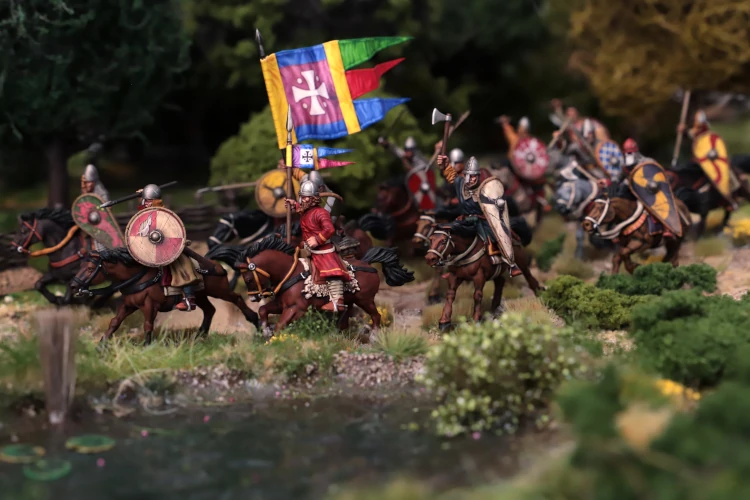
Requiring few miniatures, Pillage fits right into the fast-paced skirmish genre. Warbands consist of 10 to 15 men, depending on the “budget” of the warbands you create. Every option for your men comes at a cost: a shield, armor, a javelin, a sword—everything has a price. This allows you to build “THE” warband that matches your desired style of play. Rely on archers or crossbowmen? Focus on several foot soldiers equipped with spears or swords, warhounds, cavalry…
The objective depends on the scenario: either you defend a village against a raid, or your warband consists of raiders. The core rulebook offers several types of scenarios, allowing you to explore a variety of situations.
Ideally, warbands should be created according to the scenario at hand. Do your raiders need to move quickly through the village to go from house to house? Or do you want to play on defense, with well-armed and properly armored guards for the occasion?
The options are plentiful.
Pillage: Who is this miniatures game for?
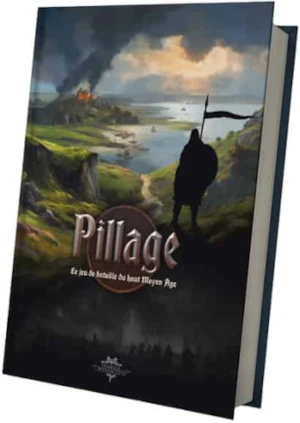
Pillage is aimed equally at history enthusiasts and fans of tactical, dynamic games. If you enjoy building customized warbands of just 10 to 15 miniatures where every piece of equipment matters; if you are looking for an affordable skirmish game without sacrificing rules depth: Pillage is made for you.
It is also a great entry point for players who enjoy the thrill of crafting beautiful thematic tables, chaining together immersive scenarios, or even running narrative-rich campaigns featuring true risk and morale management.
WYSIWYG or no Pillage for you !
The miniature genuinely represents the equipment it carries. This prevents errors and misinterpretations, keeping the game fluid. As such, in Pillage, a miniature equipped with a spear is truly equipped with a spear. You cannot say “this miniature with a spear actually has a sword!”—unless you have modeled a sword scabbard on its belt.
The same logic applies to banners and soldiers equipped with a horn!
In Pillage, there are 3 armor classes:
- No protection
- Partial protection (armor or shield)
- Full protection (armor and shield)
The idea is to classify soldiers based on their protection and to also represent their ability to defend against their opponent’s blows.
So, the most protected soldiers are those with better combat training.
The gameplay system of Pillage
The game turn is divided into 6 phases.
Initiative Phase
Each player rolls 1D6 to gain initiative. Having initiative or not can be an advantage or not—as I learned during my demo game. The goal here is to make the game dynamic, making it less mechanical and more chaotic.
Movement Phase
All fighters in your warband make their movement, then it is your opponent’s turn to do the same. This is when decisions are made: advance, retreat, or enter a house to sack it!
Certain types of terrain can have an impact: bushes, fences, stone walls. You will have to deal with the reality of the terrain. This is also when you can charge an enemy warband or simple peasants trying to flee the steel of your swords to save their lives.
The combat system
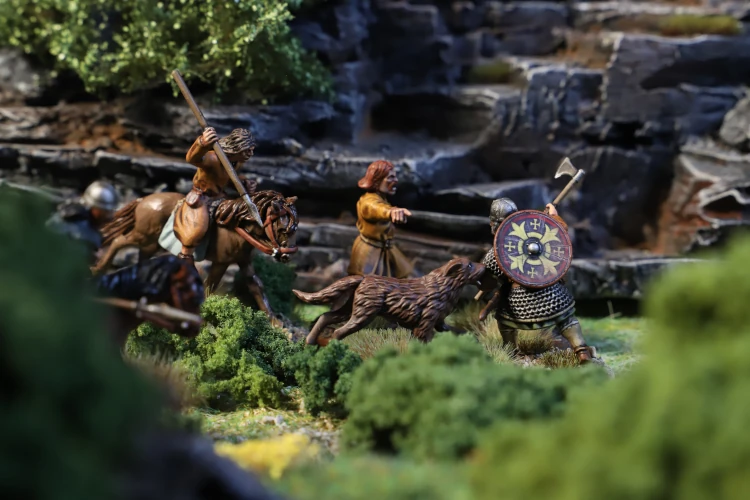
Depending on your equipment—improvised weapon, sword, spear—your chances of hitting an opponent vary.
Likewise, depending on your protection, you will have a chance to defend yourself. A miniature equipped with armor and a shield will therefore have a higher chance of survival than a miniature in simple clothing.
It is all resolved simply, with a die roll for the attacker and a die roll for the defender if the attack hits.
Note that there are interesting effects if you attack in superior numbers, and bonuses will come into play in the combat system. There is a real “bonus” for outnumbering opponents in combat. Keep in mind, however, that no more than three miniatures can attack a single one.
The shooting phase
Whether you are equipped with a throwing weapon—such as a javelin—a sling, a bow, or a crossbow, you will be able to shoot during this phase. However, watch out: your movement will affect your shooters’ capabilities.
Therefore, during the movement phase, if you plan on providing fire support with your troops, you will really need to set up their positions in advance.
This system makes handling ranged units quite unique and adds tactical depth to your movements.
The Fire Phase
What would a village raid be without a good fire? A meal without cheese, as the French would say!
Raiders or defenders can attempt to set buildings on fire. At the time, built from wattle and daub, wood, or thatch, they are susceptible to fire. A miniature carrying a torch can attempt to ignite a building. Fire then becomes a real hazard, spreading on its own from one structure to the next. Igniting a stack of firewood stored near a house can end up setting the house ablaze! By extension, the entire village can catch fire, making it an ally that can turn against the raiders themselves.
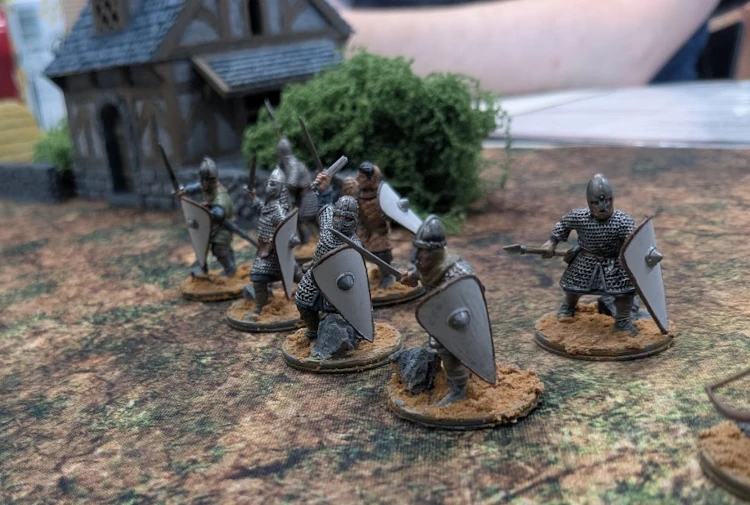
Fire can also injure miniatures standing too close to the flames!
The Influence of Morale
A warband that has lost its leader must take morale tests. Any miniature not engaged in hand-to-hand combat will flee the battlefield on a roll of 1 on 1D6. It is then removed and counted as a casualty.
Among other things, this simple rule helps shorten a game if a leader happens to die early on.
Pillage!
There are several rules for finding, picking up, and carrying loot. A soldier encumbered with loot naturally moves slower. If attacked, they will drop their loot.
Finding loot is resolved with search rolls. Several outcomes are possible, with random chance heavily influencing the quality of the search and the type of loot found.
Note that an archer carrying loot can no longer shoot. Should they wish to attack, they will also need to drop their loot first.
From there, organizing supply lines guarded by other warband members to transport loot efficiently is just a small step away!
You might also want to bring back slaves or livestock. Rest assured, in Pillage, this is entirely possible—after all, it was the Dark Ages!
Special Characters in Pillage
Special characters are specific warriors with extraordinary skills.
Leaders are special characters by nature. They are immune to morale loss, possess multiple hit points, and feature remarkable military talents.
The combat system in Pillage takes these factors into account.
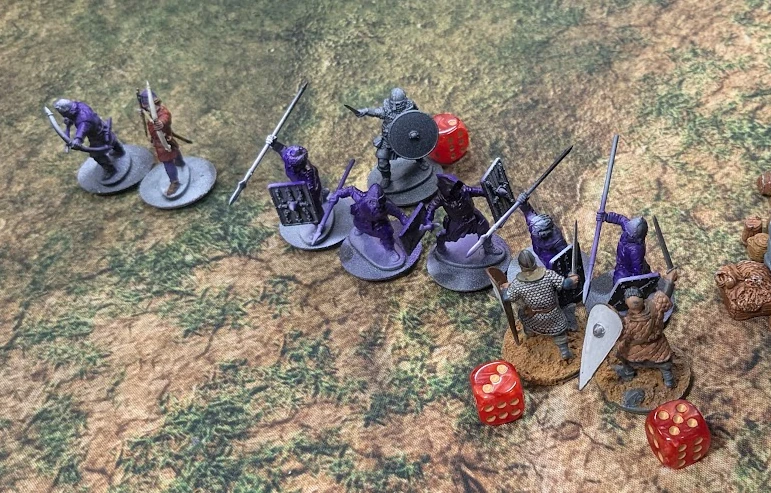
Other characters include Berserkers—who are not available to every faction in the game—as well as Healers or Huscarls, each bringing their own influence to the battle.
Recruiting them comes at a cost, making these special characters the exception rather than the norm in a raider warband.
These elements add significant tactical depth to Pillage and break up the monotony of overly conventional army lists.
Special Equipment for Pillage
What would a medieval raider band be without its banner, war horn, or hounds? A rather sad band indeed!
Pillage offers specific mechanics for these options, bringing both thematic flavor and extra gameplay to your warbands.
This equipment weighs into your warband creation budget, making your force more effective on the tabletop both functionally and visually—a leader blowing a horn, a banner rallying fellow raiders in the thick of battle, or dog handlers leading charges alongside their faithful four-legged companions.
Pillage is Rich in Detail
Weather effects and landings from ships are other features offered in the core rules. There are also numerous optional rules that add even more replayability to your games, as well as exciting tactical options for you and your opponents.
This is evident in the core rulebook’s “Recruiting an Army” section, which outlines restrictions to guide your force composition, along with a list of talents for leaders based on their faction.
Additionally, each nation has its own unique trait—much like the nation-specific rules found in Bolt Action.
For example, Normans are unaffected by heavy rain. Given their region, it makes sense that Normans are well-accustomed to damp conditions!
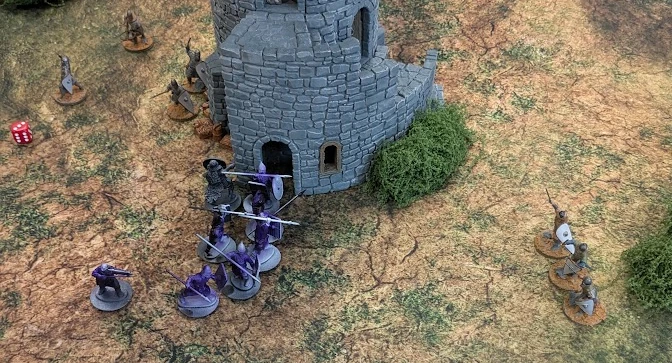
Each faction also faces restrictions on the types of units available for selection.
Rest assured, you can also create your custom faction to build your dream raider warband.
Beyond this, you will find several other elements: rules for multi-player games, tips for building battlefield terrain, and point values tailored to your gaming experience.
Then comes the scenario section: several are included in the book, and even more can be found on the website!
Does the entry cost pillage your savings?
Count on €40 for the rulebook, then a warband—about thirty miniatures—for €42. That brings the total to €82, which is very reasonable for a skirmish game, even cheaper than some well-known titles.
You will need a few six-sided dice and something to measure in inches—nothing out of the ordinary when it comes to tabletop gear.
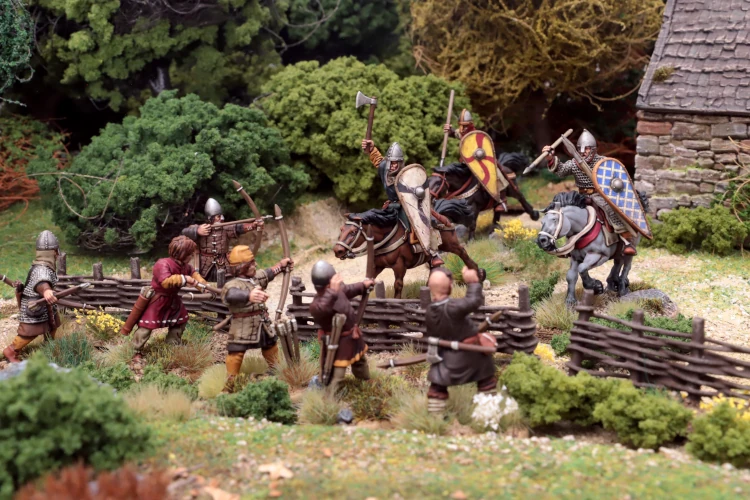
Pillage, as designed by its author, also features highly detailed battlefields. However, you can easily play on a neoprene mat with a few ruins or houses made of cardboard or 3D printed. The main thing is to get playing. With its small model count, Pillage is also a great opportunity to take your time and build up your scenery over time. The modeling and scenery section at the back of the book will definitely inspire you to build a great-looking table for Pillage.
Pillage: From Past to Future
A great success for a project that started out as a fan effort, turned professional, and eventually landed a physical French release. Finally, through a partnership with Victrix, it has grown into an international project with an English translation of Pillage.
As you read these lines, the Siege expansion for Pillage should be coming out or already released for a few weeks.
Noodle still has several ideas to expand into other historical periods fitting for plunder. Muskets and black powder during the Golden Age of Piracy have been discussed for a couple of years now.
Going further?
You will find resources on YouTube to learn how to play Pillage!
Written by:


Stay tuned
And never miss an article again! Join our Discord to get notified whenever we publish something new. You can even choose which games you want to receive notifications for!