
 by
by This article is intended for people who are new to the hobby, but also for those who would like to pass on their passion. It is also aimed at seasoned players who already master one or more systems and wish to add a new one to their collection.
Falling in love with a new miniature wargame at the store
On a Saturday afternoon, you are at your local game store. The clerk has just put out a Konflikt’47 bundle available in French. Inside: two armies, the Axis and the US. The miniatures look super cool, there is a rulebook, but nobody knows this game. The clerk then throws at you:
“Yeah, it’s like Bolt Action, but with weird weapons and combat walkers!”
Great… except you don’t know what Bolt Action is either!
This is a somewhat caricatured scenario. Store clerks are usually much more professional. Either way, there you are, tempted to start a new miniature game.
New player, new miniature wargame, new rules!
Board game vs Miniature wargame : what is the difference?
If this is your very first miniature game and you have no prior experience, we can try to draw a parallel with learning a classic board game. In a board game, you have a rulebook that allows you to use the components included in the box. Generally, you need to apply all the rules for the game to function properly.
For miniature games, it is not quite the same. Indeed, a complex system can offer you numerous options that will not necessarily be present in every game. Depending on the chosen armies, scenarios, or the miniatures available among your gaming partners, the rules all apply, certainly, but in a selective manner.
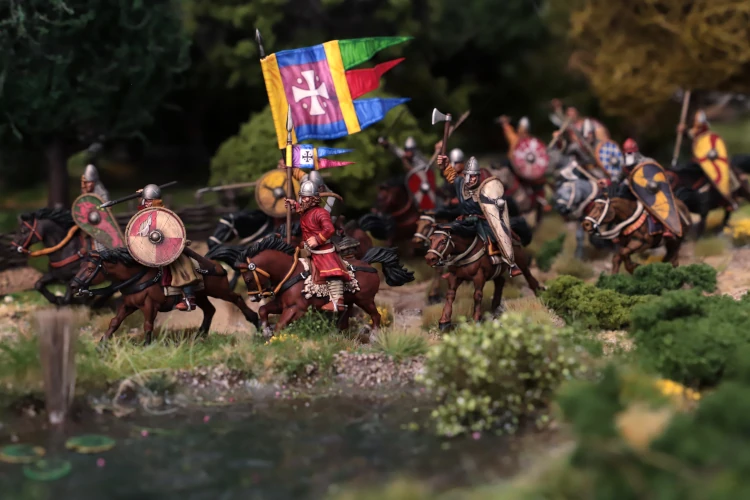
Concrete example:
If there are no vehicles in either of the opposing armies, the entire section of the rules dedicated to vehicles will simply have no application in your game.
Strategies for learning a new miniature wargame
There are several methods for approaching a new miniature game. Here, we will review a good portion of the possible “angles of attack” to successfully carry out this project!
But first of all, as a miniature player—and especially as someone who plays several different systems—I am going to share with you my tips, but also the pitfalls to avoid that I have identified in each of these strategies.
To illustrate our examples, we will use the case of acquiring a Konflikt’47 bundle.
First things first! Put down the STG44s and get the Xerox ready…
You need to print out the playsheets and weapon summary tables so you can have them close at hand during every game even when you become a veteran!
This is essential to make the games run smoothly overall.
For Konflikt’47 :

Strategy 1: Learning at a gaming club
Does your local miniature club regularly run Bolt Action games? Brilliant! You have players right there who already know the core system. Except, when you bring up Konflikt’47, you get total silence: they have never heard of it. It sounds like some mythical rumor whispered by a secret society. In short, they have no idea what you are talking about.
The first strategy, even before assembling your miniatures, painting them, and offering them a game, is to show them the rulebook. The Bolt Action players will examine the book while making noises like:
“Mm-hmm… (turns the page)… mm, mm… (turns the page)… Oh yeah, look at that! Mm-hmm… cool.”
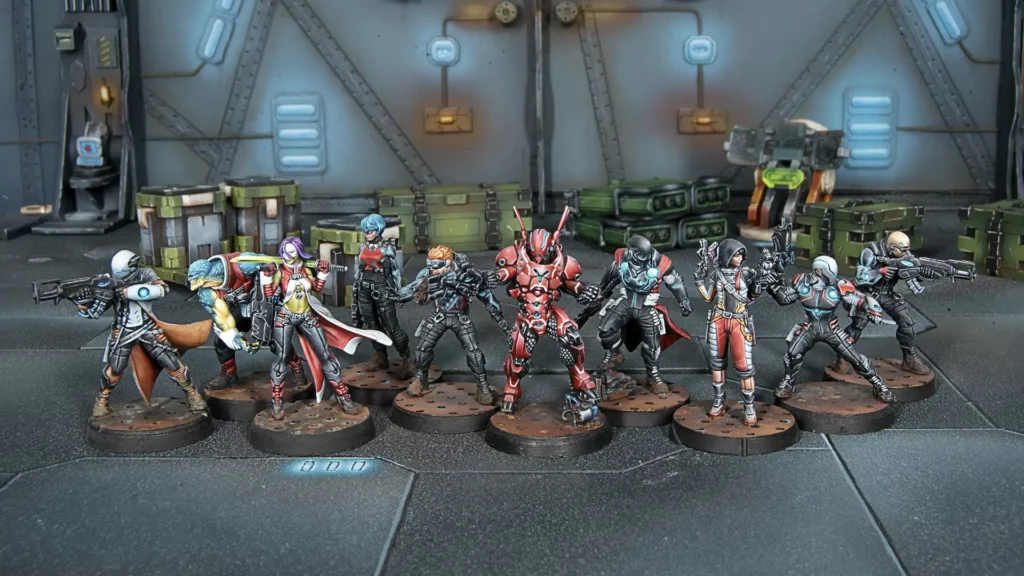
In short, they will be on familiar ground. In the end, they will realize they already master 98% of the game system! The outcome? They will probably offer you a classic game of Bolt Action first, and then subtly introduce the differences with Konflikt’47 later on.
However, this ideal scenario hides several pitfalls, especially if you yourself don’t know Bolt Action at all.
A few tips for old timers (and pitfalls to avoid)
The main flaw of seasoned players introducing you to a game is that they often want to give you “the full experience” right from the first game:
- A 1250-point format on each side,
- Heavy tanks,
- Artillery observers,
- Mortars,
- Howitzers,
- Troop transports,
- Multiple platoons,
- And national special rules…
This is a trap I have experienced myself at clubs, and quite frankly, it severely lacks basic teaching logic. You are just going to get overwhelmed by information.
The art of a good introduction for a new miniature wargame
- Favor the “skirmish” format: When trying to teach someone a new game, it is better to plan for several short, restricted games of one hour, preceded by 15 minutes of explanation.
- Limit the units: Use few miniatures to focus not on the stakes of the battle, but on the pure mechanics of the game system.
- Do a debriefing: At the end of the game, go over the essentials (the movement system, the shooting and close combat procedures) and point out the corresponding sections in the rulebook so the novice player can refer to them later.
- The rule of repetition: It is essential to repeat rule points several times. Without at least 3 repetitions, the human brain does not retain a simple rule. If the point is complex, 6 repetitions are a minimum, with a little time between each explanation.
Introducing someone and helping them absorb a game requires an enormous amount of energy and concentration. Do not embark on a complex scenario: keep your life simple! Your main objective must be to pass on your passion, not to win the game at all costs.
Is reading a rulebook linear, boss?
Contrary to what we are taught at school, reading a miniature game rulebook does not have to be linear at all. There is no question of mindlessly starting at page 1 to finish at page 194!
Instead, start by identifying the elements that present the game’s universe. Sometimes, this takes the form of a short story, or a narrative introduction to the factions or nations. Sometimes, this content is scattered in sidebars throughout the pages to illustrate a rule or simply to say: “Look at what is happening in the Pacific in 1947, this is a cool read!”.
To sell the game to those around you, there is no need to inflict pure mechanics on them right from the start. Focus on the atmosphere.
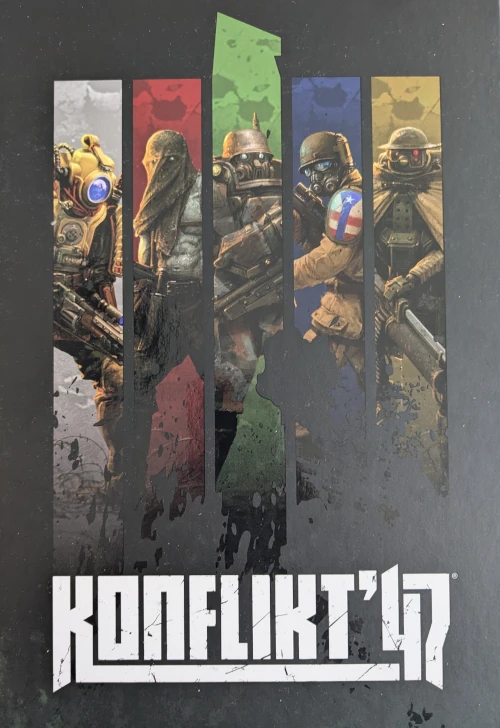
Your goal: Make André want to play Konflikt’47 with you!
To do this, tell him about the universe: the Rifts at Los Alamos and Dresden, the German undead, the genetically modified Soviet bears (“perfectly normal in Russia!”), the Axis werewolves, the Japanese ghosts, and the American combat walkers.
Okay, I admit, there are no genetically modified bears in Pillage… But it is still a great game.
At this stage, you must carefully avoid any prolonged contact with the game system.
Step 1: Preparing the first new miniature wargame
There is no need to assemble and paint the entire contents of the bundle to launch your first game. Instead, aim to assemble two squads that are roughly balanced in points. In the case of Konflikt’47, you are in luck: all miniature profiles are available online for free.
In Pillage, the profiles are all in the rulebook.
Next, print out a playsheet to serve as a quick reference, and start studying the basics of the system. For a clash between two squads, you will only need to understand:
- Initiative: the famous dice-drawing order system of Konflikt’47.
- Troop movement.
- The shooting system.
- Close combat.
The extra tip:
Create small cards summarizing each squad’s abilities: equipment stats, movement characteristics, list of potential special rules… Everything that makes each unit unique.
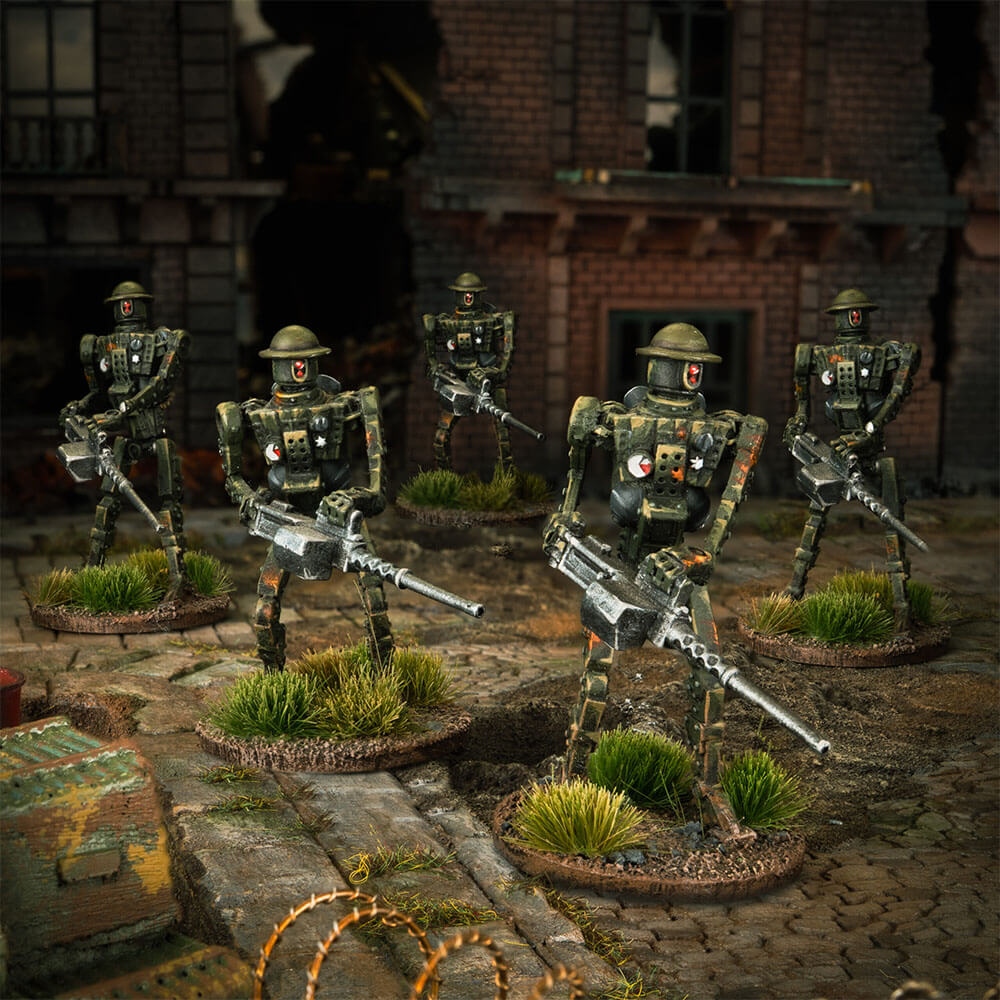
Prepare a small combat zone (90 x 90 cm, for instance), deploy your two squads, and go for a quick hour of fun. Take the time to apply the rules correctly. Check that you are following the right procedure.
Did you make a mistake?
It doesn’t matter, it happens to the best of us, and the best of us is you.
After the game: the debriefing.
What still seems unclear?
What is clear?
Read through the rulebook calmly in the following days, but only the sections you have just tested on the table.
Step 2: The second game
For this second clash, you will add new elements: a combat walker, a light vehicle, or a new specialized unit.
Each of these options adds complexity. Be aware of this and aim for a game with, at most, double the points of the first one, for about 1.5 hours of play. You are still in the learning phase!
Once again, integrating these new features requires identifying and reading the corresponding sections beforehand. You can also start creating a scenario with a simple objective and a combat zone that is a bit denser in terrain. What better way to master the rules for light cover, heavy cover, and lines of sight than a cluttered environment?
Just like the first time, take your time. If you disagree on a rule point, check the book together. It is perfectly normal to make mistakes, forget, or confuse one mechanic with another.
Step 3: The third game
By this stage, you should be starting to become increasingly independent. You can now play with the full power of the rules and add various options. This is the moment to integrate National special rules to give your armies some personality.
However, it will still take you several games before mastering the system as a whole. From time to time, you will return to the book anyway to clear up a doubt about a rare or new mechanic.
What next?
The best way to truly anchor something you have just learned is to explain it to someone who knows nothing about it! And what better way to do that than looking for a second, or even a third Konflikt’47 player within your club?
What if you don’t have a club?
If you are completely isolated, the first questions to ask are logistical:
- Does your local game store have tables to host miniature players?
- Do you have the necessary space at home to set up a gaming table?
If the answer is yes, that is already a great start!
Strategy 3: How to learn a miniature wargame on your own?
In a context where you don’t have a close friend on hand or a club yet, you will have to be clever to learn how to play this new miniature game… and make others want to join you!
The recipe is much the same as learning with a friend, but a few adjustments are necessary.
Step 1: Assemble a few miniatures
As I describe in the article “Assembling your first Bolt Action units: making the right choices from the start,” begin by assembling about a dozen miniatures per side. Then, get ready to play solo.
The article is here:
Yes, this implies that you are going to play against yourself. It is the best way to break down the core mechanics: how to activate a unit?
Yes, this implies that you are going to play against yourself.
It is the best way to break down the core mechanics:
- unit activation,
- movement,
- shooting.
You will also learn about taking cover and its implications in terms of the rules. You are going to do a few solo simulations, but this is primarily to prepare for what comes next.
Step 2: Solo training scenarios
You are all alone facing a silent coffee table. The remote control stares at you sadly, a mug abandoned by your partner judges you, and you… you deploy your troops in this organized chaos!
To keep from running in circles, here are three types of exercises to test out alone at home:
1. Shoot & Maneuver
Squads maneuver and attempt to evade enemy fire by taking cover behind terrain.
The exercise: Place a large base in the center of the table. Consider it an automatic machine gun that shoots at anything moving within its line of sight. The only way to destroy it is to get within 3 inches of it to launch a demolition charge (which triggers on a roll of 3+). Every move you make prompts a shot from the machine gun. The shooting mechanics, meanwhile, strictly follow the firing rules in the book.
2. Close Combat
Take four squads of 5 miniatures moving toward each other. None of them have ammunition: the clash will take place exclusively in close combat.
The exercise: The objective is to exterminate all enemy squads. Here, you specifically work on charge movement phases, combat resolutions, and the associated morale tests.
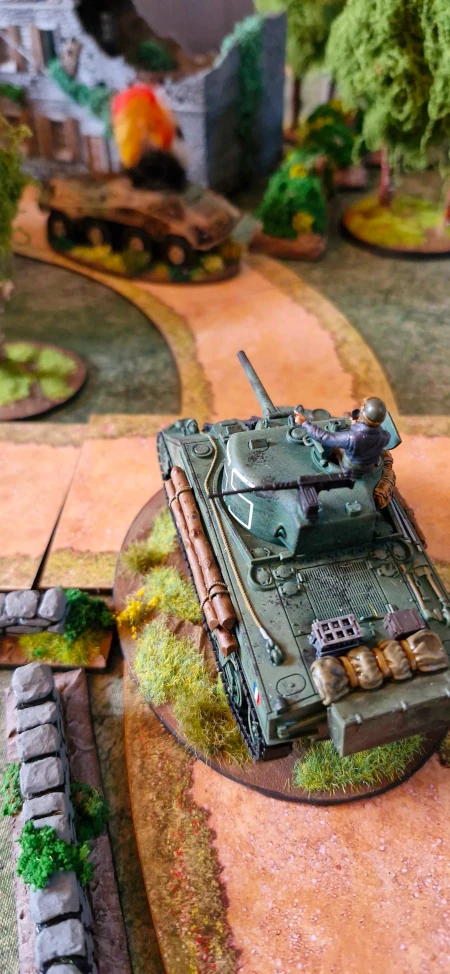
3. Tank Maneuvers
The combat zone is heavily cluttered.
The exercise: Your goal is to go from point A (your deployment zone) to point B (the enemy zone) while avoiding hedges, ruins, and minefields. This is the ideal exercise to master the complex rules of vehicle movement: pivots, reversing, and crossing obstacles.
Step 3: Ready for adventure? Take action at the store!
Once you master the basics thanks to your solo training, offer an introductory game of Konflikt’47 at your local game store. But at this stage, you can also offer a game of Pillage.
The pro tip: Run the introduction with painted miniatures. It is visually much more attractive for drawing in future players. Why not the very first members of your future club!
Make sure to prepare this session like a true professional: bring out the playsheets, summary cards for the squads, a clean rules summary, and display the rulebook prominently. The idea is simple: charm your future partners. Therefore, the game must be presented quickly, smoothly, and efficiently.
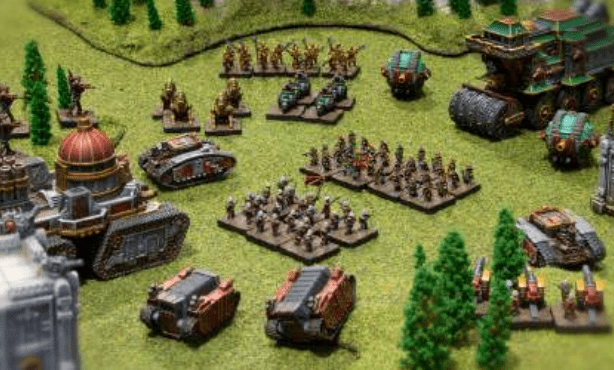
Thanks to your solo training, you have the necessary perspective to manage the game calmly.
- Aim for small lists of 250 to 500 points maximum.
- Do not exceed 15 minutes of theoretical rule explanations beforehand.
Keep in mind that it is always better to explain a rule “in-game,” right when the situation arises, rather than giving a long, one-hour theoretical lecture where everyone loses focus.
Finally, when introducing novices, the best approach is to step into the role of the “referee / host” who explains the rules to two players facing off. While it is admittedly a bit frustrating not to push your own miniatures, it allows you to focus 100% on teaching and to definitively master the game system!
Watch battle reports
There are battle reports for many games on YouTube. A simple YouTube search often allows you to watch veterans of a miniature game play together, explaining basic and even more complex mechanics.
Conclusion: Jump in, the dice are cast!
Let’s face it, opening a box of unfamiliar miniatures always brings a little thrill. Facing a rulebook as thick as a pocket dictionary can seem intimidating, but as we have just seen, learning a new system does not have to be a chore.
Whether you are lucky enough to have a club of veterans ready to adapt, a curious friend like André to share your first steps, or you have to get clever by playing solo on your coffee table surrounded by coffee mugs, the key remains the same: progression and enjoyment.
Do not try to master everything during the very first turn. Start small, accept mistakes, laugh off rule misunderstandings, and above all, highlight the narrative and visual side of this wonderful hobby. By sharing your enthusiasm and offering smooth, welcoming introductions, you won’t stay alone for long. Who knows? You might just be the spark that creates the future gaming community in your region.
So, break out the clippers, ready your dice, and happy gaming to everyone!
Written by:


Support us via Maxi Reves ✨
Help us promote lesser-known miniature games and grow their communities. Order your miniatures from Maxi Rêves using the code MAXITC and be part of our mission!