 by
Captain Fernandez mentally reviewed the 06:00 briefing elements.
The target: a local warlord affiliated with a transatlantic terrorist network, holed up in Porto Amboim. For two days, he and his six-man assault team had absorbed the target’s biometric file, habits, high-resolution satellite imagery, and comprehensive list of false identities.
According to the local DGSE station, the subject was scheduled to attend his sister’s wedding—a rare vulnerability that forced him out of his usual safe haven. The order of battle was crystal clear: infiltration at 04:30 local time, silent neutralization of the guards, capture of the subject in his hotel room, and immediate exfiltration to rendezvous point Alpha for a helicopter evacuation. Human intelligence (HUMINT) had identified only four armed militiamen and a lieutenant serving as his close protection.
Absolute priority: the target must be brought back alive. The value of his intelligence outweighed everything else.
The European Union had no legal mandate in Angolian territory; the operation relied on the strictest plausible deniability. Their rear insertion platform was the Nautilus-II, an oceanographic research vessel under a flag of convenience, discreetly modified for special operations: a twin-turbine helicopter landing pad and a perfect scientific cover to justify its presence in territorial waters. Three days earlier, the team had boarded from a Spanish S-80 class attack submarine, surfacing from a depth of 30 meters with over 40 kilos of gear per man. The reception by the civilian crew had been ice-cold.
Go!
The rigid inflatable boat cut through the Atlantic in pitch darkness at over 25 knots, two kilometers off the coast. Fernandez, at the controls of the low-acoustic-signature engine, would handle the shuttle relay. The final 600 meters would be done via combat swim to bypass coastal surveillance radar. This would be followed by a 500-meter foot infiltration through the deserted streets of Porto Amboim.
On Fernandez’s encrypted datapad, the tactical screen glowed green. Micro-reconnaissance drones (UAVs) hovering above the target confirmed the presence of the four militiamen equipped with AK-47s, the lieutenant, and the target. A secure Europol notification definitively validated the red notice.
The contract was simple: snatch the objective, avoid all collateral damage, and pray the Angolan national police wouldn’t react before their extraction in the event of an accidental gunshot.
The outboard motor slowed, its muffled sound blending into the crashing waves. Fernandez adjusted his mask, rolled backward, and disappeared into the icy water.
FIRE! Modern Combat
Fire! is a modern and realistic skirmish game that allows you to take control of regular or irregular troops. Plunged into the realities of modern military operations, you will face the asymmetry of resources, technology, and manpower across credible theaters of operation.
As players, you will confront the harsh realities of modern warfare.
This Spanish skirmish game is available in four languages: Spanish, English, German, and French. In French, it offers a rare setting in the francophone gaming landscape, as French games featuring modern contexts are very uncommon.
It follows in the tradition of modern skirmish games like Black Powder Red Earth and Spectre Operations.
Why is playing in a modern setting interesting?
The modern context might divide players. Some might be bothered by the proximity between the scenarios’ themes and real-world current events. Much like some players are sometimes uncomfortable with historical themes related to World War II.
It is worth noting, however, that many works of fiction, such as those by Tom Clancy, feature universes very close to our own world—techno-thriller novels featuring clandestine military operations or terrorist cells.
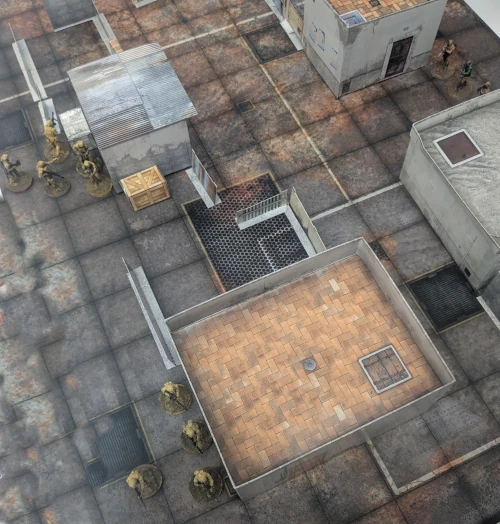
In this modern setting, you are not obligated to stick to real-world current events. You can create your own completely fictional campaigns, settings, and missions, whether inspired by reality or not.
I find it quite stimulating to touch upon modern gear: assault rifles, RPGs, machine guns. The asymmetrical aspect of combat is also very interesting. Finally, in terms of terrain, Western urban combat, a Middle Eastern combat zone, India, or the alleys of Kyiv are all possible themes for Fire!
What is the contents of the Fire! starter box?
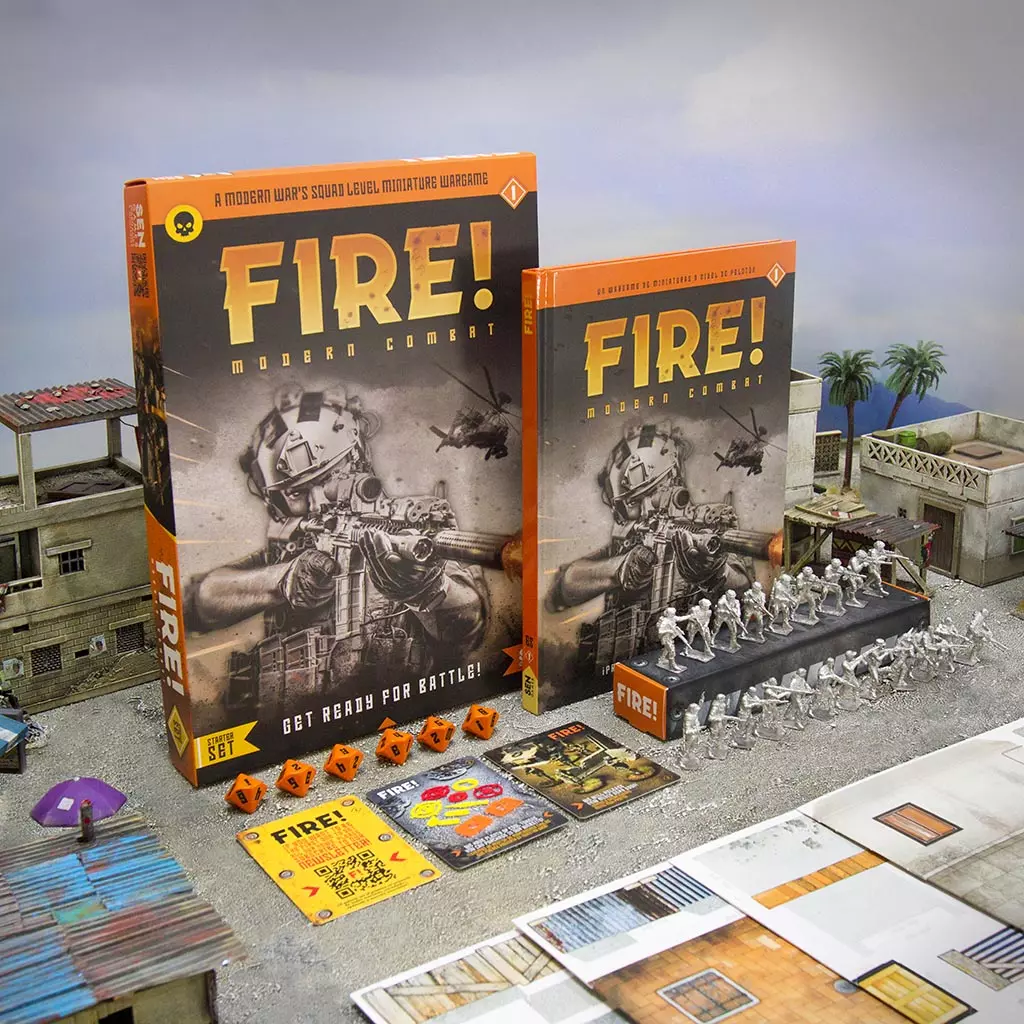
The starter box contains everything needed to play and run numerous games of Fire!.
The A5-format rulebook features a hardcover, full color, and good quality.
21 miniatures, offering regular troops and insurgents. The miniatures are made of metal and need to be glued to 25 mm bases. They also require painting for an appealing visual experience during the game. The sculpting is decent for metal miniatures.
Pre-cut and buildable cardboard terrain, including buildings, barriers, and obstacles. Enough to create a small 90 x 90 cm combat zone.
6 ten-sided dice and game markers to make the game system work.
The Fire! Game System
The game system is clearly focused on skirmish. Based on D10s, tests must be passed by rolling a result equal to or lower than a difficulty. Depending on the actions being performed (shooting, morale checks, grenade throws), these dice are utilized differently.
It is fairly easy to pick up and brings a change from our usual six-sided dice.
The Initiative System
The initiative table is one of the game’s pleasant surprises, giving an interesting dynamic to initiative throughout the entire match. By offering a probability-based balance that adjusts progressively, the system determines who holds the advantage at any given moment, making it a very original idea.
Game Turn
A game turn is broken down into several phases.
Command Point Calculation Phase
The first task is to determine the number of command points available for the turn. This is based on your team’s experience, the number of soldiers still alive, and whether their leadership is still fit to fight or stressed. These command points will be useful for giving orders to your soldiers.
Combat Scene
Part of the game system’s originality rests on this point. These combat scenes allow you, based on your initiative, to create actions that cost command points. These actions enable you to make your troops act. In response, your opponent invests their own command points to react to your orders.
Throughout this “programming” phase, your miniatures do not move. You simply know who is going to move, who is going to move and shoot, who is taking position to cover an area, who is attempting to flee, etc.
Example:
“While I order my Ranger to cover the alley with a firing order, the opponent spends 2 CPs to make their insurgent sprint for cover in reaction.”
It is only once both players have finished programming their actions and reactions that the execution order of the orders is determined. With a slight advantage for the one holding the initiative. This sequence truly organizes the combat scene. It is at this moment that the miniatures act, shoot, react, and move.
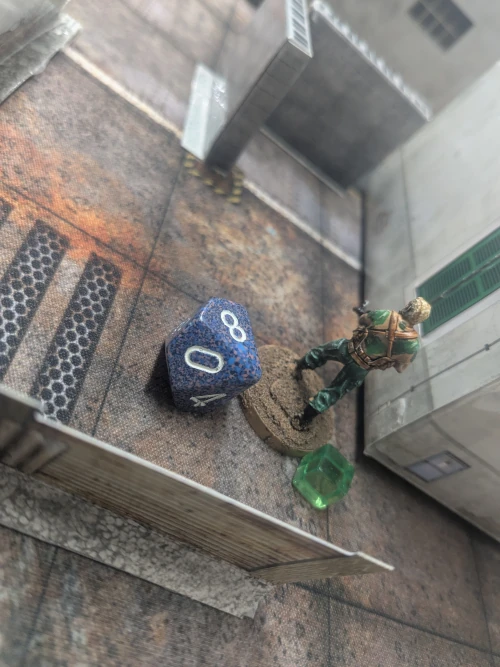
Once all orders have been executed, a new combat scene begins if there are any command points left.
You also note which soldier moved and acted during the first combat scene. Thus, giving additional orders to these troops is still possible, but more costly in command points.
End of the Turn
The turn ends when both players have no command points left. The game ends when the scenario’s objectives are achieved.
This breakdown of the turn into “combat scenes” is quite cinematic, and I find it a very original and interesting approach for Fire!, giving it a unique flavor.
Influence of Stress
The game system features two types of damage: clean, lethal wounds; here, hit points are not tracked. A bullet is lethal. Even though it is possible to equip your men with body armor, there is no concept of armor “saves.”
However, troops can also be “under fire” without being killed, and that is where stress comes into play. All weapons feature both a lethal characteristic and a stress characteristic.
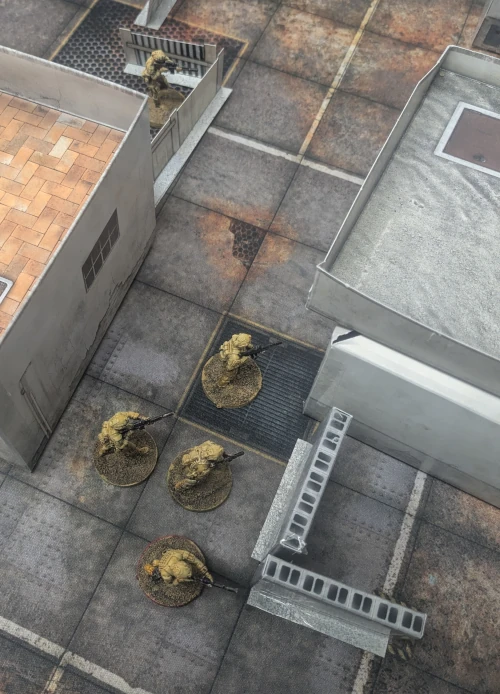
A soldier who accumulates stress runs slower, shoots worse, and above all, is harder to mobilize with orders.
This is also one of Fire!’s strong points. The idea that a combatant caught under fire, even entrenched behind heavy cover, will ultimately be pinned down by the intense stress of combat.
The Narrative Potential of Fire!
Fire! inspires you to create scenarios and tell modern stories. Because of its modern theme, current events are overflowing with inspiration for creating a mission in Fire!. The core box offers an environment geared rather toward the Middle East. The cardboard terrain includes 4 houses, several barriers and low walls, enough to make a small theater of operations that works well on a Kill Team-sized board.
There are also two teams: 12 rebel insurgents and a US Army group. Enough to play several scenarios under good conditions and test the game.
In the coming weeks, I will be offering you a few missions using only the components present in the core box, in an upcoming article.
The Price of Entry for Fire!
Expect to pay 129.95 € for the core box, containing everything needed to play except the playing surface. This will go very well with a Kill Team mat or a surface you have made yourself.
If you already have modern miniatures, in that case, the rulebook, available in French, English, German, and Spanish, will cost you 27.95 €.
You will need to add tokens and markers, which you can find to print on the publisher’s website here.
SEN Games also offers a whole range of metal miniatures. At the time of writing this article, available options include the Spanish army, US Rangers, insurgents, as well as several other choices notably journalists, civilians, mortars, snipers, and many more.
For a company that launched its game on Kickstarter in March 2025 for delivery to backers in September 2025. Which demonstrates the company’s reliability.
What I think of the Fire! box
For me, this box content is aimed at players who do not have “modern” terrain or miniatures in this theme, which remains quite difficult to acquire in France. Unless going through 3D printers who offer ranges of modern soldiers from various countries.
It offers an ideal gaming environment to start your first games in an urban setting. The soldiers provided for both factions offer several interesting tactical options and should be enough to play multiple games, both for learning the game system and exploring various scenarios.
The publisher offers a few expansions, notably various regular and irregular troops to explore other possibilities and modern combat contexts. But that is not necessarily the purchase I would target first.
The “War Journalist” option is interesting, with its two dedicated miniatures and rules. It undoubtedly adds a narrative dimension and greater tactical pressure on the field. I haven’t had the chance to test and read these rules yet, but it’s an expansion I plan to buy in the coming weeks.
I think that for a skirmish gamer, Fire! has real gaming potential. I hope this game breaks through in France, because it is not often we get this type of game directly in our language. And the care put into translating and distributing the game in French, Spanish, German, and English is an effort I applaud.
No doubt you feel like taking command of a US Ranger or insurgent unit?
But while waiting to order your box of Fire!, I advise you to take a closer look at this game by following this YouTube video.
Written by:


Stay tuned
And never miss an article again! Join our Discord to get notified whenever we publish something new. You can even choose which games you want to receive notifications for!