 by
by Looking for a skirmish game set in the modern world? One that can be played solo, cooperatively or competitively? A game capable of simulating special forces operations as well as street wars between cartels and police tactical units? Want to play a full campaign just as easily as a standalone scenario? A game where you have to complete the mission before enemy forces overwhelm you? Haywire Modern offers all of that, and more.
This article is based on a copy of the game that Modiphius Entertainment provided to us free of charge as part of a press relationship. This does not grant any oversight over our editorial content: Critical Hit retains full independence and our opinions remain free and objective.
The Briefing
The sergeant leaned over the image showing a schematic view of the area of operations. Simple lines outlined the buildings and alleys of a dense urban district. Coloured dots were scattered across the map. “Okay, guys, here’s the AO. Hostiles have been spotted at the red positions. The target is in one of these houses, marked in green. It’s moving, so we’ll have to search every one of these places. And here’s our entry point, in blue. The plan is simple: we go in, neutralise the opposition and get out with the target. The enemy has plenty of reinforcements in the area, so we stay under the radar for as long as possible. Civilian presence has been confirmed, stay sharp. Any questions? Good. Gear up. We leave in 40 minutes.”
To adapt is to dominate.
This motto of the French Army, close to the United States Marine Corps mantra “Improvise, adapt and overcome”, sums up a game of Haywire Modern rather well. You have a mission to accomplish, but only limited information about the enemy. One thing is certain: you are outnumbered. Trying to eliminate every enemy will inevitably turn into a last stand. Your only option is to complete your objectives and extract your men before the plan goes completely off the rails or rather, goes haywire.
Gaming table and equipment
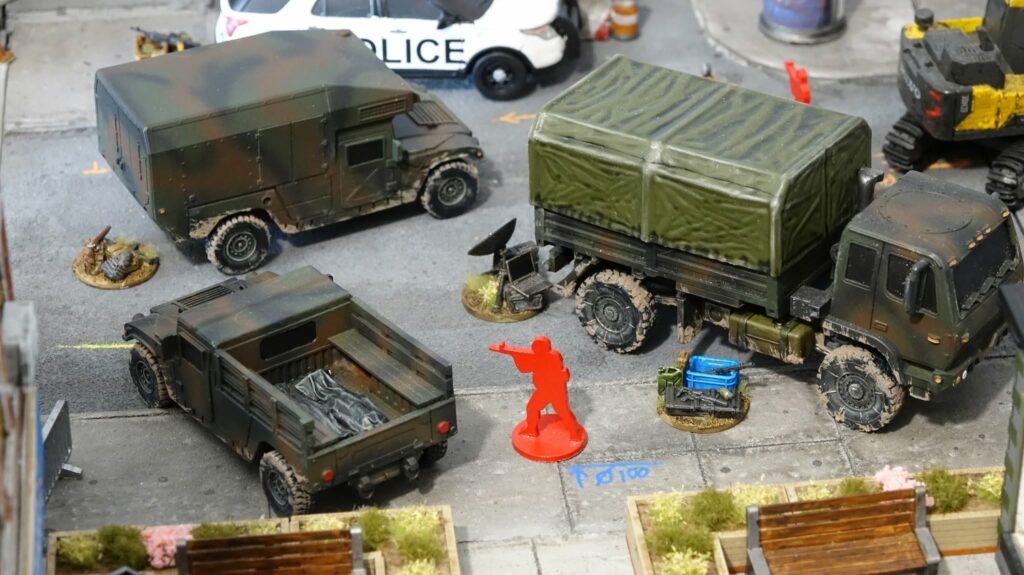
Haywire is played on a surface measuring at least 90x90cm. A 120x120cm table will be enough for most games. You will need a good amount of terrain . Most weapons have no maximum range. As a result, on a table that is too open the game will simply come down to who can put the most bullets in the air.
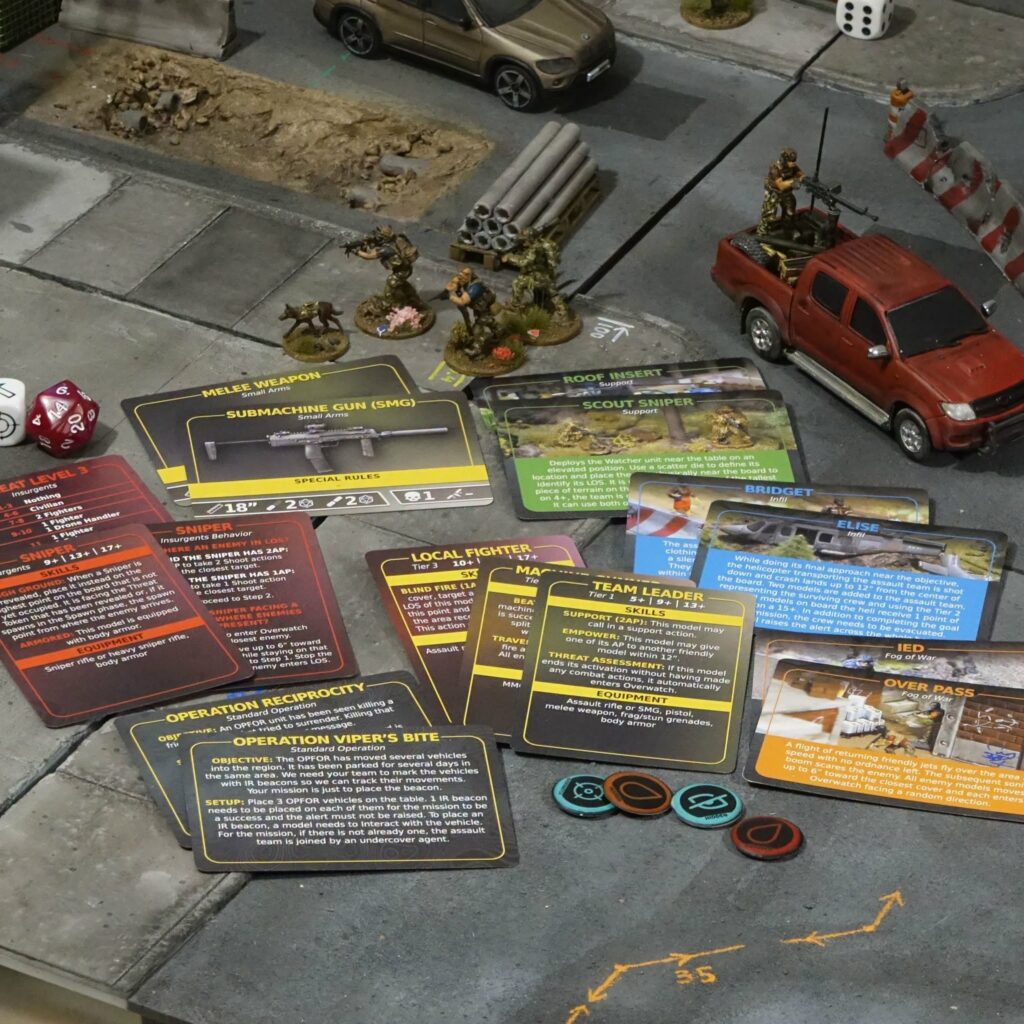
You will need one or two twenty-sided dice to resolve actions. You will also need a few tokens or small six-sided dice to use as counters. From time to time, you will also need to mark the location of two or three objectives. So far, the equipment needed to play is fairly minimal. However, the game also uses several decks of cards. They serve as quick-reference aids and to generate random elements. The good news is that all of their content is reproduced in the final pages of the book.
As for miniatures, Haywire requires at least around thirty models. That is not a huge number, but the variety required may prove more difficult. We will come back to that later.
Finally, you will need “Threat” markers. They must indicate their facing so that their field of view can be determined. You need one “Threat” marker for each 30x30cm area of the gaming table, so at least nine markers. They represent one or more enemies that have not yet been identified and are the game’s main fog-of-war element.
Forces in play
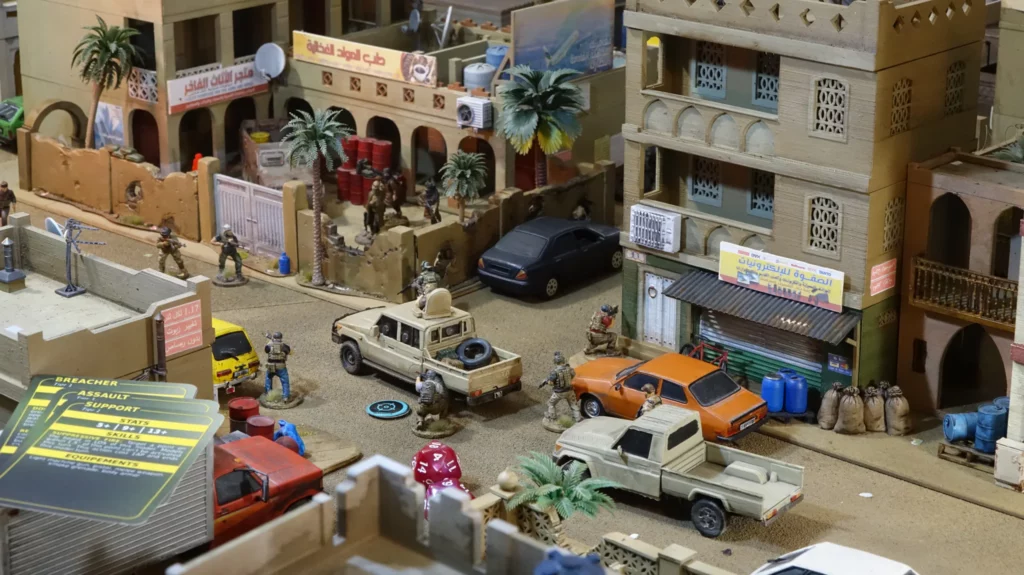
Your miniatures represent special forces, regular soldiers or militia. The enemy force also has three levels of training. Insurgents represent rebels and revolutionaries, mostly inspired by Asian or Middle Eastern forces. Armed Forces represent well-trained and well-equipped regular armies or elite mercenaries, with a Western theme. Finally, the Cartel sits somewhere in between, with a South American flavour: drug traffickers or paramilitary groups.
 Join
Join The phases of the game
At the start of a game, enemies are represented by “Threat” markers. The player’s miniatures enter the table from an edge of their choice. This is the moment to plan the details of the operation: your entry point, your opening moves, and so on.
Infiltration
The game begins with the infiltration of your troops. The stealth rules are simple but effective: certain actions alert nearby enemies, and entering an enemy’s line of sight triggers a detection test. A gunshot (without a suppressor) or an explosion automatically alerts everyone on the table. Until they are alerted, “Threat” markers move randomly around the table.
As soon as one of your miniatures has line of sight to a “Threat” marker, you determine randomly what it represents. Sometimes it will be nothing, but most often it will reveal two or three enemies. The further the game progresses, the more dangerous these markers become. Revealing them early can therefore be worthwhile, but it also increases the risk of being spotted and triggering the alert.
The alert
Your soldiers will be spotted or perform a noisy action that alerts the enemy; it is almost inevitable. Once the alert is raised, the game changes drastically. Civilians dive for cover, and that is the signal for the bullets to start flying. Wearing a helmet is strongly recommended!
Each turn continues to follow the same routine: your men act, then the enemies do. But from that point on, new enemies are generated every turn and all markers move towards your men. The mechanic is reminiscent of games such as Zombicide. Each entry point (spawn) brings in random enemies. Enemy actions are no longer random either, but follow a fairly simple script.
A race against time
Every passing turn increases the danger posed by randomly generated enemies. Losing a single turn can mean bringing in just a few enemies too many and jeopardising the mission. This makes for short, intense games, with constant tension between caution and speed. Few other games that use these same two phases, infiltration and combat, manage so well to avoid leaning too heavily towards one or the other.
In Haywire, the infiltration phase is an approach phase and often does not last very long. Without the right equipment, silently eliminating sentries is not easy. And because the danger level of generated enemies depends only on the number of turns that have passed, moving slowly can be a risky gamble. Once the alert is triggered, the rules ensure that the pace does not slow down; if anything, it accelerates.
Both phases are interesting in their own right, and you have to find the right moment to move from one to the other.
Campaigns
A staple of solo and cooperative games, Haywire includes a campaign mode. In fact, it has two. The first is a sequence of 21 scenarios of increasing difficulty, while the other is more open-ended. It is worth noting, however, that these campaign modes are not mandatory at all, unlike in many solo games. You can perfectly well play a single mission by randomly drawing an objective.
Haywire Protocol
This narrative campaign pits you against all three categories of enemies as you follow an operation that spirals out of control and reveals an international conspiracy. The campaign story is enjoyable to follow, and each of its three arcs includes information about the country in which it takes place. These passages are not necessary to play the game, but they add a great deal to the atmosphere.
It is an excellent entry point for learning Haywire Modern. The first scenario requires only the core rules, and not even the rules for generating new enemies. Besides reducing the number of rules you have to use, this also limits the number of miniatures required. You should still expect to need around fifteen enemies, twelve soldiers for your own force, and seven or eight civilians (6 are placed at the start and “Threat” markers can generate additional civilians). Likewise, the class options available to your men are limited, but they are enough to appreciate how the different roles complement one another on the battlefield.
Tour of Duty
At the complete opposite end of the spectrum, the other mode is a sandbox campaign: the ‘Tour of Duty‘. You manage your men and your base, gathering clues over the course of missions until you uncover one of the campaign’s ten final scenarios. This mode has enormous replayability thanks to its random elements, but it requires a little bookkeeping. You need to keep track of the intel points you have collected, your base upgrades, and so on. This between-game management remains very light compared with the ‘Five … from’ games (presentation here). In Haywire Modern, it only takes a few minutes: you deal with casualties, improve the base by purchasing an upgrade, and determine the next mission.
The final mission becomes available as soon as you collect six intel points. A Tour of Duty can therefore be completed in a minimum of seven missions. That is roughly equivalent to one arc of the narrative campaign. The difficulty increases with every intel point collected, and the missions also become more complex.
Strengths and weaknesses
The class system
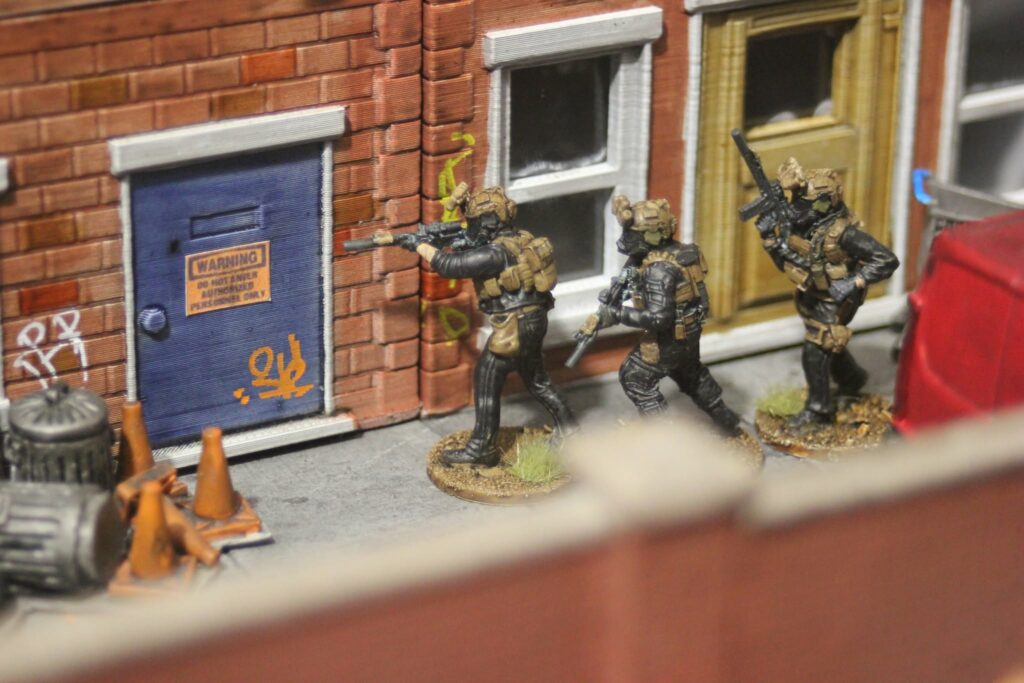
Except for civilians, every miniature on the table has a class that defines its abilities and equipment. It is very effective and one of the game’s major strengths… but at the same time it requires a suitable miniature collection.
The balance between the classes in your squad will have a major impact on the game. A mix of offensive and support roles will give you greater tactical flexibility. For example, a squad leader can give one of his actions to an ally, but will also automatically enter Overwatch if he has not taken an offensive action. He can therefore give away an action, move into position, and still gain a free shot in reaction to an enemy miniature. A rifleman, meanwhile, gets a free return shot the first time he is targeted during the turn. Other classes specialise in suppression fire or area-effect weapons (grenades and smoke grenades). These profiles become very useful once enemy numbers start to grow. And we have not even mentioned snipers, drone controllers, vehicles, and so on.
You can build your squad around the miniatures you own, but the same is not true of the enemies. They are generated randomly during the game and can belong to around ten different classes. The author recommends having at least one miniature for each class, ideally two or three. The exception is the basic class for each enemy category, for which at least ten are recommended. These troops sometimes arrive in groups of three or four! If your collection is limited, you will therefore need some way to identify each class, using whatever markings work for you (a sticker or coloured ring on the base, a token next to the miniature, etc.).
A minimalist version
Personally, I had very few miniatures that I could use to test Haywire Modern without relying heavily on proxies. I did not like the idea of using a mixture of characters from various science-fiction and fantasy ranges to represent modern soldiers and rebels.
I own a 3D printer and quickly printed a few silhouettes I found online for free. Similar models are fairly easy to find on Etsy. That gave me the idea of going for a completely minimalist aesthetic. The enemies are simple red silhouettes, my soldiers blue silhouettes, and civilians beige silhouettes. “Threat” markers are transparent silhouettes. The terrain consists of simple technical floor plans laid flat on the table. I write each soldier’s class on the base with an erasable marker. All that remains is to add a few dice and tokens.
The whole setup has a command-centre aesthetic, as though you were following the operation through spy-drone footage or thermal imaging overlaid on a map. Everything fits into a small box and a plastic sleeve. All you need then is a free 90x90cm surface. Ideal for taking on holiday or if you are short on space.
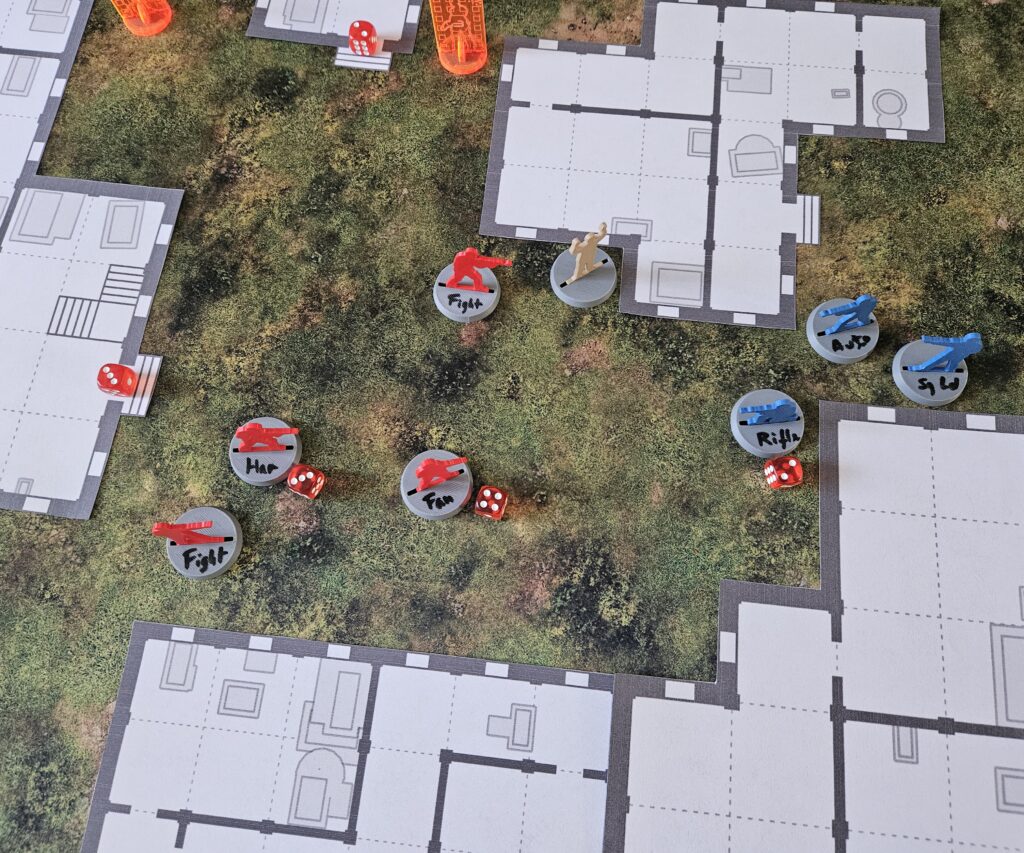
The silhouettes come from MyMiniFactory and the building plans come from Watabou’s ‘Dwellings generator’.
Flexibility and complexity
As you have probably gathered, the class mechanic lies at the heart of the system. It allows for a wide variety of profiles and roles, but when you are starting out it also means regularly checking what each class can do. One class has an action when it is targeted, another when a nearby ally is targeted. One enemy class improves the abilities of nearby enemies.
Each individual rule and effect is simple and logical, but together they form a complex system. During your first few games, you will almost certainly forget some elements. I strongly recommend using none of the optional rules at first. You will already have plenty to manage with your soldiers’ abilities, enemy scripts, “Threat” markers, the effects of actions on detection, any civilians that may be present, and so on.
Enemy AI
The behaviour of opposing miniatures is linked to their class and defined in a few simple steps. This ensures that their actions fit both their equipment and the situation.
Unfortunately, this means you will often need to check the script for each miniature. Enemy actions are resolved not by class, but by proximity to your men. You will quickly end up with four or five different enemy classes in play, and having a copy of their behaviour close at hand is almost essential.
Rules and interpretation
The core rules are very efficient and easy to learn. Each miniature gets two action points, and for your men this is also their number of hit points. After taking a first wound, your miniature has only one action per turn. After the second bullet, he is out of action. A wounded enemy, on the other hand, is immediately removed from play.
The number of dice rolled depends on the force and the range, while the difficulty depends on the shooter’s skill and the condition of the target (in cover and/or wearing body armour). There are fourteen possible actions and their description takes up only five pages, with each one explained very clearly and accompanied by a link to an explanatory video.
The action point and suppression system is very elegant. Every die rolled for a shooting action (whether the shot succeeds or fails) adds one suppression point to the target. At three suppression points, the miniature loses one action. At six suppression points (the maximum), it loses both actions. The soldier spends the turn avoiding incoming fire (or getting back up after an explosion) and cannot act. Some weapons (such as grenades and heavy machine guns) inflict additional suppression points. Smoke grenades, on the other hand, prevent suppression points from being assigned.
A matter of common sense…
Partly because of this simplicity, you will sometimes have to decide on the spot how to interpret a rule. For example, should a grenade exploding inside a smoke area still generate suppression? An enemy’s script tells it to fire a rocket launcher at the nearest target, but that target is too close to be valid because of the weapon’s limitations.
Optional rules
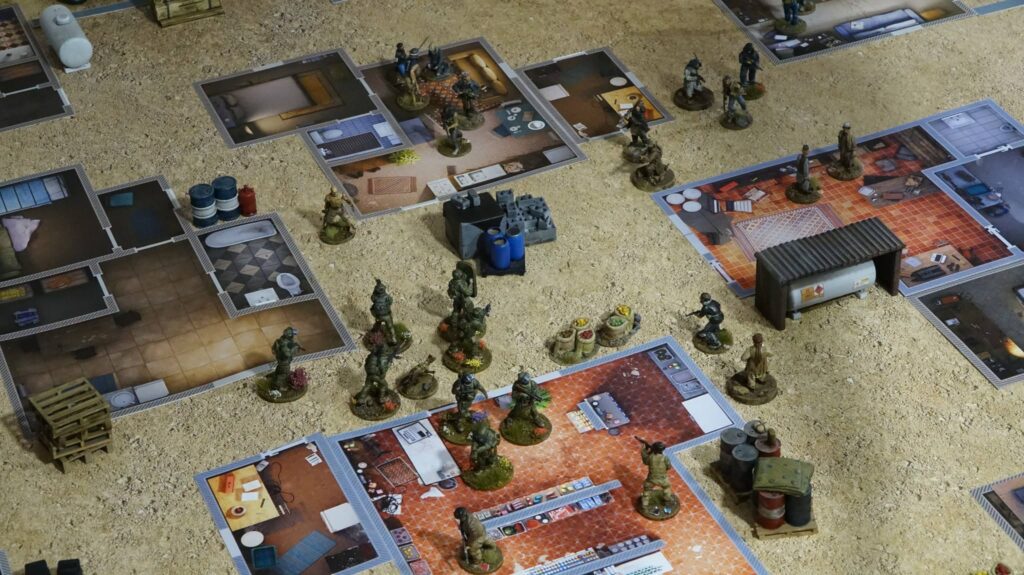
Many optional rules are provided and complement the game extremely well. You can add fog-of-war cards for an extra random element, specific rules for windows and securing buildings, and so on. There is something for everyone, and you can pick and choose the rules you want to achieve the level of complexity that suits you.
There is also a competitive mode, with a few rule adjustments. One player takes control of the enemies. The start of the game can be frustrating, however, because the enemies simply move randomly.
There are, however, some gaps in the rules. I would have liked to see optional rules covering them. Chief among these is a target-priority rule. The AI almost always fires at the ‘nearest target’, which can sometimes be easy to exploit. Leave a miniature in cover near the enemy and you can afford to leave men slightly farther away completely exposed… even though they would be easier for the enemy to hit. The only rule that forces a target other than the nearest one concerns vehicle-mounted weapons. Fortunately, the game is intended first and foremost as a solo and cooperative game.
In the same vein, a soldier hiding behind a civilian will technically be in cover… with no risk whatsoever to the human shield. Given the system, adding this kind of rule is easy for players looking for a little more realism and difficulty.
Community
Haywire Modern is a brand-new game, but it is based on earlier versions of the rules that already have their own following. In addition to the Discord, the author runs a Facebook page for the game, and there is also a fairly active group. It is a huge source of inspiration and help when getting started.
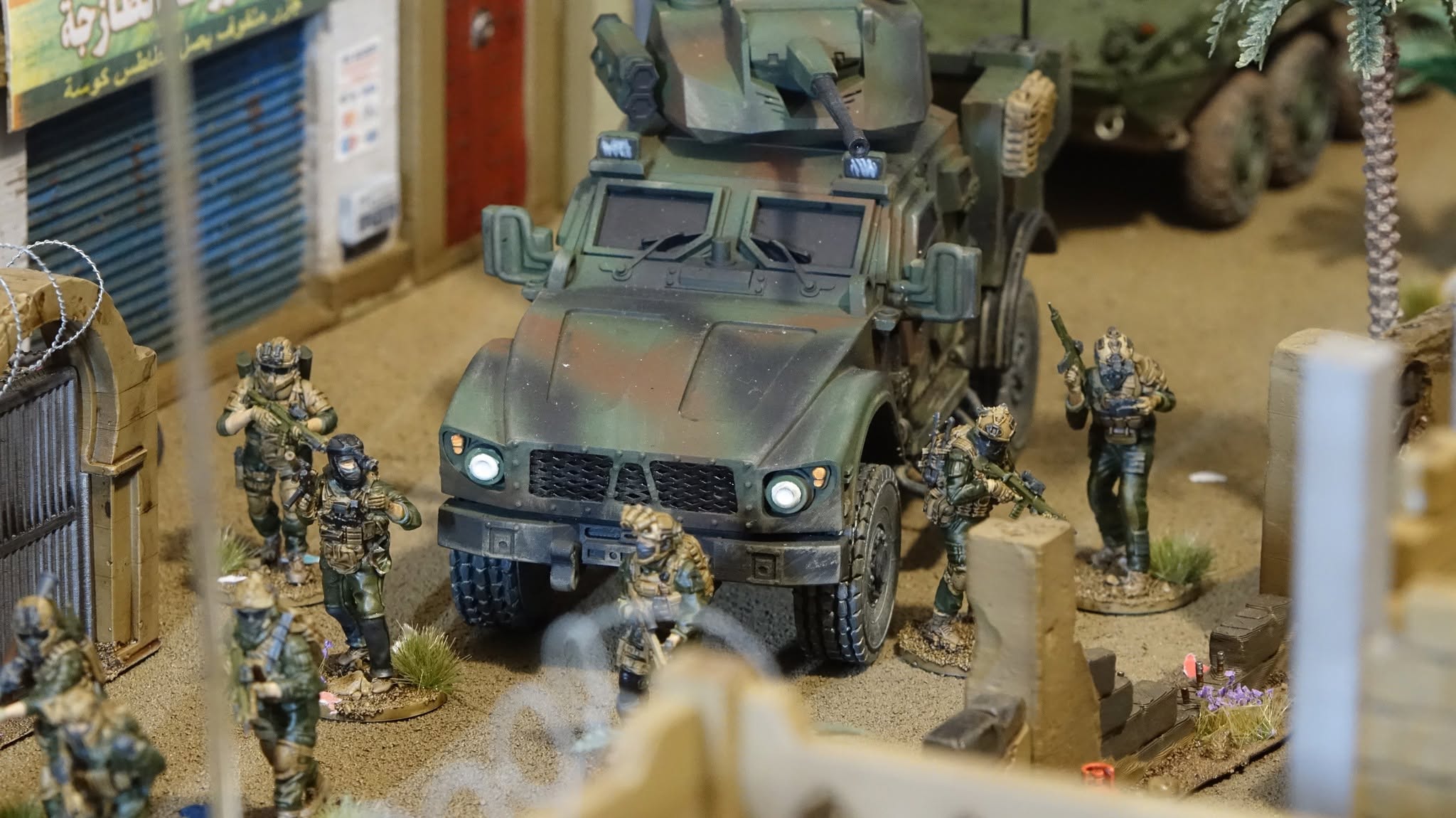
Speaking of help, the rulebook includes a Hobby Guide section. It contains tips and advice for making terrain and painting camouflage patterns. It is a nice touch from the author.
There is also a YouTube channel run by the game’s creator, with battle reports if you want to see how a game plays. Be warned: some videos cover scenarios from the narrative campaign, so spoiler alert!
A game that stands out
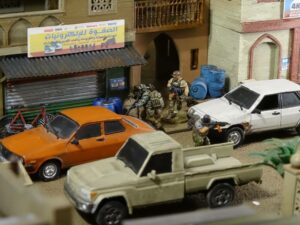
Wargames set in the modern era are not among the best known, and they sometimes suffer from overly complex mechanics. Haywire Modern feels genuinely fresh, with rules detailed enough to cover most situations while remaining flexible and lightweight enough to make it easy to adjust the desired levels of difficulty and realism. Once you have fully grasped its various core mechanisms, Haywire gives you a whole range of ways to customise the experience without making the game too cumbersome or slowing it down too much.
The engine of the game, its heart but also its biggest weakness, is the class system. The classes give the game its richness, but there are many of them. They give it a cinematic feel, but they can slow down both the flow of a game and its setup. If you do not already own miniatures that can clearly represent each class in play, you will need to find an easy way to tell them apart. Realising that you have spent three turns with the classes of two soldiers switched is extremely frustrating. And that is before you even try to correct the actions you resolved incorrectly…
The cards are not essential, but they are extremely useful. This is especially true for decks from which you are asked to draw randomly. Their contents are reproduced in the final pages of the rulebook, but I recommend printing them (either the cards or those pages), because you will consult them very often.
Haywire Modern is geared towards campaign play, in the same vein as other solo-cooperative campaign games published by Modiphius (Five Parsecs and Five Leagues). Individual missions are fairly short, so you can easily play two or three in an evening. Players looking for a highly detailed tactical experience, where they can select and track every item of equipment carried by each soldier, will probably be disappointed even with all the optional rules in use.
The game works well with the recommended minimum number of miniatures and does not take up too much space on the table. It slows down somewhat in larger engagements, but never becomes frustratingly slow.
Finally, you will encounter situations where you have to decide how to interpret the rules. For me, that is easy to forgive in a solo and cooperative game. If you dislike having to make this kind of decision during play, be aware that it happened to me more often with Haywire Modern than with other games of similar complexity. That is a little unfortunate, because the fluidity of the rules and the tension during play are precisely what encourage you to try unexpected tactics.
Is this the game for you?
If you are new to modern-era wargames and/or solo-cooperative wargames but the experience appeals to you, Haywire Modern is an excellent place to start.
Do you like streamlined rules that are simple yet elegant and easy to adapt? Do you want to be able to play a solo game without having to build an entire campaign framework first? Or do you want a wargame that feels like an action movie about military raids? Then Haywire Modern will probably end up on your shelves.
If you enjoy detailed rules, lots of equipment options and tools for influencing luck, Haywire Modern’s design philosophy may disappoint you. The game is more about managing a chaotic situation than meticulous planning.
If what you enjoy most is following a story over several games, Haywire Modern is an interesting choice. Especially if you want to keep between-mission bookkeeping to an absolute minimum. The ‘Tour of Duty’ is very light on administration, the ‘Haywire Protocol’ campaign requires none at all, and you can also simply play a sequence of random missions and add your own narrative.
Although Tour of Duty is highly replayable, a campaign can sometimes be fairly short. Seven missions minimum goes by quickly. That will be a positive for some and a negative for others. If you prefer longer campaigns while keeping your modern soldiers, take a look at Forgotten Ruin (which will get its own article one day). It is a stand-alone version of Five Leagues from the Borderlands in which modern soldiers fight orcs, wizards, dragons, and more.
For anyone hesitating to try Haywire Modern, there is a free Quickstart version containing the core rules plus a few classes and objectives so that you can test the game. It includes no optional rules, so bear in mind that you will be trying little more than the core mechanics. The full game offers far more possibilities.
Written by:


Buy the team a round
No ads, no paywalls, just pure passion. If our guides or deep dives helped you win your last game or discover your next favorite system, consider dropping a small tip on Ko-fi! Every pint helps keep the site independent and running.