 by
Guards of Traitor’s Toll is a skirmish game in which each player tries to complete as many tasks for the city as possible, while generating as little discontent among the population as they can. Let’s take a look at the core game and the first expansion : busy streets.
This article is based on a copy of the game that Grey for Now Games provided to us free of charge as part of a press relationship. This does not grant any oversight over our editorial content: Critical Hit retains full independence and our opinions remain free and objective.
Introduction: Peacekeepers first and foremost
Gone are the days when I would pound the pavements, eyes sharp and ears pricked, waiting for a chance to keep order in the Baron’s city and earn my promotion to captain. Traitor’s Toll really is a city like no other. Halfway between the Eternal Fire Empire and the Northern Kingdoms, it is a trap that ensnares anyone who needs to travel between those territories. I struggled to keep track of all the taxes levied by the assessors, but one thing was certain: no one took kindly to smuggling…
With ruined districts struggling to rebuild, the Arillo cartel, fanatics of the Eternal Fire and dark dealings in magic, my patrols were never dull. They were also a perfect opportunity to observe a microcosm on the scale of a city, with its public faces, its plots, its colourful populace, and the uneasy alliances between different guard squads—even as each squad sought to be the one that completed the most important tasks.
My only regret is that I never managed to uncover the secret of the Skailish…

Game overview
You are a Guard Captain. In the name of your Lord Protector, you patrol the streets of the city’s various districts to protect its inhabitants, catch wrongdoers, foil plots and, in the process, earn the approval of your superiors!
Guards of Traitor’s Toll (GoTT, for those in the know) is a semi-cooperative skirmish game. Players can never attack one another and figures must help each other out, but that doesn’t stop the players from getting in one another’s way. The winner is the player with the most Gold Coins at the end of the game. In practice, that usually means completing Plot tasks. You can also play solo or cooperatively if you’d rather work together.
Designed for 1–4 players, the game is played on a 36″ × 36″ (90 × 90 cm) table. It has its own custom dice, alongside standard six-sided dice (D6s), and a variety of cards for Plots, profiles, Advances and Secrets. The game has its own setting—its “lore”, or “fluff”—but, based on what we’ve seen so far in the rules and flavour text, it’s a fairly classic fantasy setting. A partnership with Wargames Atlantic provides plastic sprues of guards and civilians for the game. Grey For Now also offers resin miniatures for some of the expansions.
The game was written by Graham Davey, who also designed Test of Honour and 02 Hundred Hours, and published by Grey For Now Games. The illustrations are by Carmen Cerra. Please note that I contributed to the French edition, but I’ll do my best to remain as objective as possible in this review. You can also visit the game’s Facebook group for the latest news and to see what the community has been creating.
The aim of the game
Every game of Guards of Traitor’s Toll is a Mission, but more on that later. The aim is always the same: finish with as many Gold Coins as possible while keeping Discontent—both general and personal— to a minimum. To earn those coins, you’ll need to gsend your guards to the scenes of crimes, offences and other incidents, and be the ones to put a stop to them. But don’t rush too much: you don’t want to knock over bystanders, let rogues get away or, more generally, let things go to pot.
Building your squad
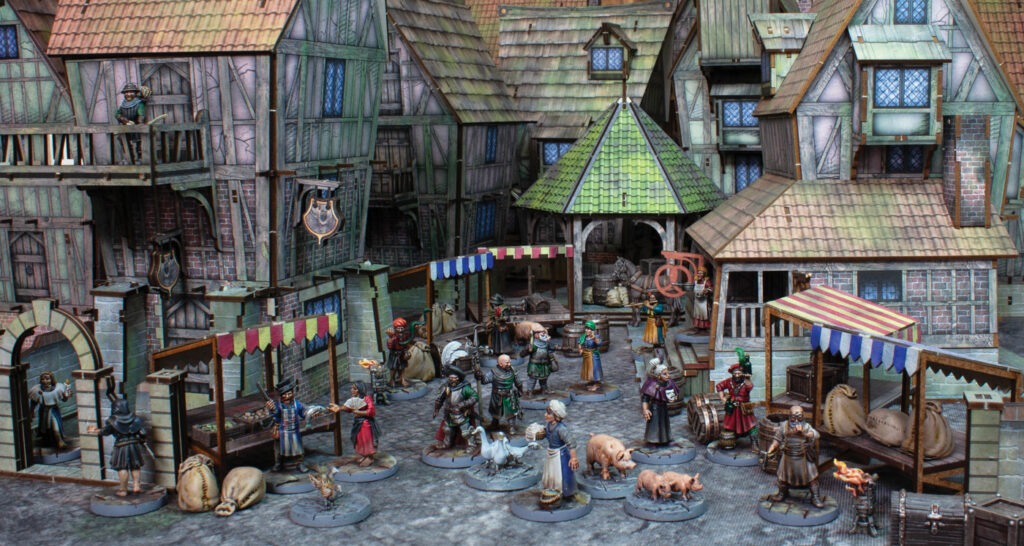
As I mentioned, you’ll be in charge of a squad. Led by a Guard Captain, accompanied by a number of guard constables, depending on the game. Some may remain at the guardhouse, ready to join the action. Your Captain and some of his minions won’t necessarily be on the table at the start of the game. They may arrive later as reinforcements, if one of your guards is injured, or when you escort prisoners back to your guardhouse. IIt’s a clever mechanic that helps you get the game moving quickly in the first few turns, while the Plots unfold, and deploy your guards where they’ll be needed most. Naturally, the more players there are around the table, the fewer guards each player will have at their disposal.
Recruitment is fairly flexible. If you stick to the core game and the first expansion, Busy Streets, you’ll find three profiles: the Guard Captain, the Sergeant and the guard constable. As for their equipment, you choose what they carry! Apart from taking a mount, a ranged weapon or an attack animal, there’s no cost for the equipment combinations you assign. So feel free to choose based on the miniatures in your collection or the pieces you find most appealing on the sprues, and create your own custom guards. You can equip both hands however you like, or even leave one hand free to make it easier for a guard to seize and subdue suspects.
It’s worth noting that all guards have slightly different profiles: some are more agile, others more cunning or courageous. You can take this further by using Trait cards to create a nimble, instinctive, calculating or brutal guard.
Traitor’s Toll is governed by the Baron’s inner circle—especially his four children, who oversee the City Guard and act as patrons to your Captains. Patron cards give you secret objectives linked to the lord you serve.. You can earn Gold Coins at the end of the game if you’ve followed your benefactor’s “guiding principles”.
Mind your own business
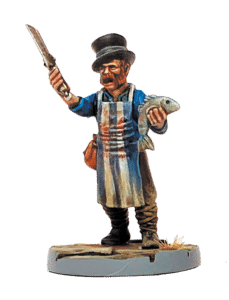
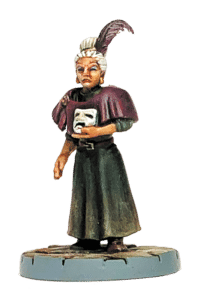
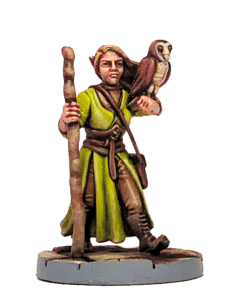
As your guards patrol the streets, they’ll encounter the many civilians of the city, going about their business. The figures that populate your table belong to categories according to the items they carry: arcane, expensive, consume, weaponry, tools or perform. Why does that matter? Because any of these Civilians could be a suspect. When Plots appear in the game, players identify one or more suitable Civilians as suspects, who may need to be questioned, arrested or protected. Civilians can also help guards with certain actions—as long as they aren’t putting themselves in danger—if the squad is popular enough and general Discontent isn’t too high.
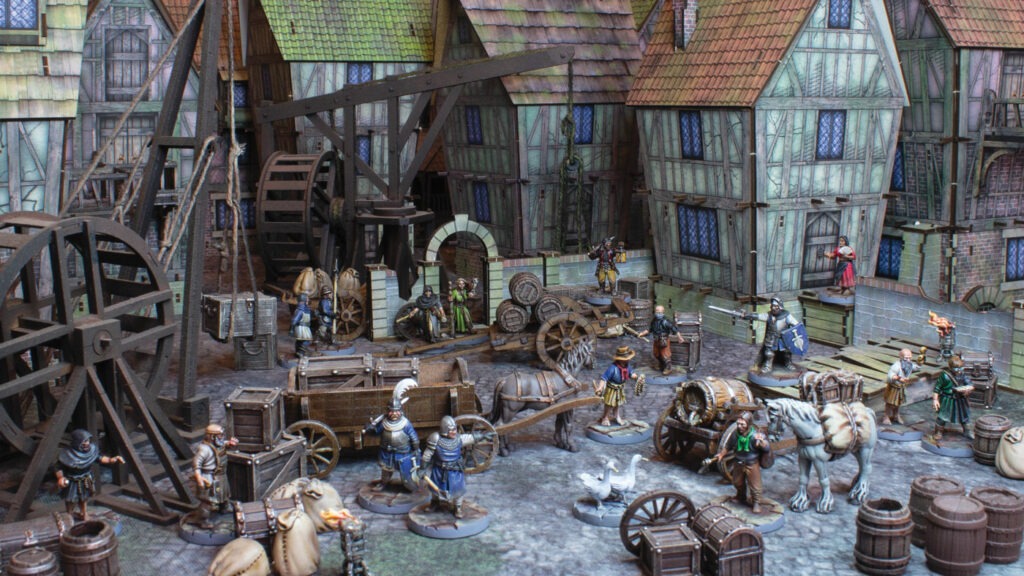
The rules recommend having at least 20 Civilians in play, but 30 or even 40 would be even better, and it’s useful to have extra figures available to manage those entering and leaving the board. Civilians move around as the game progresses, keeping the table lively and changing the layout of the playing area. You can even add carts, boats or other vehicles that might move during the game.
How the game works
A turn
The game uses tokens to represent guard actions, civilian actions, the appearance of Plots and the passage of time—which moves Civilians and brings turns to an end. The tokens are mixed in an opaque container, and players take turns drawing them. Each token offers an opportunity: move a guard, Civilians, a suspect or a vehicle; reveal a new Plot; and so on. Players take turns drawing tokens and activating figures until all three Time tokens have been drawn.
Not every figure will necessarily activate during a turn, but that’s fine. At the end of the turn, all the tokens go back into the container and another turn begins. The game continues until the Mission and/or all the Plots are complete.
Plots
Plots are at the heart of the game. The Mission may set specific conditions for the game, but Plots represent the events unfolding in the city. They require the guards to complete tasks in order to be resolved. These might involve pickpockets stealing from the crowd, food poisoning, buildings on the verge of collapse, or merchants offering a service to guards who come to see them. Plots are the main way to earn Gold Coins and Advances: cards that represent your guards’ history, experience or items gained in return for their service.
There are also Major Plots, which unfold like a quest chain. These are more developed stories, and they may lead to deeper plots that may reveal more about the city’s secrets…
The dice system
As mentioned earlier, the game uses D6s (six-sided dice) to resolve some effects, such as identifying Civilians, but it also uses special dice. These have their own symbols: swords (one, two or even three on a single face), a silver coin or a foot. To take a test, roll as many dice as your score in the relevant ability, adding or subtracting any applicable bonuses or penalties.
The foot will generally increase the distance you can move when rolling for movement.
The silver coin can trigger special effects, depending on the figure’s equipment or special rules.
The swords have two uses. First, they determine success: the system is simple—three swords count as a success; six count as a critical success, which can be useful in combat. Swords are also used to determine movement direction. Whether your guards are wandering until they spot something out of the ordinary or Civilians are milling about, you choose the direction indicated by one of your sword results and send the figure that way—whether you like it or not. It’s a clever system that adds an element of chance and fun while remaining easy to use!
Missions
The core rulebook offers six Missions, each with its own stakes, setting and special conditions. The first, however, is a basic Mission that can be replayed endlessly. This mission, Patrol Duty, lets you explore a district of your choice and play through a Major Plot that serves as the main focus of the game. You’ll need to patrol several times to uncover the city’s many secrets, and every patrol will be different from the last!
The six Missions can also be played one after another—or with Patrol Duty games in between—to form a campaign with its own ongoing storyline. This lets you follow the story as your guards improve.
Finally, Mission 0 serves as a tutorial. It introduces the principles of Plots through a scenario that guides you step by step. It’s a real boon for learning the game quickly and easily!
A city of many districts
As you may have gathered, the game calls for urban terrain. You’ll need buildings, a market square and streets. The scenarios don’t prescribe a particular layout, so you’re free to design your districts as you see fit.
Add details such as crates, carts and market stalls—anything that can bring your city to life. Your games will be all the more engaging for it, and playing on wide-open streets with no obstacles isn’t particularly exciting. Don’t worry about making buildings playable inside: although figures can enter them, you don’t need to model the interiors. A balcony is useful to show where the figures are, but not essential. Arches connecting buildings can also make an interesting addition.
Over time, you may enjoy varying your layouts to represent the wealthy districts, the docks, the ruined quarter and all the other landmarks of the city. I hope your explorations will inspire you to create varied and distinctive table layouts
What makes this game so enjoyable?
How can I sum up everything I love about this game?
First, I really enjoy the semi-cooperative format. We don’t attack each other, but we jostle for position to be the one who completes each task. It makes for good-natured, very entertaining rivalry—and you can also play solo or fully cooperatively.
Second, the Secret cards you uncover during the game as a result of your choices, are a real narrative highlight for me. I’m always eager to find out what’s still hidden!
Then there’s the simplicity of the system: roll as many dice as your ability score; three or more swords count as a success!
Finally, I love the unusual presence of Civilians on the table, along with movable terrain that makes the game—and the table itself—feel even more alive.
That said, some aspects may not be for everyone. Your figures won’t always go where you want them to when they’re simply roving and haven’t spotted anything suspicious, and you have to be willing to accept that. Moving Civilians and identifying them can feel slow or complicated. If so, don’t hesitate to try the alternatives suggested by the designer. Finally, each weapon has its own Coin Effects, so it may be worth making a handy reference sheet listing the Coin Effects for your squad’s weapons.
As for me, I’m completely won over by a game that really tells a story. Whether through the movement of all the figures, the Plots and their twists, or the indirect interaction between players, Every game has made us laugh or surprised us in some way. The fun is definitely there, supported by a simple system that still offers plenty of possibilities. If you enjoy light-hearted games with a strong sense of place, or you’re looking for a change from straightforward combat, give it a go!
Written by:


Stay tuned
And never miss an article again! Join our Discord to get notified whenever we publish something new. You can even choose which games you want to receive notifications for!