 by
Star Wars Legion has a rather peculiar way of handling grenades. In the game, they mostly serve to add a keyword to an attack pool, a function that does little justice to their true potential. A grenade is an area weapon, designed to cause chaos and punish clumped-up units. In this article, I’m proposing a game design exercise: giving grenades a credible way of working, leaning as much as possible on the existing rules.
The problem with grenades today (2026)
The problem with grenades in Star Wars Legion is that they’ve never found their identity. They aren’t thematic, and they don’t deliver the feel you’d expect from such a weapon. A grenade can be thrown from range 1, sometimes even while engaged in melee, without ever hurting its user. Their behavior is very far from reality, which is a real shame.
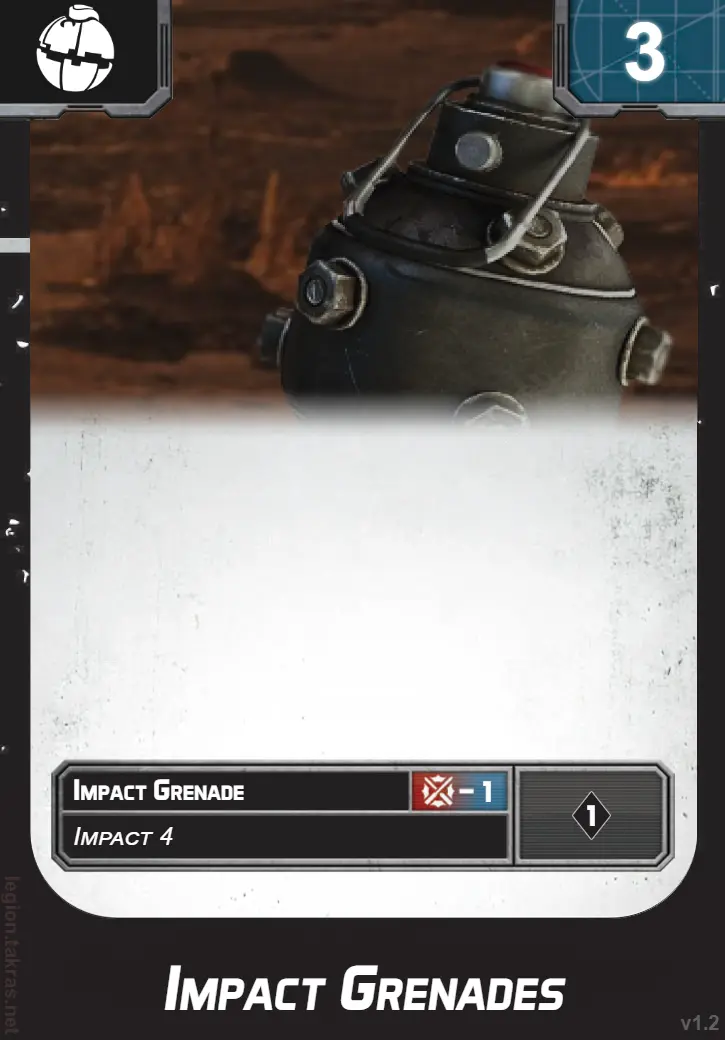
So why such a gap? Because grenades are the product of what we call bottom-up design. I already introduced this concept in my article “What’s Your Problem, Alliance? – Part 1”. In short, the designer first comes up with a gameplay function, then glues a piece of Star Wars fluff onto it. In our case, the idea seems to have been to let you add keywords to your attack pool to punch through enemy defenses more easily. But let’s be honest: the grenade wasn’t the best choice to dress up that function.
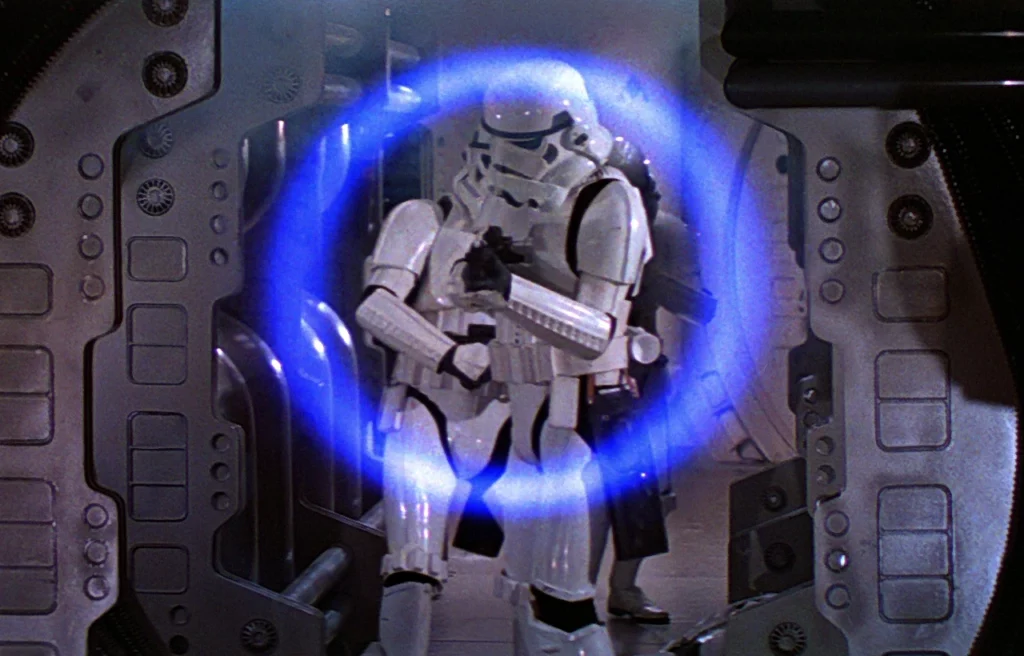
Note that this ill-fitting theme isn’t Atomic Mass Games’ doing: it’s a legacy of Fantasy Flight Games, the game’s original publisher. AMG, for its part, seems well aware of this flawed design, since its latest iteration introduced Overcharged Blaster Packs and Tank Hunting Munitions, anti-personnel and anti-tank upgrades whose role is very close to that of grenades, but with a far more coherent bottom-up theme.
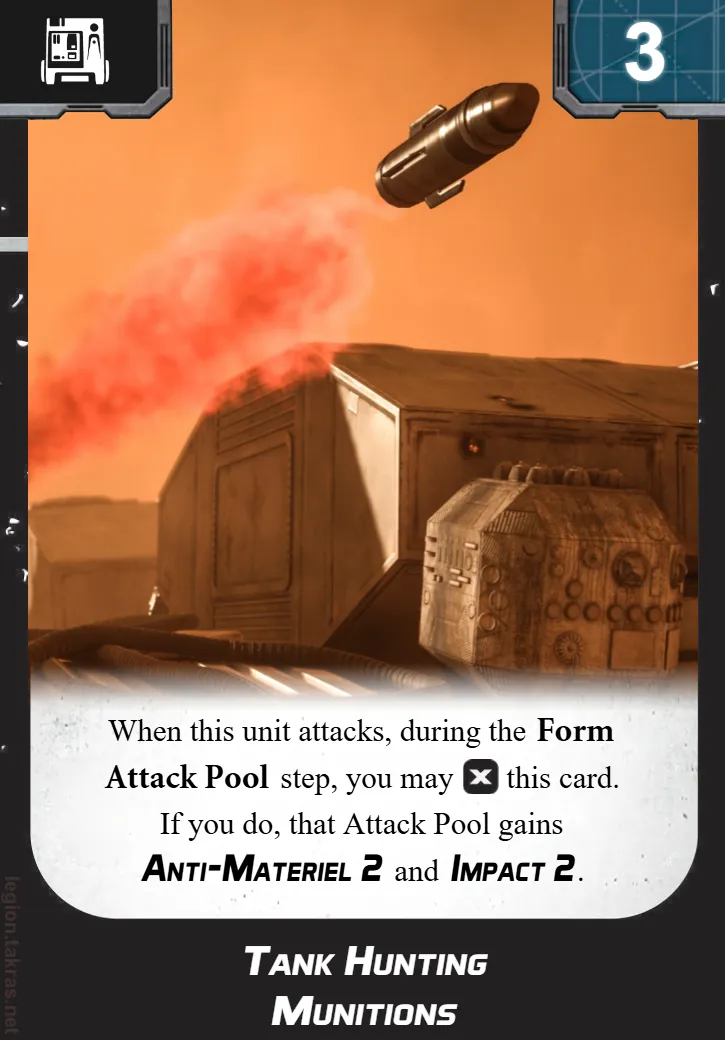
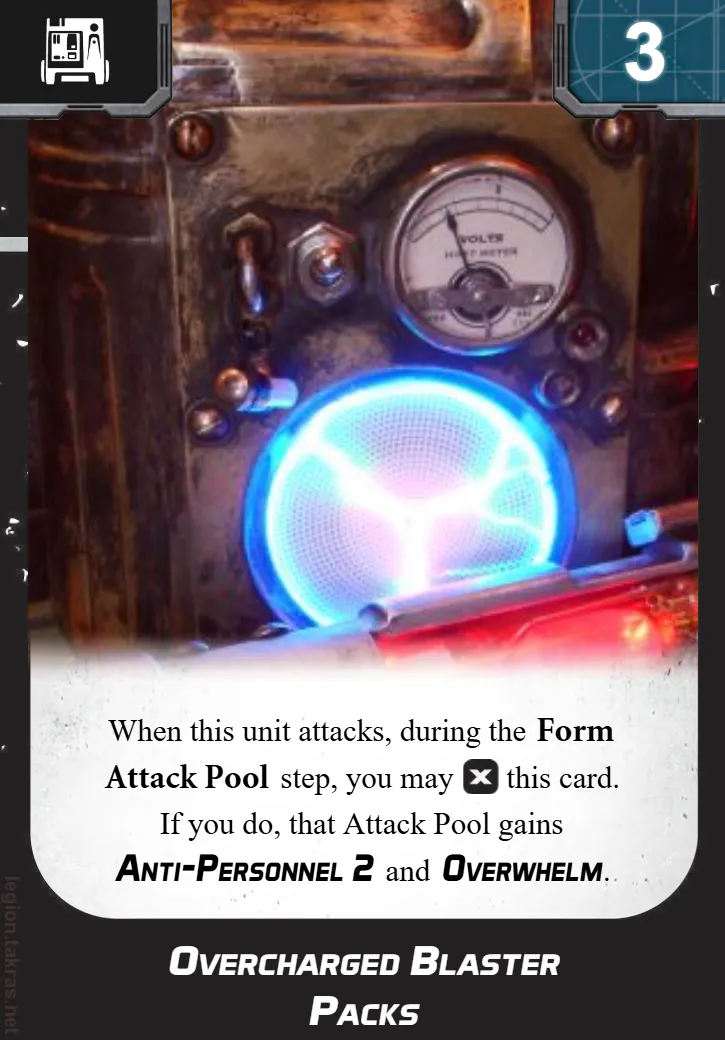
The arrival of these upgrades does create a problem, though: FFG grenades and AMG munitions are now stepping on each other’s toes. Since grenades are the ones suffering from an incoherent theme, it’s up to them to reinvent themselves and find their own role. In this article, I’d therefore like us to design a top-down grenade together: starting from how a grenade actually works and translating it into game mechanics, with a double goal: a credible weapon, and a role distinct from that of existing weapons and upgrades.
What we expect from a grenade
When I hear the word “grenade”, I picture a lobbed arc, panic and an area-effect weapon. I hear a soldier yelling “Take cover!”, an explosion, flying debris, disorientation and a ringing in the ears.
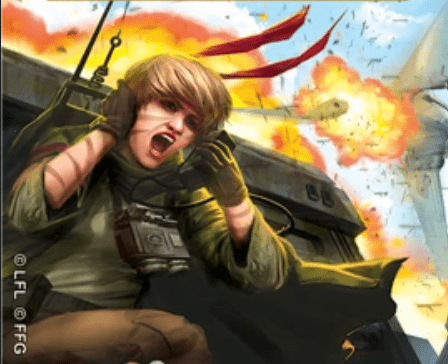
By the very nature of its explosion, a grenade should be particularly dangerous against groups of enemies. Rather than targeting a specific unit, it should affect an area of the battlefield and hit every unit within its blast radius. It would thus encourage players to avoid clustering several units in the same spot.
What already works
They say the best soups are made in the oldest pots, so let’s take a detour through the rulebook to find the mechanics and keywords we can reuse to cook up grenades worthy of the name.
The smoke grenade

In my opinion, the smoke grenade is the best-designed grenade in the game today, because it’s thematic and works in a credible way:
- It doesn’t target a unit but an area of the battlefield;
- It has an area effect;
- It’s single-use.
Let’s keep its design warm for our recipe.
Area weapons and Charge tokens
Here’s the irony: Legion already has a concept designed to describe explosives, and grenades ignore it. Crazy, isn’t it? Since you rarely come across this type of weapon during a game, here’s the official definition of area weapons again:
A weapon with a yellow range icon (1) is an area weapon. When using an area weapon, perform a separate attack against each unit, friendly and enemy, that is in LOS and at the range indicated by the number on the range icon, even if that unit is engaged. Attacks made by area weapons are always ranged attacks.
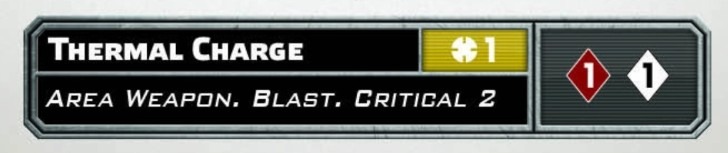
Obviously, this feature is perfect for our grenades. Nothing to change: into the basket it goes, no questions asked.
The Assault X and Spray weapon keywords
The Assault keyword, which expresses the idea that a weapon is more effective at short range than at long range, fits the image of a grenade perfectly: the closer the target is to the point of impact, the more destructive the explosion. Unfortunately, Assault only triggers at range 1, which is precisely the maximum range of our grenades: it would therefore always be active and become redundant. We need to rework Assault, or invent a similar keyword, that only activates at range 1/2 (that is, one half).
Let’s keep the principle of this keyword in mind, but remember that it can’t be used as is.
The Spray keyword, which makes the attack pool depend on the number of miniatures targeted, suits the grenade for a simple reason: an explosion doesn’t choose its victims. The more clustered the miniatures are, the more it hits. That’s exactly how an area weapon that punishes clumping should behave. Grenades and Spray should be inseparable. Spray describes a real effect of the grenade, and by bringing it into our recipe, we’re following a genuinely top-down approach.
The Arm X: Charge Type keyword (and Detonate)
Similar to Smoke 1, the Arm X: Charge Type keyword has you place a token entirely within range 1 and in LOS of your unit leader. The notion of “throwing an object” already exists in Legion, and once again it’s surprising that this feature wasn’t applied to grenades.
Another automatic addition to our basket!
Hit and run

Whether it’s Bossk or Sabine, their Pip 1 cards have an interesting design on several points:
- gaining the Arm 1 keyword for one round;
- a free move after using the action, needed to get away from the token and out of the blast range.
And that wraps up our shopping trip for keywords and effects. I think we can now get cooking on our grenades 2.0.
The proposal: the Concussion Grenade, reworked
Here’s the recipe, fresh out of the oven. Or rather, the recipes: I have two proposals. The first is more simulationist, the second is better balanced for gameplay.
The simulationist version
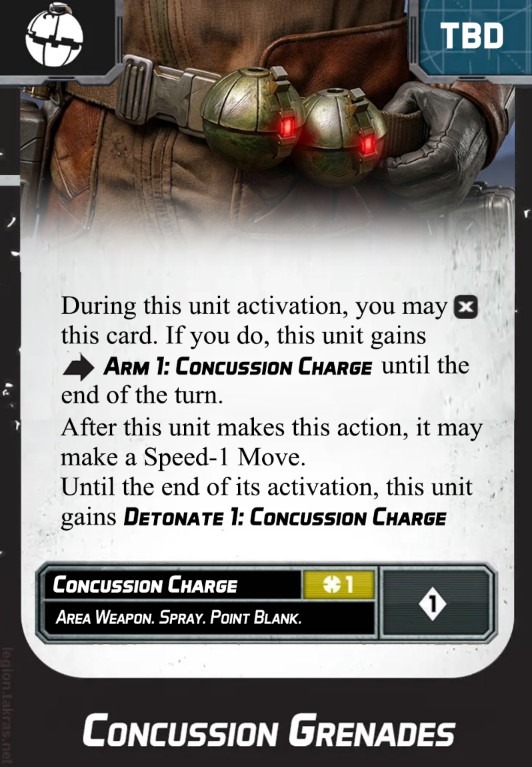
The card’s text is similar to that of Bossk’s or Sabine’s Pip 1, except that the effect isn’t permanent: you can only use the upgrade once per game. When you spend it, you gain the keyword Arm 1: Concussion Charge. This is a new type of Charge invented for the occasion, simply to set it apart from the existing charges. Just like with Bossk and Sabine, after this arming action the unit can make a Speed-1 Move, which is strongly recommended to get away from the blast zone. The unit then has until the end of its activation to detonate the charge.
As for the Concussion Charge itself and its weapon keywords, I’d like to share a few thoughts and explanations:
First, if I’m not mistaken, this is the first time the Spray keyword isn’t paired with Blast. This means the defending unit can benefit from cover against the potentially large attack pool. This choice is driven by top-down design, naturally: a grenade doesn’t strip away your cover. It’s actually the first thing any soldier would look for when finding themselves face to face with a live grenade.
Second, as I explained earlier, since Assault X couldn’t be adapted, I opted to invent a new keyword: Point-Blank. It’s defined as follows:
Point-Blank:
When a weapon with the Point-Blank keyword is added to an attack pool, if the defending unit is within range (1/2) of the charge token and has LOS on the charge token, you may upgrade all of that weapon’s attack dice.
The difference with Assault X comes down to two points. First, the activation distance is shortened: Point-Blank only works if the unit targeted by the explosion is very close, i.e. within range (1/2). Second, it doesn’t upgrade a limited number of dice but the entire attack pool.
Third, to temper the strength of the Spray keyword, the attack pool is made up of white dice that don’t convert surges. Each die therefore has a 1-in-4 chance of hitting beyond range 1/2. Point-Blank improves those odds with a black die without surge conversion, for a 1-in-2 chance of hitting when the target is within range (1/2). Once again, this is a choice driven by top-down design: soldiers with a grenade at their feet are more likely to kick the bucket than their neighbors standing farther away…
An example in play
In the illustration below, I’m offering a concrete example of the reworked Concussion Grenade in action.
The Fleet Trooper is the last survivor of his squad, and he’s equipped with a Concussion Grenade. During his activation, he first makes a move toward the Pykes. For his second action, he decides to spend the Concussion Grenade card. He thereby gains the action Arm 1: Concussion Charge, which he uses immediately. The Fleet Trooper places the Charge token at range 1 of his position and makes sure the enemy Pyke unit is within range (1/2) of the Charge token. Having used the Arm 1 action, the Fleet Trooper is allowed to make a speed 1 move, as stated on the Concussion Grenade card. He uses it to get into cover.
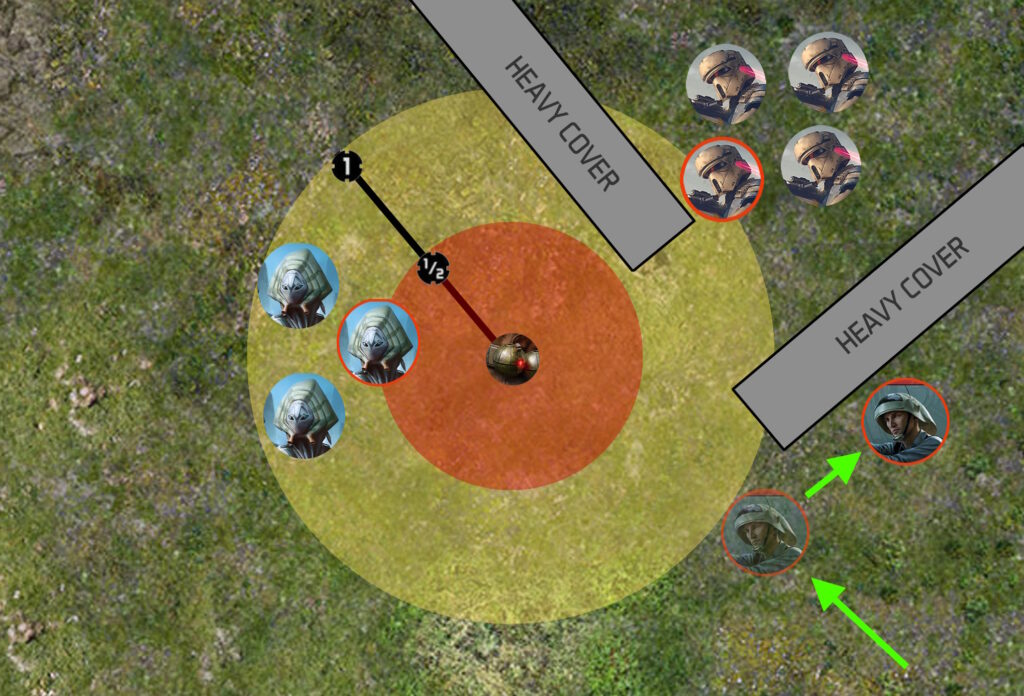
Before the end of his activation, the Fleet Trooper decides to detonate the grenade. Since both the Pyke unit and the Shoretroopers have LOS to the token and are within range of the area weapon, two attack pools are created:
- A pool of 3 black dice against the Pykes, since the unit is within range 1/2, so the Point-Blank keyword can be activated;
- A pool of 4 white dice against the Shoretroopers, who benefit from heavy cover.
If a pool produces at least one hit, the targeted units receive a suppression token, as is normally the case after an attack.
The more balanced version
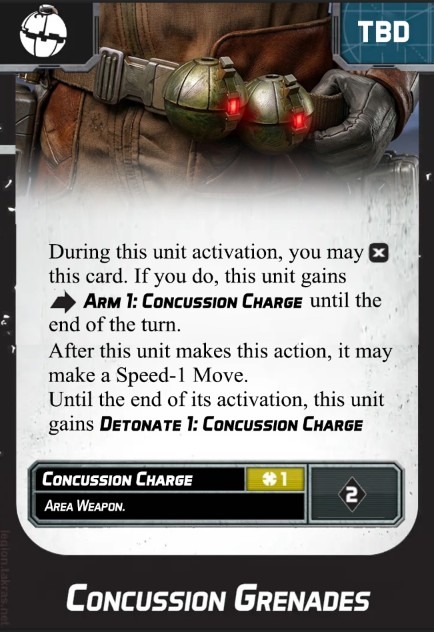
In this version, it’s simply an area weapon, with no other keyword attached. The grenade generates an attack pool of 2 black dice for each unit within range 1 and in LoS of the charge token, which averages out to 1 hit per pool. No Blast keyword neither, defending units can benefit from cover.
Why those grenade redesigns would improve Legion
In Legion, effects and keywords work like yin and yang: each has a counterpart that cancels it out. Armor has Impact, the Dodge token has High Velocity, Pierce has Immune: Pierce, and so on. But what counters clumping synergies? Beam X tries, but its impact remains anecdotal. The result: units packed tightly together enjoy their bonuses without really paying the price. The recent emergence of the Fire Control upgrade is yet another example of a tactic that’s hard to counter.
That’s precisely the place the grenade could fill. With the reworked design, it would fulfill a mass removal role, a mechanic still rarely seen in Star Wars Legion. This role is particularly interesting for the meta, because it introduces a natural constraint on two types of lists: those with high activation counts and those that take advantage of having their units close together. Think of the Teamwork, Inspire and Calculate Odds keywords, the Clones’ ability to share tokens, or Droid units with their Coordinate keyword. These are all synergies that reward clumping, and the grenade 2.0 would be an effective counterweight.
On top of that, the new version of the grenade opens up other possibilities. First, the profile cards of Commanders and Operatives could be revised to let them take grenades. Right now they can’t, because the current grenade is never appealing for characters who would never trade their multi-dice attack pool for a single die. The new version, on the other hand, offers an interesting offensive alternative, with the ability to generate multiple attack pools.
Giving every faction a universal way to generate several suppression tokens in a single activation is appealing too, and it makes the Bring Them to Heel secondary objective a viable option for all factions.
The limits of the new models
This new version has its limits too. First, Arm X and Detonate X are two separate events, and they don’t target a specific Charge token. A unit could therefore arm a grenade without detonating it, and let a second friendly unit, also equipped with grenades, take care of it in its place, at a more favorable moment or from a better position. That isn’t a gameplay problem as such, but the top-down design isn’t really respected if grenades are used this way.
Second, the free move that follows the Arm X action can create synergies worth watching, particularly with keywords that trigger after a move, like Snowtroopers’ Steady. I haven’t been able to test these interactions on the table, and they would need real playtesting before going any further.
Need advice building your army list?
Join your country’s Star Wars: Legion Discord community and get answers to your questions.
 Join international
And you, what design do you prefer ? Or what would you propose?
Tell me about it on Touche Critique’s Discord. I’d be delighted to add a section to the article with your proposals as a point of comparison!
Written by:


Stay tuned
And never miss an article again! Join our Discord to get notified whenever we publish something new. You can even choose which games you want to receive notifications for!