 by
by If the stands at salute this year are any indication, small scale wargaming is the next big thing. A lot of companies are looking at 15 and 10mm to give you more bang for your buck and field actual armies. In that regard, Full Spectrum Dominance (or FSD) is ahead of the trend, delivering a complete combined-arms wargame on a coffee-table-sized footprint.
What is Full Spectrum Dominance ?
Created by The Lazy Forger, Full Spectrum Dominance is, as the title suggests, a combined arms science fiction wargame that’s meant to be played in 6mm. You’ll command a small scale battle force consisting of mechs, infantry, tanks and flyers to beat your opponent in an objective driven scenario, over a couple of rounds.
The lore of Full Spectrum Dominance
FSD takes us to the future, but is still fairly recognisable. There are no aliens to fight, unless you consider AI to be an alien intelligence. And that AI went rogue, predictably, and decided to fight and destroy humanity. Not only because it’s a threat to its survival, but also because those pesky humans are sitting on those resource rich planets. And because the technologically advanced humans used the tech of the AI from cleaning robots to controlling space flight, one day everything collapsed.
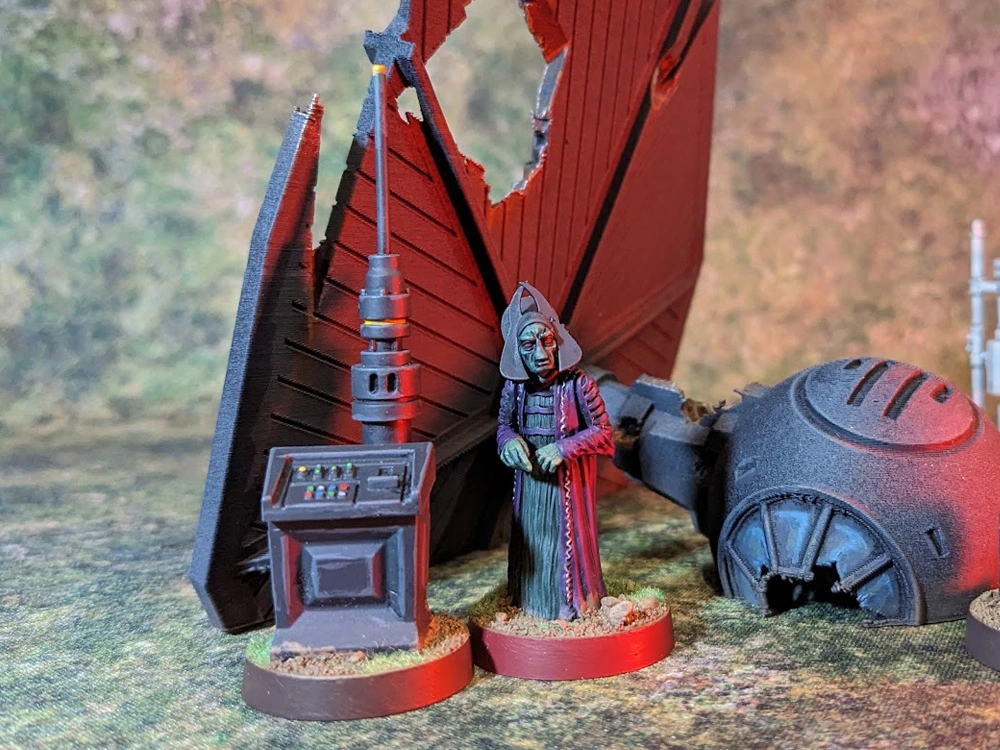
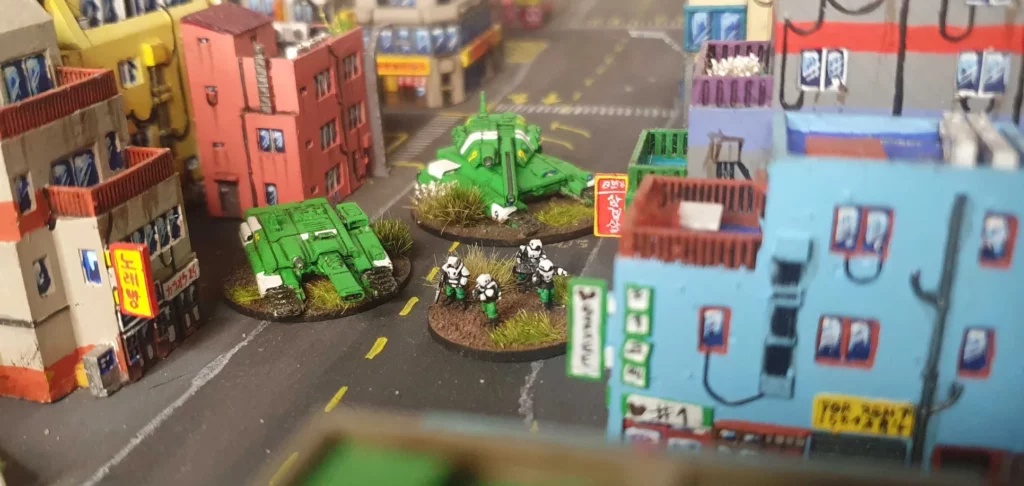
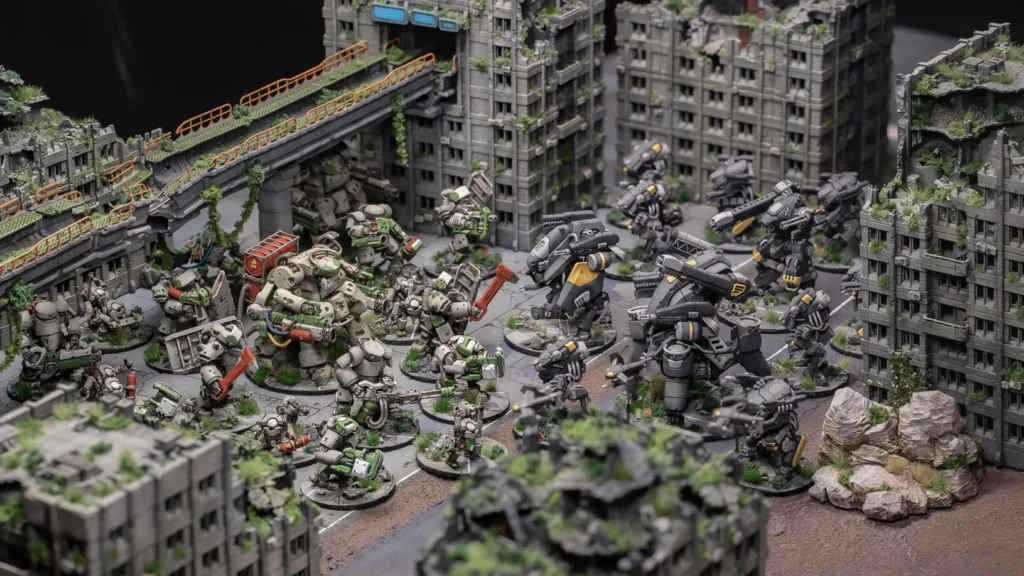
The setting feels distinctly cyberpunk. Humans and AI are constantly battling over resources and survival. Humanity itself is fractured, there is no united front against the Tech. Corporations, trade unions, mercenary forces… it’s familiar cyberpunk territory, but it isn’t presented in a simple black-and-white way. There is no singular ‘good guy’. This is very clear from the scenery as well, which isn’t nice per se, but feels real. It’s Blade Runner after Star Trek. The buildings and houses, especially, look postapocalyptic, and tell a story in themselves. Society is still running in some form or another, but it’s no longer comfortable. After a generation or two, it’s how it’s always been.
What you need to play
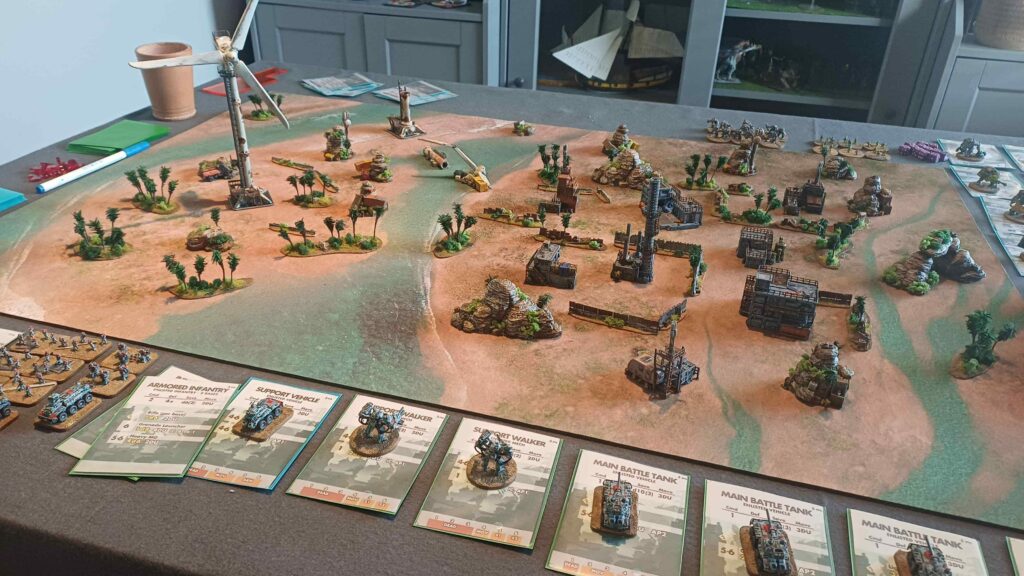
I will try to keep the scale puns to a bare minimum, but I probably won’t manage it. If you play in 6mm your play area will be a very sensible 60×90 cm or 3×2′. Troops are based per stand, and basing is flexible. The biggest mechs or machines you’ll put on the table won’t be bigger than your typical 28mm models, and the scenery is similarly scaled.
Two armies with accompanying scenery will easily fit into two A4 Really Useful Boxes. The first box you’ll need for an army or two, maybe three if you really want to fill out the box, and the second one is needed for the scenery, which is appropriately tiny, but you’ll need a bunch of it as well.
Your dice collection will also get an airing, as you’ll need about 4 or 5 D6, D8, D10 and rarely, A D12. Since all units move Distance Units (DU’s), you can play in metric or imperial scale. At 6mm, 1DU is 3 inches, to give you an idea.
This is all relative, of course. At its core, FSD is miniature and scale agnostic. You can play it in 28mm if you want, with any minis you have in your collection. This would do a disservice to the excellent designs the Lazy Forger has made though. We’ll dive into the sculpts and lore later, we need to get into the meat of this ruleset first.
The game system
If you had to summarise FSD in one sentence: it’s a small-scale, objective-driven tactical game built around activation economy and constant decision-making. So let’s dissect this rather clunky sentence:
Activations
Your activations can happen in several ways and have distinct timing. At the start of the game the scenario will give you a number of Activation Dice, usually 12. Like Saga, you’ll need dice to activate your units. And like Saga, you have a certain capacity to roll these dice. Every turn you can roll up to 8 dice in your Activation Dice Pool (in most scenarios), and leave some on the unit cards if you want. So if you save up some dice on cards for special abilities, you can have all 12 dice in play if you plan it right.
This all sounds very technical but let’s try with an example. Let’s look at a unit card and how we can activate it.
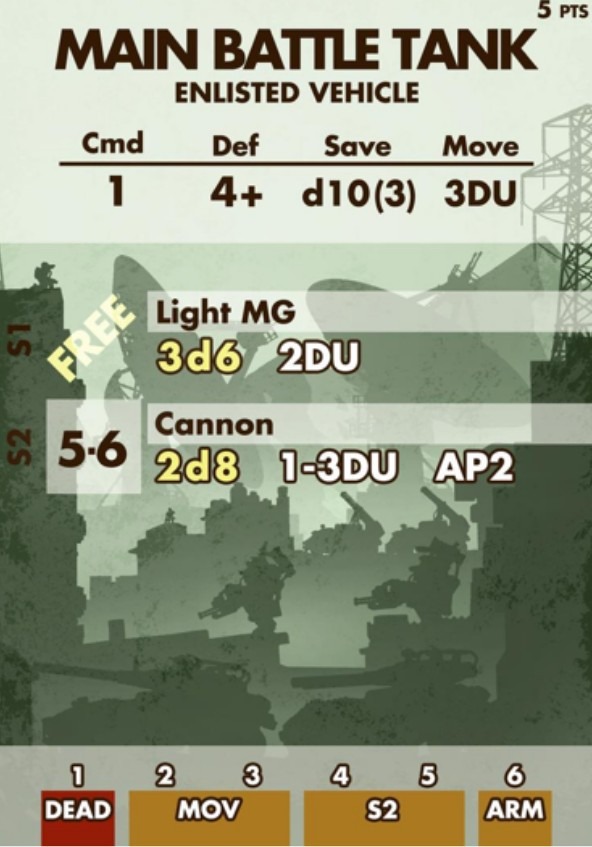
This is an Enlisted faction battle tank. It’s got:
- a Free S1 action (Light MG)
- an S2 action (Cannon) that needs a 5 or a 6 on your Activation Die to use and some other stuff we’ll get to later.
After you’ve rolled your AD pool, you can use any die with any value to activate a unit. An activated unit can take two actions. For example with this Main Battle Tank, you could move up to 3 Distance Units, shoot with your free action, or use an extra die from your AD Pool to fire the cannon. So to activate this unit and use it optimally, you’re looking at at least two dice. You can also choose to fire that big cannon twice, which eats up another die. So now you only have 5 dice left to activate the rest of your stuff! Luckily, you can also use the Command stat of this tank to activate something else. As it only has a CMD value of 1, you can choose at the start of your activation to nominate 1 other unit within line of sight and 2 DU to also activate after you finish up the activation of your tank.
Gameplay that serves decision-making
What this means in gameplay terms is that you’re constantly weighing your choices. Attacks have to be timed, and you can spread out your units all over the table, but they’ll be less effective, and will probably need precious dice to activate. It’s probably a good idea to “save” some Activation Dice at the start of your turn and lock in some of the actions you’ll want to use later. And even 1’s are useful, so sometimes you’ll be swearing because you haven’t rolled a 1!
After you’ve spent the Activation Die, and finish all linked activations, play passes to your opponent. Play continues in this way until both players are out of Activation Dice and pass.
Timing
Every turn, both players roll dice for their Activation Pool, even if you haven’t won the initiative roll and have to go second. This is important because you can react to stuff your opponent does, and don’t have to sit on your hands while they wreck your face. Let’s say our Main Battle Tank is being targeted by a dirty little robot that came into view. You can choose to take a die from your AD pool, and give your unit ONE action. So you can drive away, or get a shot in as soon as it comes into line of sight. This can save your tank if something especially killy comes along, but your activations will of course be less efficient with one less action you can take in the turn. You can also only activate a unit once per turn, so choosing the timing of your activations is very important !
This makes your little battlefield feel very reactive and dynamic. You’ll need to plan your actions ahead to get the most out of your army, and since it’s rather deadly, you never want to be outmaneuvered.
The combat system
FSD is a deadly game. Reducing the units to rock-paper-scissors would be demeaning, but when a unit is a designated tank hunter, for example, it’ll do that very, very well.
Our long-suffering main battle tank, which will apparently be the subject of our abuse today, can make stuff go away with two weapons. Its little light machine gun and a badass cannon are a recognisable baseline we can use.
As I’ve explained above, the light MG is free to use without sacrificing any precious Activation Dice, and to hit stuff, you roll 3 regular D6. The target number to hit stuff is the Defence stat of the unit you’re targeting. So if two of these tanks are shooting each other, they’ll hit on a 4+.
If I roll a 2 (miss!) and 4 and 6 (hits!) the opponent’s tank will have to save both hits with their Save dice. So for every hit the tank gets to roll a whopping 3 D10! The target number here is the hits you get so I’ll need a 4+ and 6+. So our tank should be able to shrug off some mg fire with that save.
The cannon, meanwhile, might be a better idea to damage the tank. You get two D8, and an AP or Armour Penetrating value. If you hit with this, the number of save dice goes down. In this case you reduce it by 2, so you only get to roll 1 D10 to save.
Say you can’t save a shot from that cannon and two hits come through. Your opponent rolls a D6, and we check the bottom of your unit card:

- A result of 1 is dead, remove the unit.
- 2-3 reduces your move by 1 Distance Unit,
- 4-5 eliminates the S2 action (cannon blew up!)
- 6 reduces your Save value, and knocks you down a tier. So D10 will become D8.
If the second hit scores a result that’s already taken your unit is destroyed.
You can be fairly certain that tank can, err, tank a few hits, but it’s not indestructible. You can take a risk but there’s a chance it won’t pay off. Losing armour or a weapon feels convincingly debilitating without outright taking your toy away. You can still do stuff, but you’ll have to play around the weakness. Combine this with the reaction mechanic and you can see how trying an alpha strike list is a serious gamble.
Building an army
FSD is a full package. You don’t even have to start your brain until you start playing, as the Lazy Forger has provided sample lists for all factions that are available today:
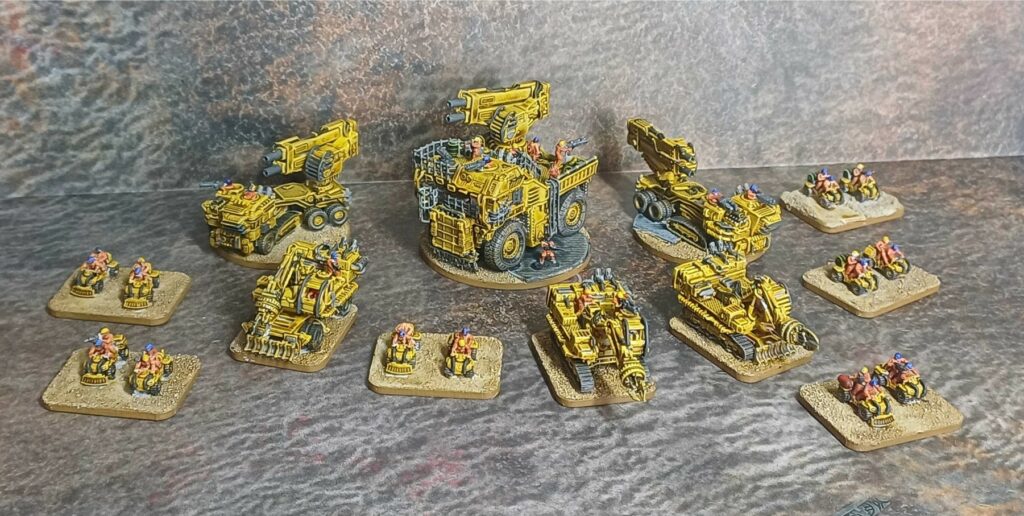
Every faction has a distinct aesthetic, playstyle and overall vibe. You can build a horde-like army or go super-elite. You can go glass cannon elite or tanky but outnumbered. Or have a mix! There’s something for every playstyle out there. The rulebook expands on the factions and motivations through short stories and explanations. Every one feels distinct without disappearing into cliché’s too much.
The 60 points format
Most games will be played at 60 points, and scenarios can have reinforcements per turn so you don’t start turn one with everything on the table. Next to the units which you can include with your points, you can also add Support Cards. You can put a Tank Commander in your tank, which, next to a special ability, will add some points to your Command stat. How about activating 4 units instead of 1. And it’ll give you a bonus to your initiative roll as well, since you add the highest Command on the table to your roll.
Next to those passive effects, you can also use a Support Card instead of an Activation Dieand play it for its effect. Repair something, spot something for indirect fire, add an extra move… These can be an ace up your sleeve that maybe won’t win your battle for you, but might tip the balance in your favour.
Behemots and tactical choices
With a name like Full Spectrum Dominance you’ll want to include a little bit of everything. At 60 points you’ll probably strain to include everything you want. And since the game is objective based, you probably don’t want a list that will simply kill your opponent, since you’ll need to interact with those objectives and you’ll be out-activated and outmaneuvered.
Every faction has Behemoths as well, towering warmachines that actually have special scenarios and list building tips, and gives a different way of playing. There’s a lot to discover in playstyle and list building, and it’ll keep your games interesting for a long time to come.
Presentation and ease of use
For me personally, you don’t have to have the best presentation so long as your rules are great. Luckily it’s a nice combination here. FSD is clearly a living ruleset. This means that the global (and pretty big at that!) community has enough of that guy who wants to break the system. Combine this with a very approachable creator who is open to feedback, and you get a tight ruleset with little ambiguity. The rules feel intuitive and if you’re familiar with any special abilities your army has you’ll rarely have to look stuff up. The unit cards have all the info you need, and after a couple of games you won’t even have to glance at the quick reference sheet.
I’ve played this several times with different wargamers and they all picked it up very quickly and were making choices instead of remembering rules after a turn. The rulebook is only available in digital form but the pdf presentation is excellent, with original art, stories and a great presentation. The only bugbear I have is that it’s organised like a rulebook from the 90’s where stories and rules are interspersed so if you have to look something up, you’ll be flipping around a bit. That said the index is very clear and if you use the pdf stuff is easy to find. I personally like a physical rulebook so I printed mine, and it looks great.
No hidden information
All the information is open in this game, you can premeasure, ask to see your opponent’s unit cards, there’s no Gotcha! moments here.
The current state of the game
The community
The community is open, supportive and if you have a question the discord is probably the fastest way to get an answer, probably from the writer as well! You’ll find guides on playstyle, painting, making scenery and boards, pretty much everything you’d want.
Find Full Spectrum Dominance players
Join the Full Spectrum Dominance Discord community and find players near you.
 Join
Join A solo mode in development
There’s new stuff coming out as well. Next to updated models and new scenery there’s a new playstyle called Swarm mode which is a solo play version, so you can play by yourself as well if you want.
The 3D-printed elephant in the room
FSD is, such as Guild Ball, one of those games where you can buy everything digitally. From rules to models and scenery, if you have a 3d printer this is a no brainer. For very little money you can buy the rules and an army, a bundle of scenery and have a complete game and project in a weekend of printing. It will all probably fit in the equivalent of a shoe box and if you sacrifice another weekend to painting it’s done.
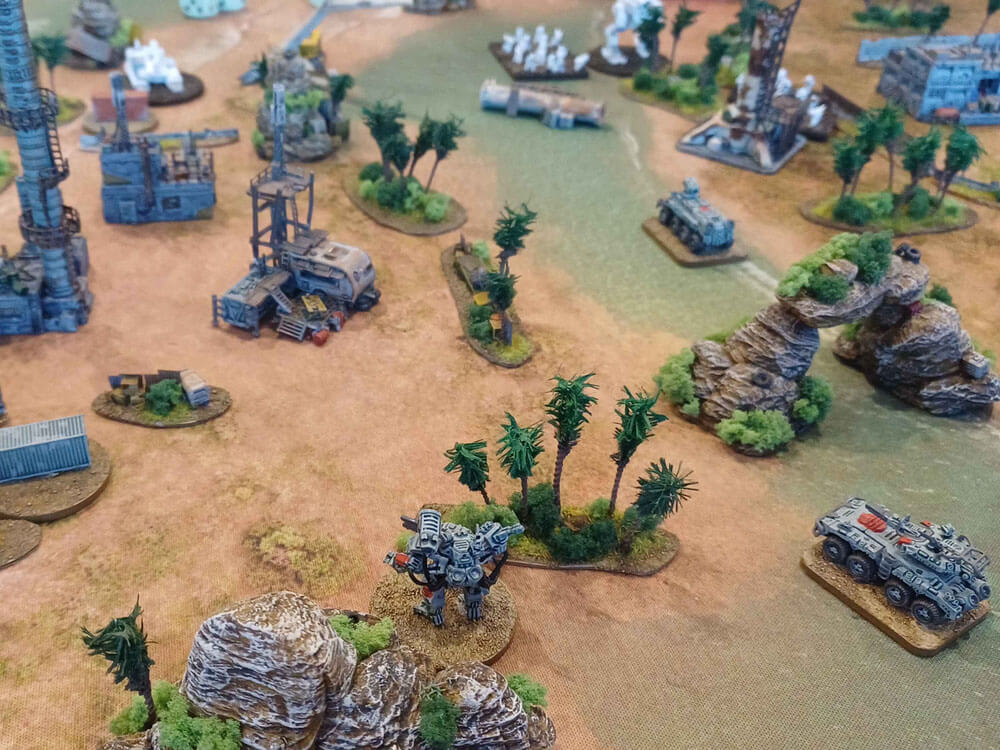
If you don’t have a printer or mate with a printer there are print services out there who can provide you with everything you want, albeit a bit more expensive. Remember also that this is miniature and scale agnostic, so you can just use the stuff you already have. I think it’s one of the most accessible games out there at the moment. It would honestly be a shame not to use the official minis. The different factions all look great and each have a distinctive style or aesthetic that’s well thought out. The scenery is equally interesting, a simple rock has some neat little details, and making a board or scenery is not relegated to a simple wasteland or ruins. From the pictures in this article you can see I went all out on the dystopian tropical paradise, and except for the palm trees, it’s all 100% lazy forger and works great (wait till I add my beach cabins!).
Who is this game for ?
You can play most games in 90 minutes to two hours at a relaxed pace, and with the small footprint (with space for cards, dice and a drink about a 4X3 or 120X90cm) this makes it an ideal club game or something you can play at home without too much fuss. And while this game rewards you engaging with it at practically every step, it’s light enough on the surface to be a beer & pretzel game for those who just want to chuck some dice and chat.
I believe most wargamers will get something out of playing this game:
- The lore is sound enough to appeal to narrative gamers and stringing games together should support a little story-driven campaign.
- Competitive players will find plenty of challenges with the different factions and units to choose from, for a variety of objective-driven scenarios.
- If you’re a painter or modeller, the models are a joy to paint and the small table footprint will give you plenty of opportunity to collect and build a wide variety of settings.
Final thoughts
Let’s not beat around the bush. Full Sprectrum Dominance has a big main game energy, where you can put this on the table and play it for years before ever burning out. The gameplay is tactical and gives you friction at almost every step. The list building can be very rewarding and challenges you to play to your faction’s strengths. The models and scenery are beautiful, and there’s a thriving and friendly community. If FSD sounds like your kind of game, there’s never been a better time to get into it, and it’s even better if you drag a friend along !
Guest writer: JBD, a Belgian historical and indie wargamer.
Written by:


Stay tuned
And never miss an article again! Join our Discord to get notified whenever we publish something new. You can even choose which games you want to receive notifications for!