
 by
by If you enjoy combat sports set in roaring arenas, where athletes love to show off and taunt their opponents, then Hexadome Legends might be just what you’re looking for. Step into the role of a team coach, draft your legendary fighters, and build powerful synergies within your team as you battle for victory. Let’s take a closer look at this futuristic sports game!
This article is based on a copy of the game that Corvus Belli provided to us free of charge as part of a press relationship. This does not grant any oversight over our editorial content: Critical Hit retains full independence and our opinions remain free and objective.
Hexadome Legends: game description
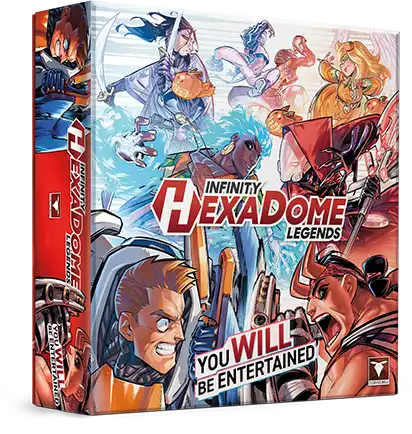
Hexadome Legends is a futuristic sports arena game that pits two teams of 4 fighters, called Legends, against each other in the Hexadome, cheered on by the crowd. Just like our real-world combat sports, there’s a real culture of swagger and showmanship here, with characters sporting strong personalities, some brushing right up against insolence with their overconfidence.
Hexadome Legends is published by Corvus Belli, the publisher behind the skirmish game Infinity, and that detail matters, because this arena game takes place in the same universe. We’re plunged into a setting around the year 2200, taking part in an epic sport called Aristeia. I won’t dwell too much on Infinity’s lore here, since we’ve already covered it in our review of the game.
The comeback of Aristeia!
Hexadome Legends is the update to the 2019 game Aristeia!. Think of it as a V2 of sorts, with the game’s name, character profiles, rules, and components all reworked to deliver an improved experience.
Objective of the game
The objective in Hexadome Legends depends on the scenario being played. That said, while there are four different scenarios, all of them will have you capturing zones on the arena board. To give you an idea, the game board is laid out in 6 numbered zones (1 through 6), plus a 7th called the central zone.
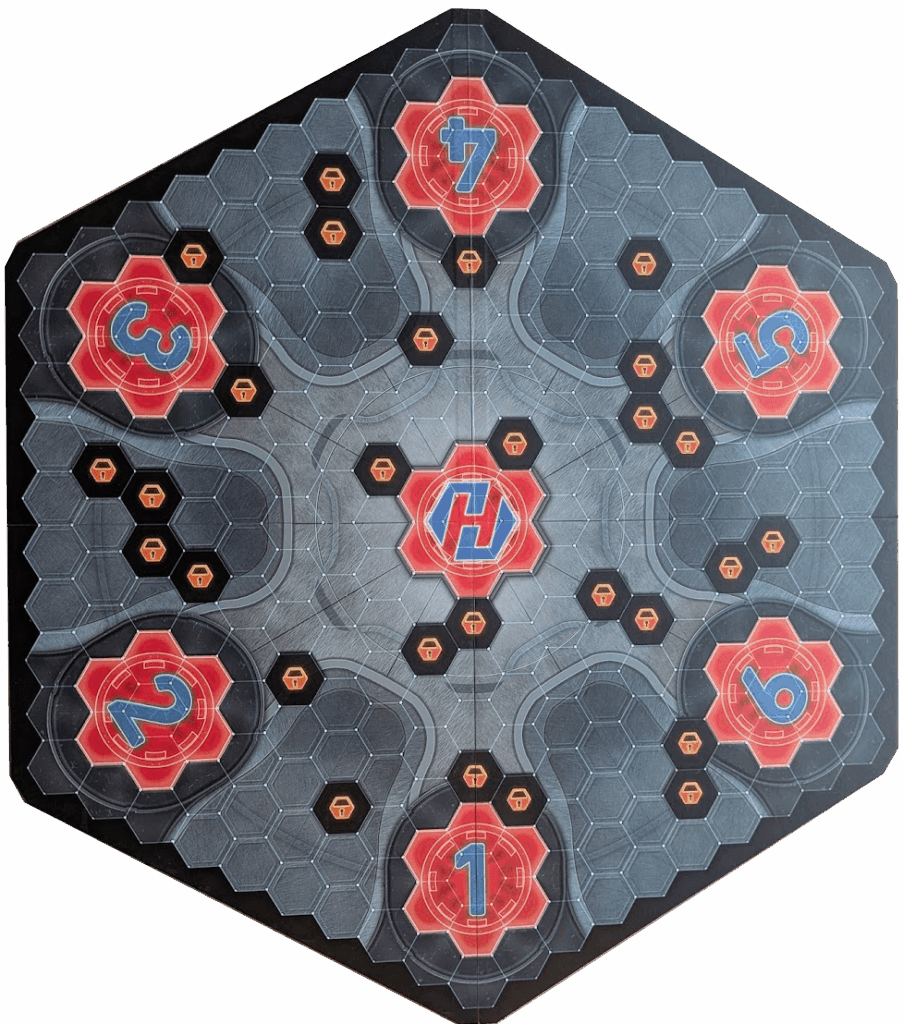
To control a zone, a player must have more fighters than their opponent in that zone. Controlling a zone earns you points. The game ends at the end of the fifth round, or as soon as a team reaches 8 victory points (whichever comes first).
Let’s take the Scorched Earth scenario as an example. Here, the zones you need to capture shift with every round. In round one, the central zone is the one to control: it becomes what’s called the active scoring zone. In round two, a different zone becomes active. And so on for the following rounds, with one extra constraint: the new active zone must always be different from the previous ones.
This moving-objective principle is one of Hexadome Legends’ greatest strengths. You’ll find it in the other scenarios too. Here’s a quick rundown of each:
- Assault: a single active zone per round, which changes every round.
- Scorched Earth: same principle as Assault, but the active zone must always be different from the previous ones each round.
- Conquest: 5 permanent active zones. If your team captures a zone at the end of a round, it belongs to you until the end of the game (even if your fighters leave it) or until an opponent recaptures it.
- King of the Hill: the only active zone in the game is the central zone, and every fighter sent to the infirmary from that zone earns the opposing team 1 point.
Except for King of the Hill, these scenarios force your characters to stay constantly on the move. This is where the sports theme really comes through: the game keeps up that sense of urgency you get in real sports, where you need to score before the clock runs out. Every fighter tips the scales in their own way: some lock down chokepoints or slow the opponent, while others launch their teammates forward to snatch that decisive position!
Which raises an obvious question: who should you field to win?
Building your team
Arena games usually make you pick a “warband,” a predetermined roster of fighters, sometimes with an alternate for one or two characters. Not so in Hexadome Legends: here, you can combine any characters you like. That’s the game’s second big strength. The Hexadome Legends core box gives you 8 fighters, which in theory works out to 70 possible team configurations! I say “in theory,” because in practice not every combination will be equally effective.
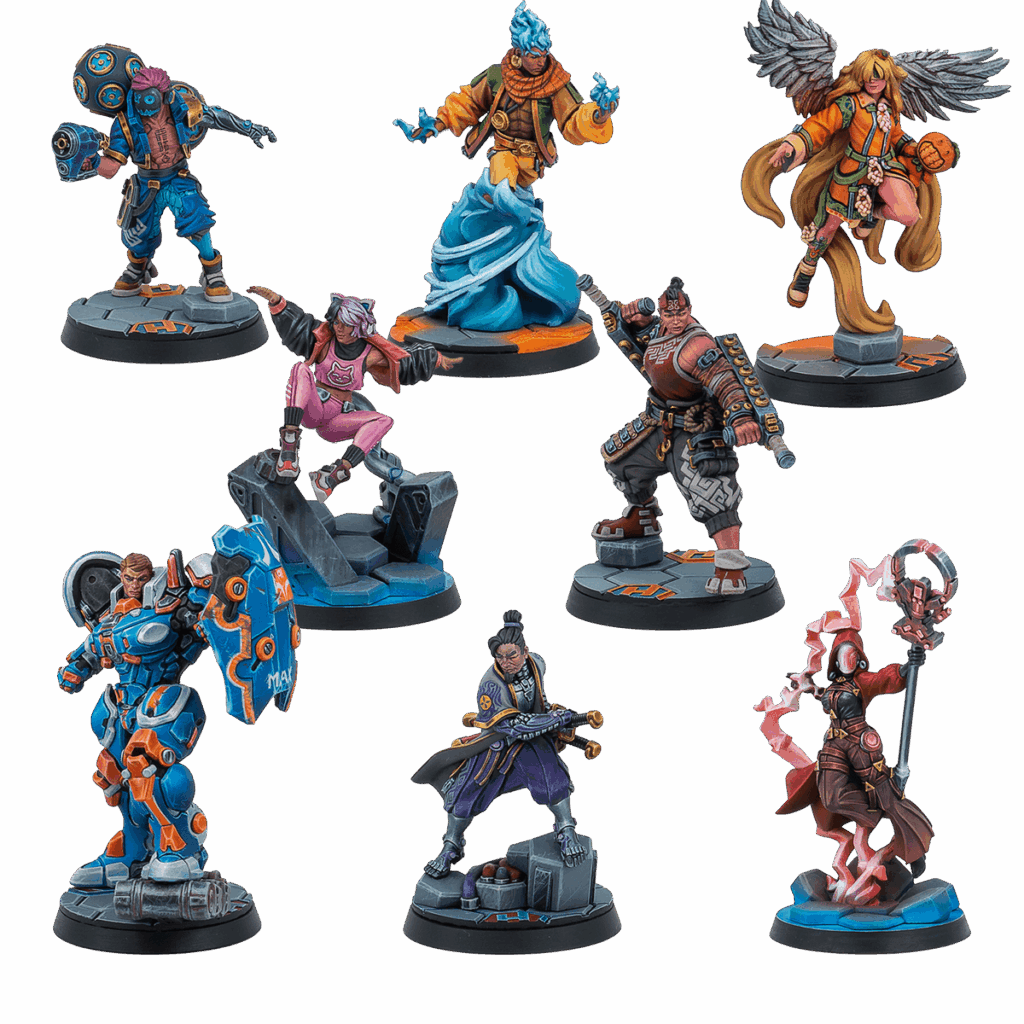
Every character has a unique profile. Some shine as team support, others as tempo control, and others as brawlers (melee or ranged). For example, Djin Afara is an evasive fighter, able to teleport from one edge of a wall to another. He covers huge distances fast, making him especially dangerous in scenarios with shifting active zones. Miyamoto Musashi, on the other hand, is built for close-quarters combat. Under the right conditions, he can chain together several free attacks!
So building a team really comes down to finding the right balance between “classes”: go all in on speed? All in on damage? A mix of the two, leaning more on movement support? It’s up to you to experiment!
Draft your team!
Note that if you’re playing this at home, the rules invite players to draft their fighters in turns: the first player picks a character, then the other player picks one. You keep alternating until each player has built their team of 4 characters.
If you’re not comfortable with that (which is perfectly normal if you’re new to the game), the starter booklet offers two preconfigured teams. Phew!
The activation system
Hexadome Legends runs on an action point system. In other words, when a character activates, it receives a budget (⚡️) of points to spend on various actions.
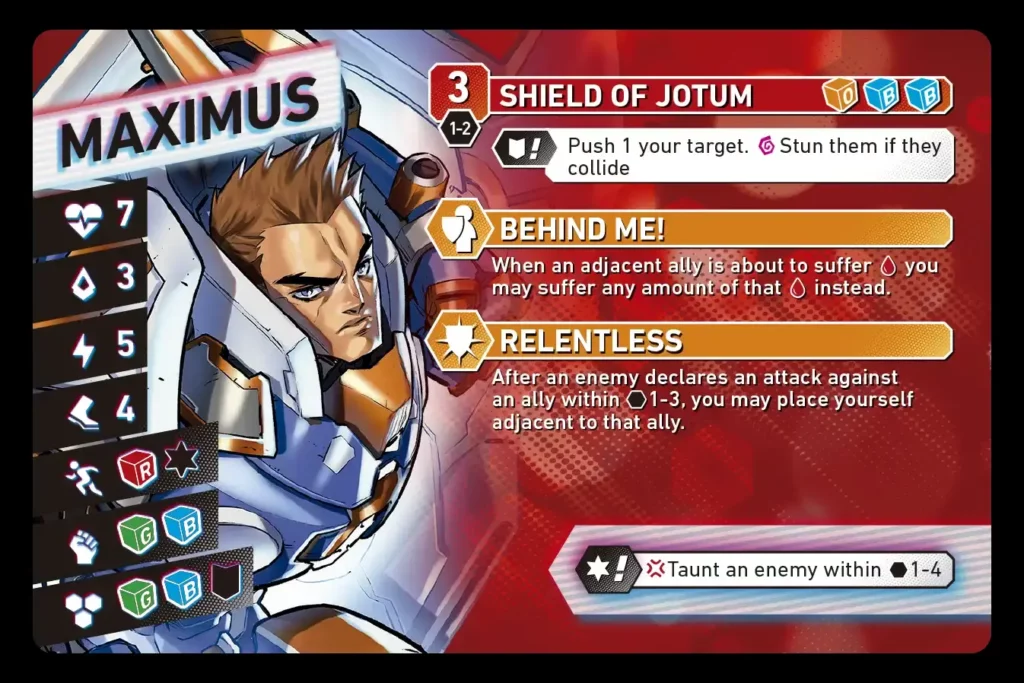
Take Maximus as an example (see image below): on activation, he gains 5 action points (⚡️). If he wants to use his Shield of Jotum attack, that will cost him 3 action points.
Action point systems aren’t new; you’ll find them in plenty of board games, like Zombicide, for instance. It’s an effective resource-management system, particularly for guiding the player in understanding how to use a character: by giving certain actions a high cost and others a low one, the player quickly picks up on how a character is meant to be played and which of its actions are the most powerful.
The catch with this system, though, is that you spend your time calculating your budget while also trying to execute your tactics. When there’s only one resource to track, it’s manageable, but as soon as you add a second one, it gets a lot more mentally taxing. And that’s unfortunately the case with Hexadome Legends, which introduces a second resource: movement points. You get movement points by spending action points (2 action points for 4 movement points, for example). When I say it gets more mentally taxing, it’s mainly because the two resources overlap constantly, since you’re not required to spend all your movement points before starting another action. On top of that, as the game goes on, various effects will add or subtract these resource points, requiring even more attention.
Back to Maximus for an example: with his 5 action points (⚡️), he spends 2 to gain 4 movement points (👟). He uses 1 to move forward 1 hex. He then spends 3 action points to use his Shield of Jotum attack. Finally, he uses his last 3 movement points to move 3 more hexes. But Maximus could just as easily have been under an Immobilized status, which would have reduced his movement points by 1, and if he’d just come back from the infirmary, he’d have lost some action points too. Players can easily get their wires crossed doing this math.
That said, the end result is fluid gameplay: being able to slot actions into your movement is tactically interesting and enjoyable to play.
As for the actions themselves, there are several types: moving, attacking, or using a special action listed on your profile card. Some actions require you to roll dice to determine their effects, while others apply their effects immediately. While some characters also have passive abilities, all of them have a talent, which triggers as soon as your character rolls the right symbols on their dice.
Which brings us to HexaDome Legends’ third big strength: its combat system built around proprietary dice!
The combat system
HexaDome Legends uses an opposed dice roll combat system (both players roll dice and compare results), and relies on proprietary dice, meaning these aren’t standard dice but dice whose faces carry symbols. Each color of die has a different result distribution, similar to the dice used in Star Wars: Legion. There are offensive dice (mostly ⭐), defensive dice (mostly 🛡️), and others that sit somewhere in between.
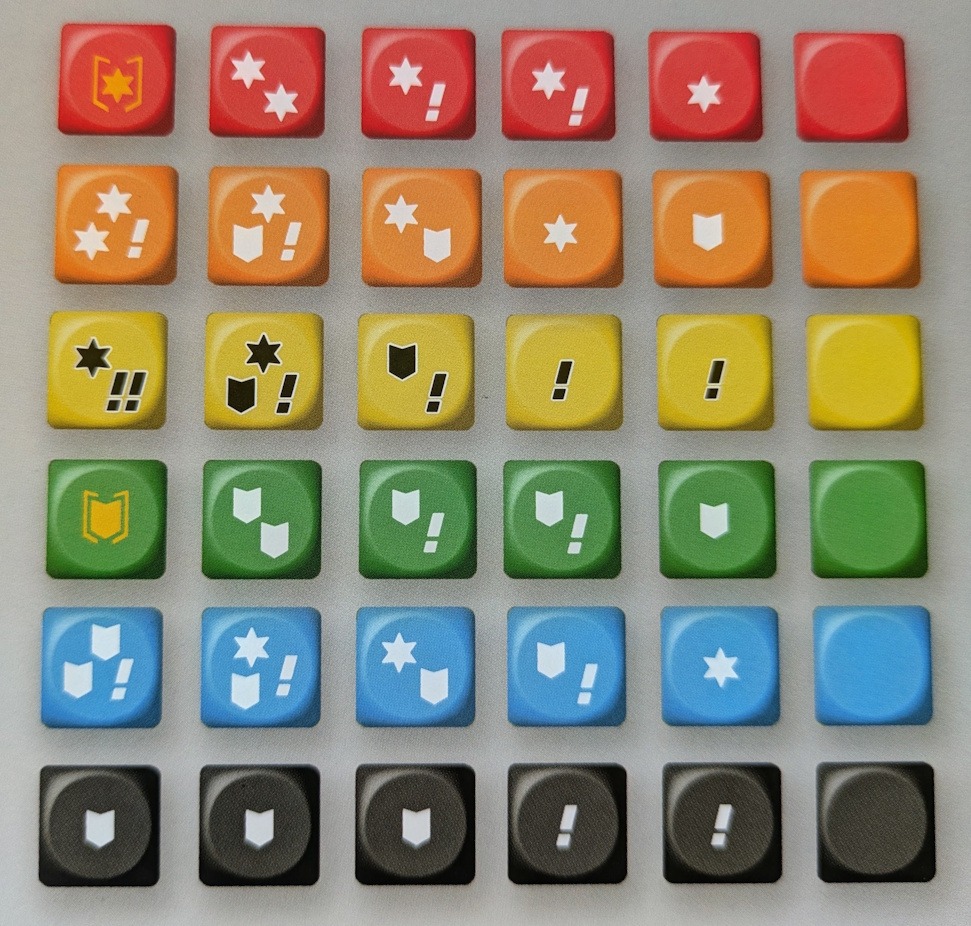
These proprietary dice are especially clever because their behavior is unusual: you don’t read a die’s face as a whole, but count each symbol on it individually. So a ❗⭐ result isn’t treated as one combined symbol, but as two separate results (1 x ❗ and 1 x ⭐). Each symbol has its own meaning, and certain special abilities (particularly talents) will ask you to combine them to unlock effects.
For instance, Maximus can trigger his talent any time he rolls ❗⭐ (it doesn’t matter whether the two symbols came from separate dice). The player then applies the effect shown in the hatched box at the bottom of his card. If he does, those symbols are “consumed” and can’t be used for anything else.
The upshot of these multi-symbol dice, gameplay-wise, is that a single die face can carry several effects. For example, the orange and blue dice can generate both damage and blocks. That means an attacker is never safe from a well-placed counter-punch, since the defender can also generate damage ⭐. The result is a dynamic combat system that blends risk-taking with realism.
In HexaDome Legends, you’ll think twice before picking a fight with someone bigger than you!
Statuses: the tactical layer you shouldn’t overlook
Characters can pick up statuses over the course of the game. Most act as debuffs, though some have positive effects (e.g. protection). These statuses chip away at or weaken a fighter’s abilities, like Fatigue, which reduces the number of action points, or Poison, which deals damage to the fighter at the end of their activation.
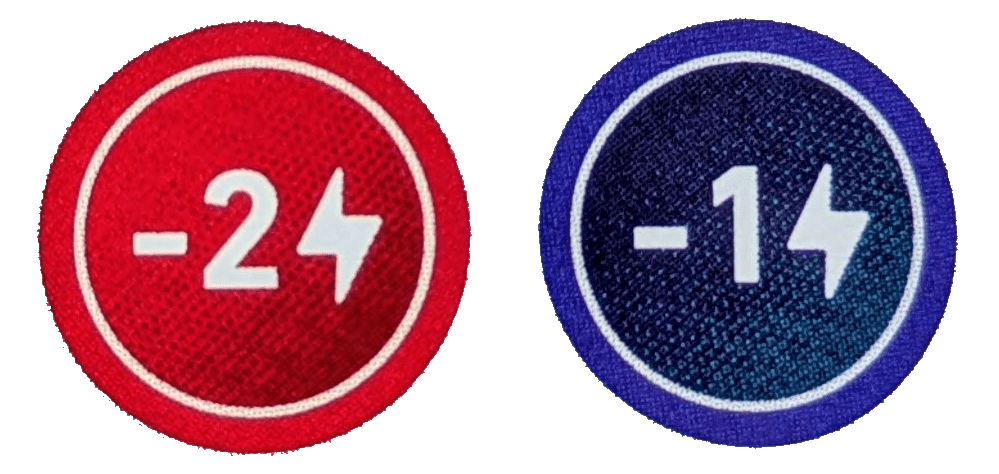
Note that statuses evolve over time: they typically have a strong immediate first effect, followed by a weaker second effect that kicks in on the character’s next activation. For example, the Immobilized status strips all of a character’s movement points the moment it’s applied. Once it evolves, it only reduces their movement point pool by -1.
A deck of cards… but not really deckbuilding
Finally, like any self-respecting arena game, HexaDome Legends also features a deck of 18 tactic cards. It’s made up of 10 generic cards plus 8 character-specific cards (2 cards for each character). Each character has 4 tactic cards reserved for them, but when you’re building your deck, you must pick 2 out of those 4, no less no more. Deckbuilding in Hexadome Legends is therefore very limited.
Tactic cards all list an activation window. So you always know exactly when you can play them, and that can just as easily be on your turn as your opponent’s. They let you do things like reroll or add dice to your pool, gain movement or action points, ignore damage, and more.
What HexaDome Legends does well
I’ve already touched on the game’s strengths earlier in this article, but I’d like to dig into them further.
Positioning over attrition
The first big strength of HexaDome Legends, in my view, is its shifting objectives. Most of the points in this game come from positioning your miniatures. Eliminating enemy fighters earns you few points, if any, depending on the scenario. That’s a welcome departure from other arena games, notably Warhammer Underworlds, where attrition is strongly rewarded. The box art doesn’t lie: this is a fast-paced game, and your team will be constantly on the move.
Freedom in team composition
Second big strength: the freedom to build your own team. On this point, it’s hard not to draw a comparison with the skirmish game Marvel: Crisis Protocol, which offers a similar freedom in choosing your roster. It’s a strength for two reasons:
- The first, obviously, is replayability. Being able to build 70 different teams from the starter box alone is dizzying. And it won’t stop there: a wave of new characters is coming down the line. From what I recall, V1 of the game featured 32 characters, and Corvus Belli has announced that future expansions will each include one reworked Aristeia character plus one brand-new one. This free-combination system is a huge strength compared to other arena games. For comparison, a fixed-warband arena game like Warhammer Underworlds typically offers 2, or maybe 4, warbands in its starter box…
- The second reason is that every new expansion is potentially relevant to you. Forget those games where your faction has to wait its turn for a release that actually concerns it. In HexaDome Legends, every expansion is a fresh opportunity to rethink your team.
Realistic combat
Combat in which both attacker and defender can take damage is a welcome twist. We’re so used to “I hit, then you hit,” where the defender is just a spectator counting off lost hit points. Here, attacking means taking a risk. Attacking becomes a real strategic choice.
This system changes how you approach every fight. You no longer charge headfirst at the nearest opponent: you have to weigh whether the odds are in your favor before engaging, or risk taking damage in return. It’s a refreshing detail that sets HexaDome Legends apart from more “classic” arena games.

Find HexaDome Legends players
Join the HexaDome Legends Discord community and find players near you.
 Join
Join Where HexaDome Legends falls short
That said, HexaDome Legends isn’t without its flaws. Or should I say missed opportunities?
An underused sports theme
The first thing that comes to mind when I think about this game is its underused sports theme. For a game set in a stadium, the 12th man has zero impact on gameplay. Gaslands, which shares a similar theme (a futuristic world unfolding in front of a crowd), features various in-game effects to simulate crowd support. I would have loved to see HexaDome Legends do the same. You could imagine, for instance, a character pulling off a string of actions and earning a “hyped up” status, a movement bonus, or an extra action point.
Double resource management: was it necessary?
I can’t help but wonder if merging movement points with action points wouldn’t have been simpler. Moving one square = 1 action point. Fighter profiles would obviously need to be adjusted accordingly ( for instance, by increasing the cost of their attacks and abilities by the same amount as their current movement points, to preserve each ability’s usage limits). A system like this could have lightened the player’s cognitive load without sacrificing tactical depth.
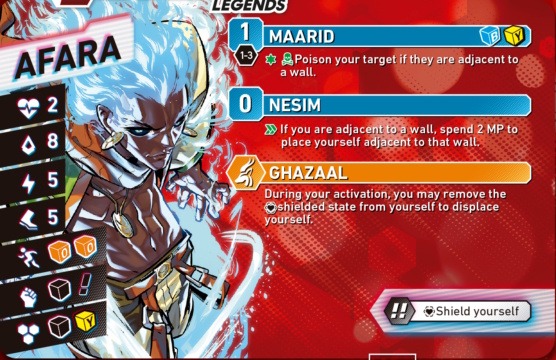
As it stands, this split creates a few small friction points in the play experience. Take Afara, for example: his Nesim ability costs zero action points, making it look free at first glance. In reality, it requires two movement points to activate. This way of presenting information makes the card a little harder to read at a glance, not unlike those “free” services whose terms and conditions reveal, in fine print, that they’re actually paid.
This brings me to the 3rd issue I noticed with HexaDome Legends:
Readability could use some work
I find the game’s readability isn’t always up to par. I just mentioned Afara’s card as an example, but it’s not an isolated case. Some genuinely essential actions, like Move or the generic ranged attack, are available to every fighter but don’t appear on any profile card. Yet the whole point of these cards is to summarize what each character can do — a kind of cheat sheet, one where a reminder of these actions would have earned its place.
There’s also no real way to tell your team members apart on the board. The current version does include colored tokens, but those are meant for the Conquest scenario, not as dedicated team markers. That’s a problem for a game that encourages you to try out plenty of different team compositions, especially since sooner or later you’ll face an opponent fielding fighters identical to yours.
You might argue that once the figures are painted, it’s easy enough to recognize your team by its paint job. That’s true for wargaming veterans, but few people coming from board games actually paint their miniatures. Honestly, for a V2, I expected proper, easy-to-use team markers — something like colored rings that clip onto the figures’ bases. You’ll find that kind of thing in Zombicide.
Back in the day, Aristeia shipped with stickers to mark your team, but that solution didn’t hold up well over time. Personally, I ended up magnetizing both the sticker and the figures’ bases, so I could easily switch teams between sessions. I imagine I’ll have to do the same with this version, because if the Conquest tokens really are meant to double as team markers, it’s a disappointing solution given how excellent the rest of the components are.
Another readability issue shows up on the tactic cards: the text is printed in small type over a hatched background. And it’s common knowledge that a hatched background makes text harder to read. Why take that risk when larger text on a solid background would have avoided the problem entirely?
If the essence of an arena game is to draw on the best of the board game, miniature game, and card game worlds, I’d say that goal isn’t fully achieved on the board game side: clarity and simplicity are exactly what should come from that world. You might call these small details, and you’d be right — none of this takes away from the game’s quality. It’s just a shame, since these small readability flaws were avoidable.
Is HexaDome Legends right for you?
HexaDome Legends is a solid arena game that sets itself apart from the competition with 3 major, unusual strengths. On the downside, its deckbuilding is fairly limited and its sports theme feels underused.
HexaDome Legends was built with tournaments in mind, so it will mostly appeal to competitive players. This is a math-heavy game, where calculations are frequent and necessary to gain the edge over your opponent. For a competitive game, the core box offers excellent value for money. Its replayability is strong too, with 8 characters allowing for 70 different configurations — a pretty impressive number compared to other arena games out there! The miniatures are excellent quality, both in terms of material and sculpt, and the characters are visually distinct from one another, which makes them a pleasure to paint.
Written by:


Support us via Maxi Reves ✨
Help us promote lesser-known miniature games and grow their communities. Order your miniatures from Maxi Rêves using the code MAXITC and be part of our mission!