 by
by “Hard to port!” The bridge pitches, glass rattling under the thunder of a broadside that misses the bow by inches. Ahead, the enemy battleship advances slowly. Its turrets turn at a measured pace, searching for the right range. The engine-room telegraph rings, the boilers roar, and the ship tears across the water like a wounded beast. Another broadside erupts nearby, flooding the deck with salt water. A shadow passes beneath the hull—friend or foe, there is no way to tell. The gunners shout out ranges; the deck reeks of powder and hot oil. “Fire!”
A thousand feet above, the aircraft carrier’s bridge is bathed in cold light. The flight deck rumbles. The catapults unleash a swarm of fighters that dive towards the melee, engines screaming, before shrinking to black specks above the battleships. From here, everything is visible—the white wakes of torpedoes, the flashes of broadsides, smoke crawling across the water like a shroud. An enemy vessel slowly rises, ballast tanks venting steam, its guns trained on the exposed belly of the flying carrier. “Drop ballast, gain altitude!” The giant climbs, its entire frame groaning, and the deck tilts beneath their boots as the first salvoes streak in from every direction.
An underrepresented genre
In the world of wargaming, naval warfare is probably the least represented genre—even less so than space combat, with which it shares many features. Both tend to have fairly strict movement rules that convey the inertia of vessels weighing several thousand tonnes and travelling at full speed. Firing arcs are typically divided into forward, aft, port and starboard. There is a huge range of vessel sizes, from small one-person craft to titanic leviathans. Some games even provide a way to manage different altitudes. Dystopian Wars has all of this.
The balance between simulation and playability is particularly delicate in games of this kind. In my opinion, the previous edition leaned heavily towards simulation at the expense of playability. The fourth edition corrects course. Many elements that were certainly realistic but weighed down the game have been simplified or removed altogether. If the level of detail in the previous edition’s rules appeals to you, I encourage you to try them—they can still be found easily in older-edition boxes. Personally, though, I appreciate the change.
A Dystopian Age game
This game is set in the Dystopian Age universe from Warcradle Studios. You can find my article on that setting here.
Dystopian technology
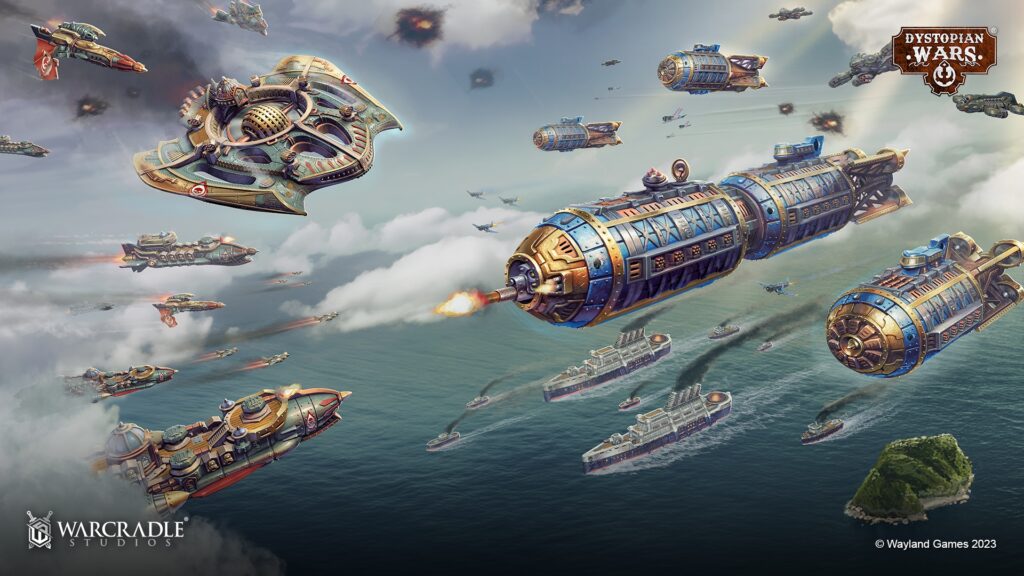
The setting’s steampunk character is impossible to miss. In this alternate nineteenth century, humanity has discovered an incredible source of energy, and its wildest ambitions clash on, beneath and above the water. It has everything: ships armed with death rays, fleets of zeppelins, colossi walking across the seabed, mechanical krakens…
Have you ever wondered which is more powerful: a battleship armed with freezing rays or a teleporting hovercraft frigate? Or what happens when the Nautilus is attacked by a flying saucer? If you are wondering now, you have come to the right place.
Rules fit for giants of the sea
A modern system
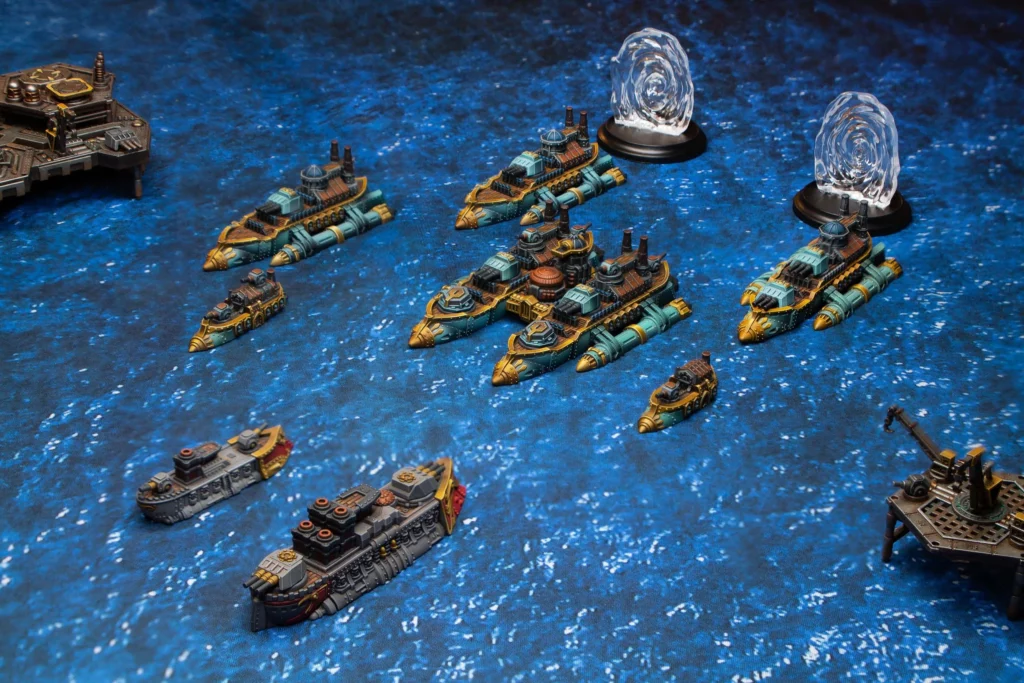
The game system follows current wargaming trends: alternating activations, objective-based scenarios, points values for building lists, and so on. Dystopian Wars uses special six-sided dice, although you could just as easily use standard ones. You will need a lot of them, though. No, I mean A LOT. As in “a flagship fires at a single target and you roll 50 dice” a lot. When it comes to delivering a sense of power, I have rarely seen anything better. But you do need to enjoy the sound of little maths rocks rolling across the table.
With that many dice, you will soon prefer the proprietary dice with the game’s little icons to sorting values in a sea of identical pips. A dice-rolling app on your phone quickly becomes an appealing alternative.
Source: Warcradle Blog
Manoeuvres and firing arcs
I mentioned this in the introduction, but it is an intrinsic part of the genre. The heart of the game—aside from the buckets of dice—lies in firing arcs and manoeuvring. Each weapon on a ship can fire in one or more directions depending on where it is mounted on the hull.
This brings me to a relatively unique feature of Dystopian Wars: some hardpoints let you choose which weapon to mount on them. There is no additional cost and no restriction beyond choosing from the available options. This can lead to some very interesting combinations within a unit or even aboard a single ship.
And of course, the larger a ship is, the less manoeuvrable it becomes. Turning one of these sea titans all the way around takes both time and space. Moreover, each profile has a minimum distance it must travel in a straight line during each turn before it can make a turn. Planning your movement is essential. Otherwise, half of your beautiful guns may be good for nothing but firing celebratory salutes.
Weapons and range bands
Dystopian Wars has chosen to simplify the issue of firing range. Weapon effectiveness is divided into three range bands: up to 10 cm, between 10 and 30 cm, and beyond 30 cm. A weapon type can be devastating at a given range yet have no firepower at all in another band. Most weapons are useful at two or more ranges, however. Depending on their armament, some units will therefore prefer to remain far from their target while others will want to close the distance.
Each weapon also has keywords that indicate its special rules. Ships have their own keywords too. There are a lot of keywords in this game—so many that the publisher did not include them in the rulebook and instead put them in a separate document! Many are shared by every faction; others are used by only one or occasionally two factions. A few are used by just one ship in the entire game, at least at the time of writing.
Action management
Despite carrying numerous weapons, a ship cannot target every enemy within range. Dystopian Wars limits the number of actions a unit can perform each turn. Actions are used both for complex manoeuvres—such as making two turns during an activation—and for firing at targets. A unit will often perform two actions per turn, sometimes three, but rarely more. This forces players to choose carefully and make every action count. Naturally, elite forces generally have slightly more actions to spend than others to compensate for their smaller numbers.
This regulates a unit’s effective firepower during the game and also forces the player to choose which target or targets that unit will engage. The downside is that it adds yet another characteristic to track. Some ship profiles become very crowded.
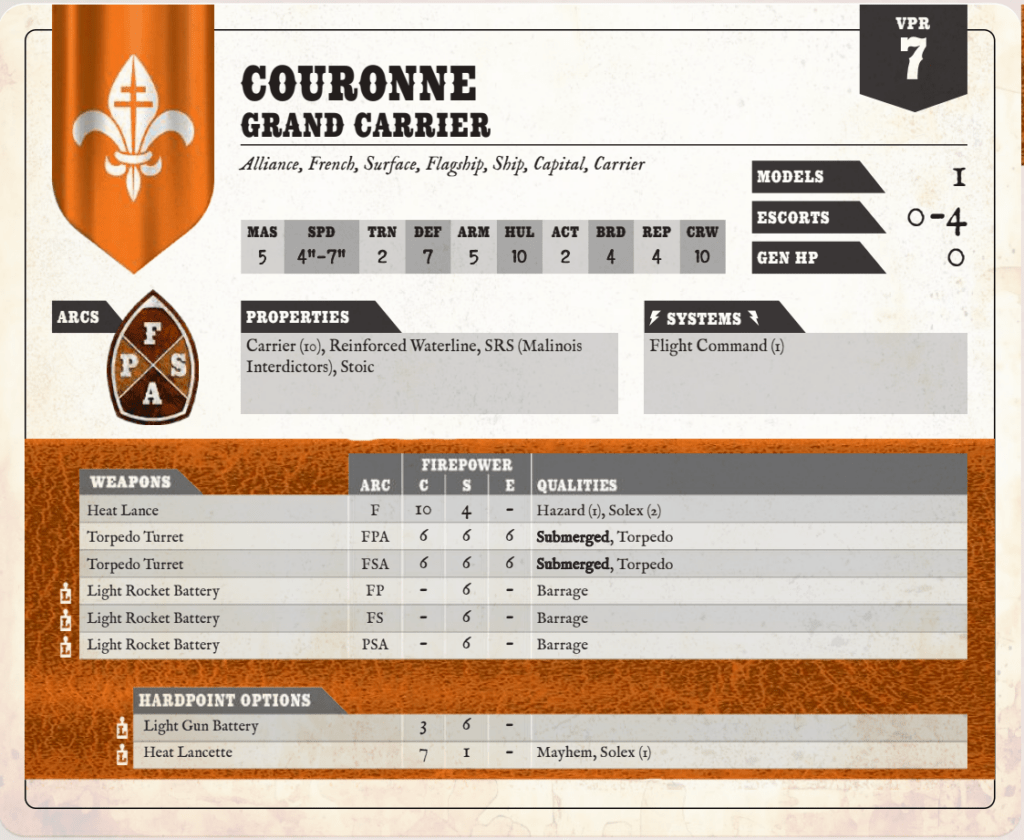
Source: Alliance Orbat 4.01
Advanced rules
Once you have played your first few games, you will want to include the advanced rules.
These expand the fun to include aerial support, boarding actions, extremely close-range fire (broadsides), ramming, escorts (which provide a defensive bonus), repairs and critical damage. In short, everything that makes an admiral’s life worth living.
Most importantly, they introduce a key part of the game’s identity: the “crippled” status. Large ships are no longer simply removed when their hull reaches 0. Instead, they become crippled, suffer significant penalties and can no longer control objectives. Ouch! They do, however, remain in play until their owner decides to withdraw them or they vanish in an enormous explosion caused by excessive critical damage.
Why keep vessels that badly damaged? Perhaps one of them is central to your plan and, even if you are no longer certain it can act effectively, it remains a threat. Alternating activation provides another important reason: an isolated crippled ship is still a unit you can activate. You can stall, forcing your opponent to use their important pieces before you use yours. And yes, you can also use crippled ships to obstruct lines of sight.
Scoring points and cards
The Dystopian Age games use victory points. You accumulate them throughout the game, and whoever has the most at the end wins. Unlike many games, however, there are several ways to score: through the scenario, by reducing enemy ships to 0 Hull, and with cards.
Each turn, units that meet a scenario condition earn a certain number of Victory Points for their side. Only “surface” ships count. You therefore cannot score this way with submerged submarines or zeppelins. They saw you coming, you crafty devil! Generally, you need to have units in a particular location, such as near an objective marker or within a region of the table. It is very conventional and provides the most points.
Reducing ships to 0 Hull is fairly self-explanatory. The number of points earned depends on the vessel’s profile and is generally proportional to its points cost. If you use the advanced rules, a crippled ship will therefore already have awarded Victory Points to your opponent. That is another reason to try to squeeze a little more value out of it.
The cards
Finally, there are the cards. As in the other Dystopian Age games, each opponent starts with an identical deck of cards. They serve four purposes:
- determining initiative each turn
- passing “morale” tests
- triggering special effects (or countering your opponent’s)
- earning Victory Points (Minor Victories)
Special effects and Minor Victories use cards from the player’s hand, which contains between five and seven cards. This adds a layer of resource management on top of the tactics, forcing you to choose between improving certain actions and scoring more points. It is a fairly unique and interesting aspect of the Dystopian Age games. These additional Victory Points can put you ahead or help you make up for falling behind on the scenario. On the other hand, triggering a special effect at the right moment can give you a serious advantage.
Initiative and morale tests use a simple numerical value on the card drawn directly from the deck. For once, there is no dice roll and no hand management. It is pure chance. Although… if you drew plenty of good—or bad—cards early in the game, you can expect the others to come out later!
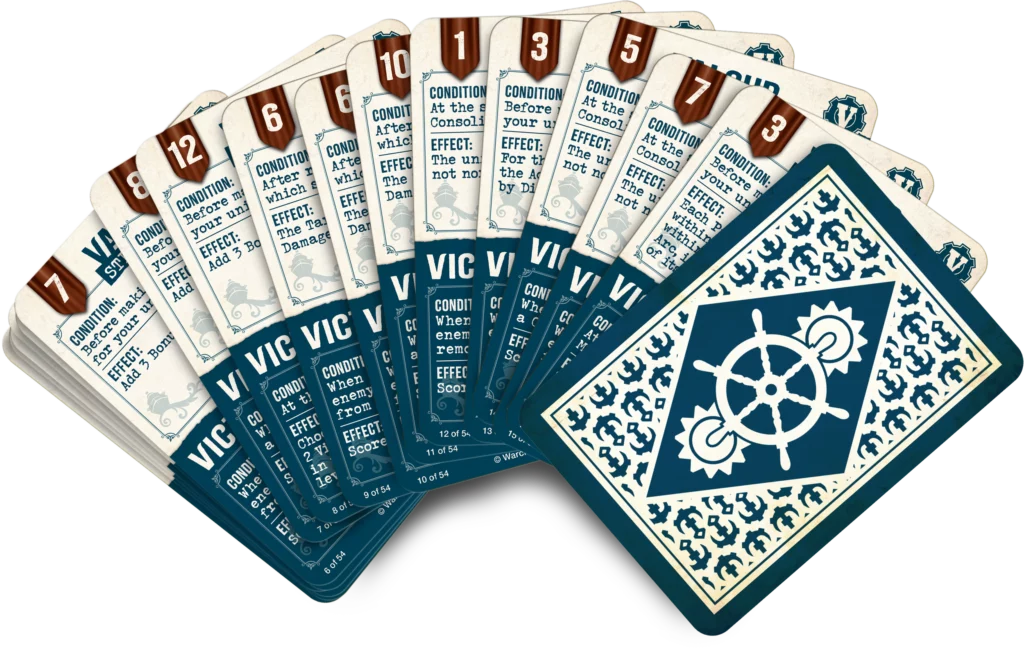
Source: Warcradle Blog
There are card decks with a faction’s symbol printed on the back; they are otherwise exactly the same as the decks included in starter boxes. I would have preferred faction decks to feature a few variants that could be used if both opponents brought them—or simply agreed to do so. But no: the text on the cards is strictly identical. Unless you particularly want a deck for your favourite faction, or you are not buying a box that contains one, you can simply use the generic cards.
The fleets
Although every faction can do a little of everything, each naturally has its own characteristics and, above all, unique special rules. The ship profiles also reflect the philosophy behind each faction or subfaction. The Scandinavians in the Imperium faction, for example, have many rules that give them advantages during boarding actions. Other fleets can field far more submarine units than average and play the silent predator. Without at least some surface units, however, this can turn into a game of whack-a-mole.
The fleet-building rules also ensure a certain degree of variety. You can include only one unit of any given ship type, except for one type determined by your chosen fleet. With all the available ships and equipment options, creating an army without duplicate units is no problem at all. Players who enjoy fine-tuning their lists can spend hours on it.
The levels of play
Controlling submarines, surface ships and aerial units creates considerable tactical variety. As in most games at this scale, managing combined-arms warfare is crucial. Your bombers probably cannot destroy a large ship on their own, for example, especially if it is protected by fighters. They can, however, provide effective support for an attack. They can also strike a small ship that is otherwise out of reach, saving you from having to turn your flagship away from whatever more important task it is surely handling.
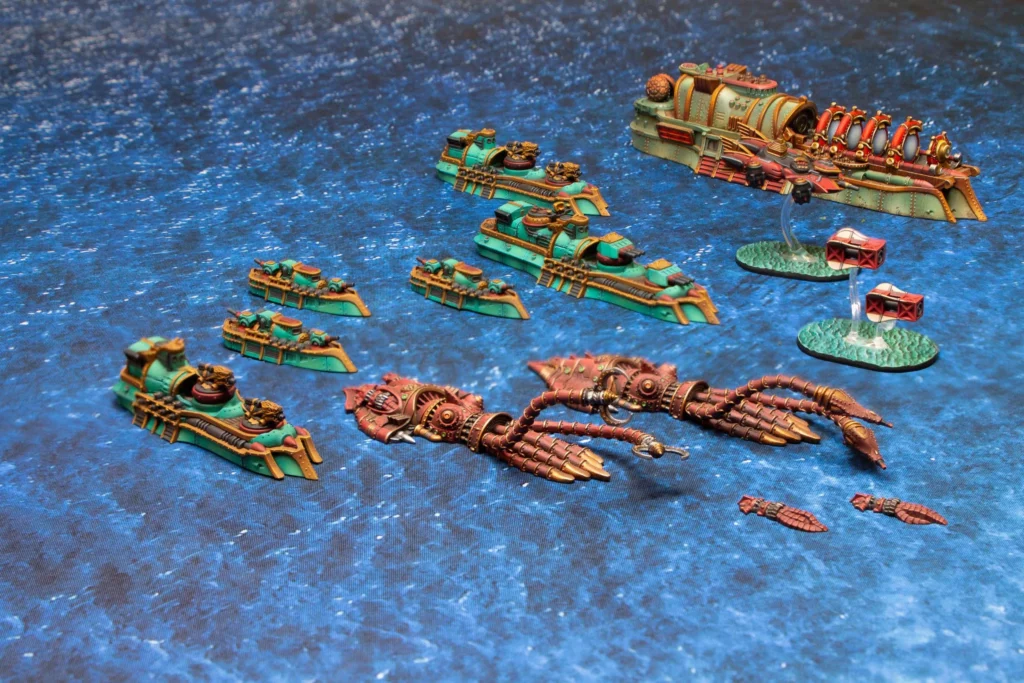
Source: Warcradle Blog
Conclusion
Beyond its science-fiction-tinged steampunk designs, the system itself is worth a look. It does not revolutionise the genre, but it brings a host of good ideas together into a coherent whole. You will probably be ready for the advanced rules after one or two games. Frankly, that is just as well, because the basic rules soon become a little dull. Some fleets are in fact designed around the use of the full rules—boarding fleets, weapons that inflict critical damage easily, and so on.
The full game is tactical and fun. You will sometimes face one difficult decision after another, but that is what makes it exciting to me. The various fleets offer a wide range of playstyles. From simple but effective forces to fleets chasing winning combos, and from highly specialised to versatile all-rounders, there is a fleet for every preference. You do, however, need to enjoy managing the geometry of movement and firing arcs.
The rules are moderately complex, and some mechanics take a little more work to master. The rulebook’s layout helps enormously. Across every kind of game, I have rarely seen a rulebook this practical to use. Every two-page rules spread includes a table referencing the pages of related rules. I wish more game publishers would follow Warcradle Studios’ example.
Who is this game for?
Of course, if merely looking at a boat makes you seasick, this game is not for you. Although in that case, I have to wonder how you managed to read this far—thank you, by the way.
If you like wargames with streamlined unit cards and not too many markers scattered everywhere, this is not going to work for you either. I have not even mentioned Disorder markers—which measure panic on board—the effects of critical damage, or tokens for aircraft sorties from carriers. Let’s be honest, markers end up everywhere in this game. Not quite to the point of buying a table vacuum cleaner, but if seeing them in your beautiful souvenir photos bothers you, removing them will take some work.
Personally, I would classify Dystopian Wars as a game of medium-to-high complexity. It is not exceptionally difficult, and the rulebook is very well designed. But it is clearly not a simple game either; that much should be obvious to everyone. The core system is learned very quickly, and none of the rules seem to come out of nowhere. They all share the same DNA. Even so, mastering the full rules takes a little time and effort—especially with the profusion of keywords.
If none of that puts you off, I highly recommend the game. It is one of the best ship-combat games I have tried, spaceships included. Each faction has unique, varied and fun mechanics. The setting is compelling and immersive. The blend of steampunk and science fiction is delightful and has a genuine impact on the game mechanics.
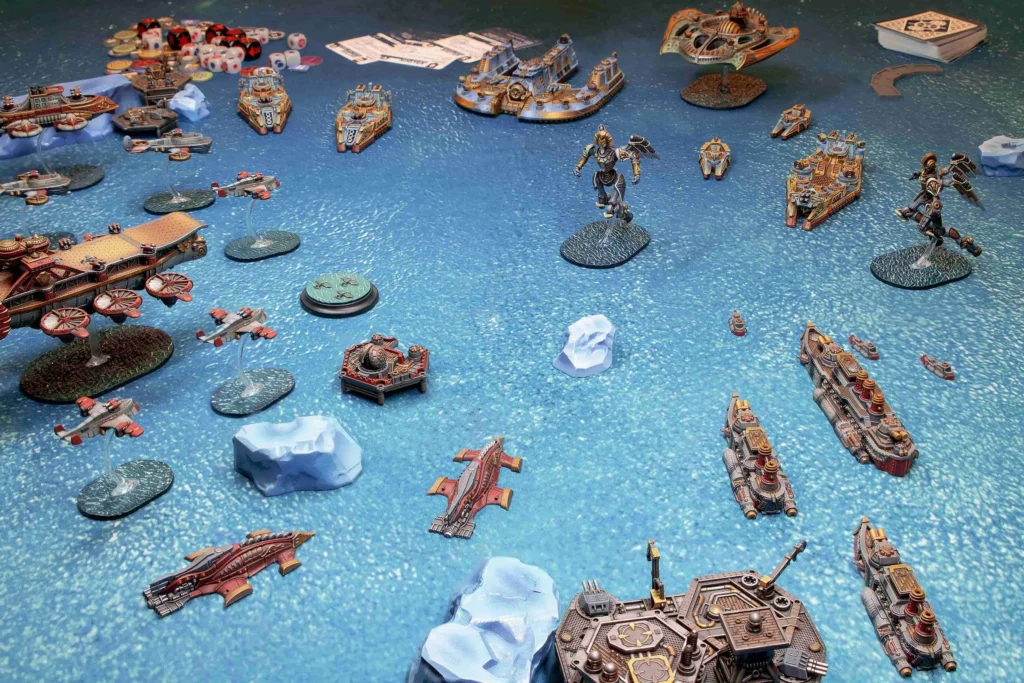
Source: Warcradle Blog
How do you get started?
If you want to take the plunge and try the game, it is easy. You can give it a go even if nobody nearby already plays Dystopian Wars.

Find Dystopian Age players
Join the Dystopian Age Discord community and find players near you.
 Join official group
 Free rules online
The rules are freely available on the Warcradle Studios website here. You will also find printable markers there.
Each faction’s army list, called an Orbat, is also available on the factions page.
The ships
As for miniatures, most models from previous editions of the game can be used. If you have ships for other games at roughly this scale (1:1200), or even spaceships, they can do the job. You can also simply cut out a few ship-shaped pieces of cardboard. If your budget allows, the starter sets are a very good way to begin. They contain everything one player needs.
There is also a two-player starter set containing a Crown fleet and an Imperium fleet. This box has the advantage of including scenarios that introduce the rules gradually over several games.
Beware of older boxes
Be aware that the difference between fourth- and third-edition boxes is not as obvious as one might hope. Fortunately, there is a simple way to tell them apart. Boxes from the latest edition have a coloured tab bearing the faction logo in the top-right corner. On older boxes, the faction logo appears in the bottom corners.
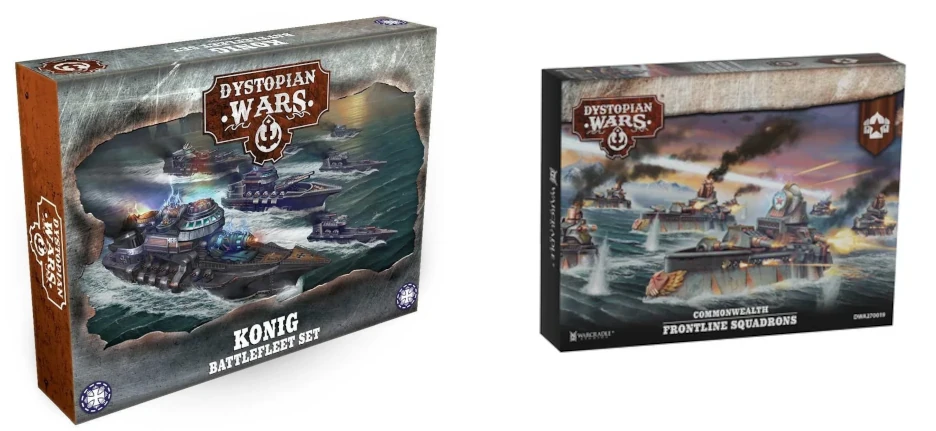
As for the rulebooks—which are included in starter and Battlefleet sets—the latest edition’s book is blue, while the third edition’s is brown. That is easy to spot too, but it is rarely visible on the box…
There is nothing wrong with buying a box from the previous edition, but read the latest version of the faction’s Orbat carefully. Some models have been merged and are now distinguished only by different equipment. Take care during assembly as well, because some options cannot be magnetised.
Written by:


Stay tuned
And never miss an article again! Join our Discord to get notified whenever we publish something new. You can even choose which games you want to receive notifications for!