
 by
by Some games just don’t fit neatly into a single category. They shrug off established conventions and end up carving out a genre all their own. That’s exactly the case with arena skirmish games, sitting somewhere between miniatures games, board games, and card games, borrowing a bit from each. In this article, I want to dig into what actually defines them, where they shine, where they fall short, and why this genre keeps flying under the radar. It deserves a lot more attention than it gets. Sometimes also called arena combat games, they happen to be some of my favorites, so it’s about time I gave them their due.
What is an arena skirmish game?
Think of the arena skirmish game as sitting right at the intersection of board games, miniatures games, and card games, borrowing a piece of each one. So on the table, you’ll typically find a board, a deck of cards, and a handful of miniatures, all working together.
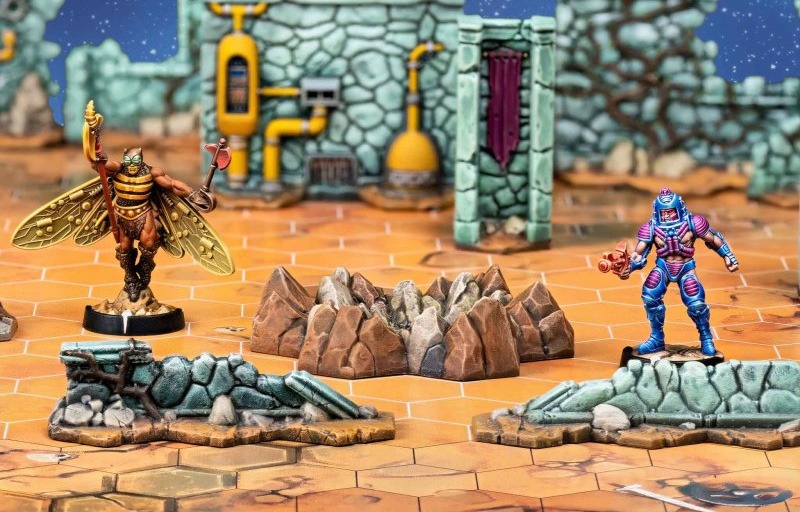
Each player controls just a handful of miniatures, squaring off inside a tightly bounded battlefield, usually called the arena, which is where the genre gets its name. That arena takes the form of a board built from hexagonal spaces, and not all of them are equal: some give you an edge (cover, bonuses), others will punish you if you’re not careful (traps, hazards). Learning to read the board, where to strike from and where to steer clear of, is half the game.
As for the fighters themselves, their rules are refreshingly lean, yet that simplicity doesn’t stop players from pulling off some genuinely clever combos. There’s a fraction of the keyword bloat you’d find in a standard miniatures game, and what’s left is easy to learn in one sitting.
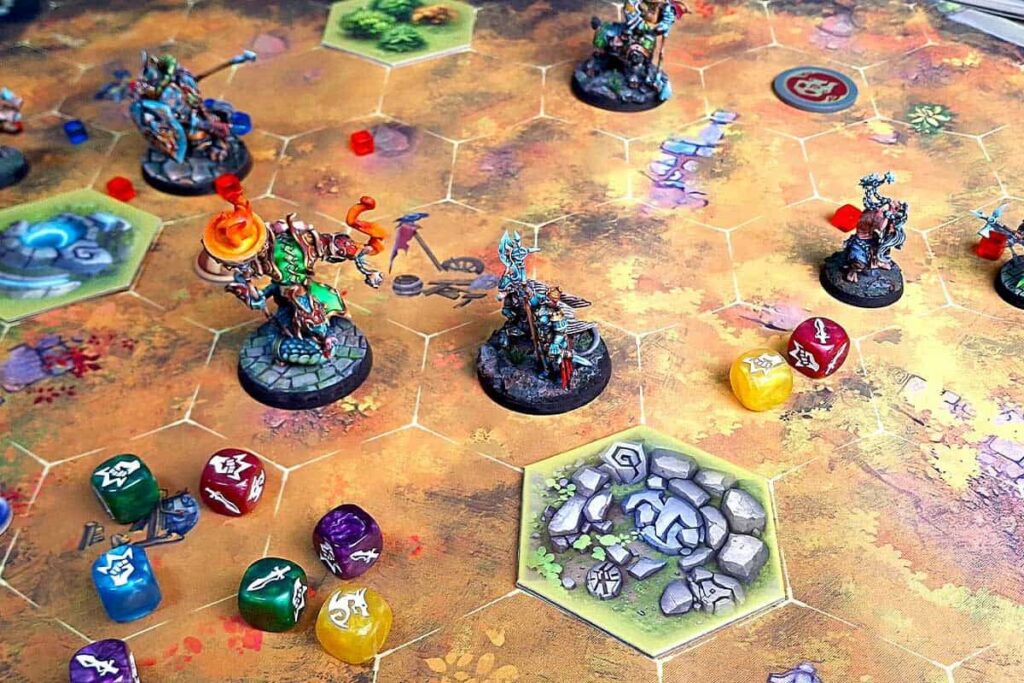
Over the course of the game, your deck of cards is what really lets you steer the action. Play a card and you can buff your own fighters (extra abilities, a free move) or throw a wrench in your opponent’s plans. See an enemy standing right next to a trap? There’s probably a card that shoves them onto it and takes them out of the fight on the spot.
And don’t let the word “arena” trick you into thinking this is just a slugfest. Winning isn’t about attrition, grinding down the enemy until only one side is left standing. It’s about position: holding and defending specific spaces that are set before the game even starts. Taking out the opposing fighters is rarely the goal in itself, more a tool to get you where you need to be. Wargamers will feel right at home here, since that balancing act between board control and going for the kill is already second nature to them.
Some arena skirmish games go a step further and hand each player a second deck, one that deals out private, secret win conditions. Unlike a regular miniatures game, you’re now dealing with hidden information on two fronts: you don’t know what your opponent is actually trying to pull off, and you don’t know what they’re holding either. That fog of war is a card game staple through and through, and it’s exactly what makes arena skirmish games click with players who came up on TCGs rather than tabletop miniatures.

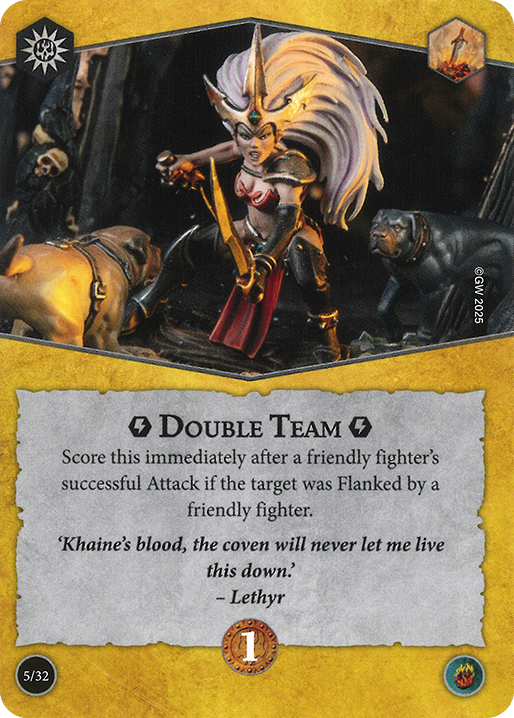
One last thing: arena skirmish games are built for competition, plain and simple. You’ve got real levers to pull to sharpen your strategy, like which warriors to field, which deck to build, which style of play to lean into. What you won’t usually find is much of a story. Narrative just isn’t the priority here. The setting exists mostly to give the fight a reason to happen.
Why play an arena skirmish game?
There’s a lot going for the genre. Here’s where it really earns its keep:
Start with the obvious one: everything about it is compact, from the box to the playtime. It all fits in a single box and travels easily. Setup is almost instant, and games themselves are tight and fast, figure 40 to 60 minutes once you know what you’re doing. That means you’re rarely stuck playing just one game a night; squeezing in two or three is easy. It’s also why arena skirmish game tournaments tend to be packed with rounds: the one-day Warhammer Underworlds events I’ve played in ran 5 rounds, all best-of-one.
Then there’s the fact that, by sitting at the crossroads of board games, card games, and miniatures games, an arena skirmish game gets to cherry-pick the best of all three:
- From board games: simplicity and accessibility. Beyond the compact footprint already covered, the grid, a straight import from the board game world, takes almost all the guesswork out of positioning your miniatures. Spaces settle any question of distance or line of sight before it can even come up, so you’re never stuck arguing the point with your opponent. Combine that with lean rules and a handful of keywords, and you sidestep the constant rulebook-flipping that miniature games are famous for. The whole experience feels tighter and more controlled, and that shows in how smoothly and quickly games move.
- From card games: tension. This is where hidden information and reactive play come from. Because players can act on each other’s turns, there’s no dead time, and everyone stays on edge the whole game. Some titles even layer in deckbuilding for an extra strategic wrinkle. Put it all together and you get a genre that keeps surprising you and delivers fun fast.
- From miniatures games: strategic positioning. Just like on a wargaming table, where you put your fighters matters a lot. The difference is forgiveness: a bad deployment in a wargame can basically decide the game on the spot, but arena skirmish games give you room to recover. Repositioning is quick and constant, so your fighters end up darting around the board like a boxer who never stops moving.

There’s also a hobby angle: arena skirmish games are quicker to build and more satisfying to finish. With so few miniatures involved, a handful of painting sessions is all it takes to get your 4-5 fighters ready for the table. Your pile of shame stops feeling like a life sentence, and those shorter painting sessions mean you get that finished-model rush a lot more often.
Committing to a faction in a typical wargame is a real decision: it costs you money, shelf space, and hours at the painting desk. Arena skirmish games let you sidestep all that and jump between wildly different factions without wrecking your budget. That freedom means you get to actually play with color and variety: an orc here, a raider there, a specter and a water spirit somewhere else. It’s a genuine breath of fresh air if your hobby has started to feel like painting the same soldier over and over. Looking at you, A Song of Ice and Fire.
Arena skirmish games are also surprisingly flexible about how you play them. Being a genre mashup doesn’t mean you’re locked into using every piece of it. Most of these games hold up fine without the card decks. You lose a layer, sure, but rarely one that’s essential. I actually do this on purpose: when I teach someone the rules for the first time, I leave the deck out entirely for round one. Once they’ve got the basics down, I bring the cards in from round two onward.
I’d go even further: if you’re someone who just isn’t into miniatures (does that person exist?), you can drop them altogether, since the board itself is grid-based. Plain bases or tokens do the job just as well as stand-ins.
Bottom line: arena skirmish games make a fantastic on-ramp into all three of these hobbies, or a smooth bridge from one to another. I’ve never had any luck getting my partner to try Magic: The Gathering (“too much text”) or Star Wars: Legion (“too demanding”), and yet, somehow, we’ve played close to ten games of Warhammer Underworlds together. Honestly, I still can’t quite explain how an arena skirmish game won her over where everything else failed. My best guess: the board game DNA makes the whole thing feel a lot less intimidating.
The drawbacks of arena skirmish games
None of this means arena skirmish games are flawless, far from it. Ironically, its biggest weakness comes straight out of its biggest strength: this is a hybrid, and hybrids are jacks of all trades, masters of none. Ask players coming from card games or miniatures games what bugs them most, and it’s usually the same complaint: their favorite piece of the puzzle just doesn’t go far enough. “In Magic, I can do this and that.” “In a proper wargame, I’ve got way more freedom to do this or that.” And honestly, they’re not wrong: an arena skirmish game will always be more limited across the board. That’s simply the price of doing a bit of everything.
Think of it like a smartphone. You can watch a movie on it, sure, but your TV does it better. You can game on it, but a console blows it out of the water. You can even get work done on it, but nothing beats a proper computer for that. And yet, if your house were on fire, the one thing you’d grab on your way out without a second thought is probably your phone.
The other big issue: this is a niche within a niche. Picture that same diagram from the top of the article, but instead of games, imagine it’s showing communities, groups of actual people.
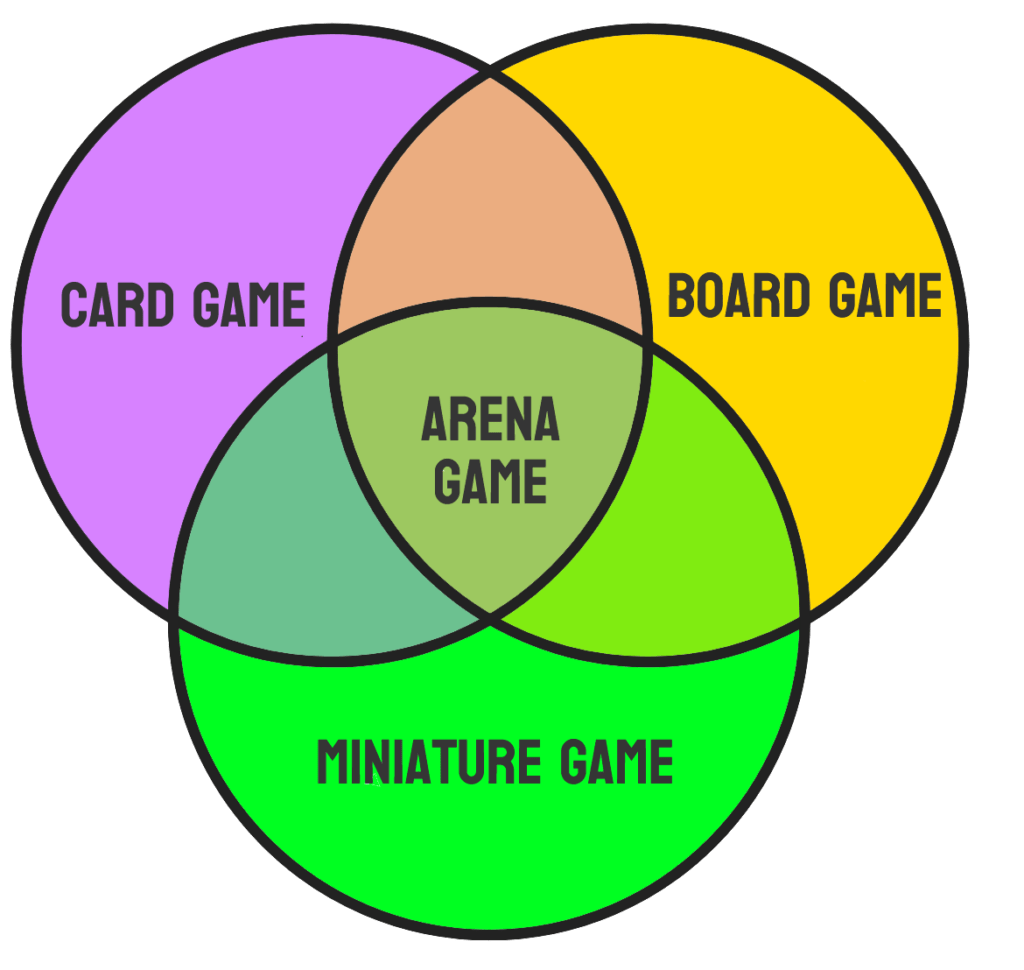
Only a sliver of each community actually cares about arena skirmish games; people who genuinely enjoy all three hobbies at once aren’t exactly common. The knock-on effect is obvious: arena skirmish game communities are small, which makes them fragile. The 2020 pandemic is a perfect example. It nearly wiped out games like Aristeia! and Warhammer Underworlds outright. The good news is that neither publisher gave up: both games eventually came back a few years later with a second edition and rebuilt their community around it (Aristeia! is now known as Hexadome Legends).
I mentioned earlier that these are competitive games, but that condensed format has a cost. The meta ends up shallower, simply because there’s less room for it to grow. It doesn’t take long for the community to converge on what actually works: which fighters to run, which deck to pair them with. I’d also argue that bad matchups hit harder here than in a typical miniatures game. A wargame faction usually has multiple viable game plans built in; arena skirmish game warbands tend to be more one-note. So some matchups are just plain lopsided, with one side holding a clear edge over the other, which nudges players toward buying extra warbands just to have a wider range of answers. And that’s the irony: you picked a small, tight game, and now you’re stacking expansion after expansion onto it, chasing the depth it didn’t come with.
Last point: despite all the miniatures on the table, immersion isn’t really this genre’s thing. That’s the board game influence talking: grid spaces and codified rules interactions push the game toward something more abstract, more like a puzzle, than an actual simulation of combat.
Arena skirmish games: gateway or destination, you decide
Arena skirmish games have their strengths and their weaknesses, but I’m convinced this style of game deserves more love than it gets. Its qualities outweigh its shortcomings, as long as you judge it for what it is, not for what it isn’t. For some, it’ll be a starting point: a way to learn the basics of card games, miniature games, and board games, before diving deeper into one of these three paths. For others, it’ll be the exact opposite, a destination in itself, the place where they feel right at home precisely because it brings together a bit of each world at once.
Arena skirmish games are also a fantastic solution for wargamers who are short on time (yes, dads, I’m talking to you), or simply short on shelf space. In that sense, they answer a real need when you’re juggling a busy family life: the chance to experience the thrill of three kinds of games at once, in the least amount of time possible. And that’s precisely why, if I had to save just one game from my collection, it would be an arena skirmish game, the only one able to sum up, all by itself, everything I love about this hobby.
Finally, although arena skirmish games are all built on a blend of several genres, they don’t all mix them in the same proportions. Some publishers lean heavily into the “miniatures game” side at the expense of the board game or card game elements, while others go the opposite way and push the “card game” dimension much further. As players, we each have our own idea of what the ideal balance looks like. The trick is finding the arena skirmish game that nails it for you!
To help you find your ideal arena skirmish game, I’ll be covering a range of arena skirmish games. As always on Critical Hit, my goal is to offer you alternatives to Games Workshop titles, and in this case, alternatives to Warhammer Underworlds. Which games will I be featuring? That’ll be a surprise! But for the curious among you, know that I’ve already dropped plenty of hints in this article.
Written by:


Support us via Maxi Reves ✨
Help us promote lesser-known miniature games and grow their communities. Order your miniatures from Maxi Rêves using the code MAXITC and be part of our mission!