 by
by This article is based on a copy of the game that Warlord Games provided to us free of charge as part of a press relationship. This does not grant any oversight over our editorial content: Critical Hit retains full independence and our opinions remain free and objective.
Intro – Paris, april 1944
François had settled onto a bench in the Tuileries Garden, feigning nonchalance. On this Saturday, April 9, 1944, the late afternoon bathed Paris in a deceptive gentleness, offering city dwellers a brief moment of calm.
His eyes soon spotted his target: an ordinary stroller, blending into the crowd, seeking shade under the canopy of plane trees. Only one detail, invisible to the untrained eye, betrayed him: a tiny red cockade pinned to his beret, the rallying sign of the “Alphonse” network.
Without a glance at the stranger, François stood up and walked away to pretend to admire a marble statue, leaving his satchel behind on the park bench. The contact continued his stroll with measured steps, looking detached, before taking the seat. A few moments later, the man resumed his walk, taking the satchel with him.
The exchange had lasted only a heartbeat. Yet, behind this mundane gesture, François could not help but think of the sacrifices made by the Resistance. A human chain in the shadows, stretched across occupied Europe, had been necessary to snatch these documents from the Green Vault in Dresden. They detailed new refrigerated vehicles designed by Axis engineers—useful for transporting specific troops, something he had thought impossible only a few months ago. Rumors from the Normandy resistance had confirmed their existence: the undead, reanimated by a mysterious process originating from the events in Dresden a few weeks prior.
He left the garden with a smile on his lips, brushing past a German patrol that suspected nothing. Under this spring sun, the soldiers seemed almost at peace. As if the promise of a radiant summer could make them forget that the Western Front was catching fire. As if Paris, the “open city,” would remain eternally sheltered from the world’s crashing roar.
Festung Europa, the first supplement for Konflikt ’47
Konflikt’47 offers a fascinating uchronia: what if the Second World War had not ended in 1945 because of a strange rift? If one examines the Festung Europa expansion, it becomes clear that the divergences appear well before 1947.
Contents Festung Europa
In this beautiful 116-page full-color book, you will find several elements to inspire you to create scenarios in the Konflikt’47 universe. Several operations across various military theaters in Europe are presented. I have translated the titles of the book’s major chapters.
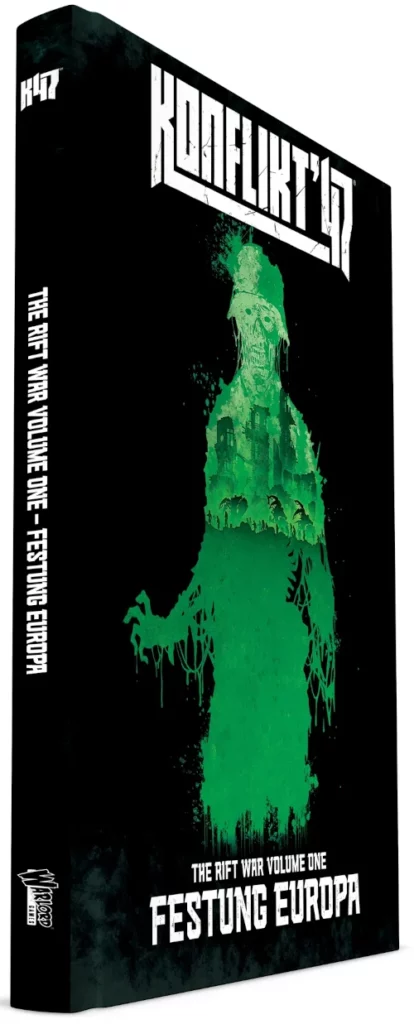
- The Dawn of the Rift War
- Western Europe from February ’44 to February ’47
- The Areas of Operation
- The Conference on Necromobilization
- Operation Valentine: February 14 to July 10, ’47
- Operation Pluto: February 12 to June 14, 1947
- Operation Touchdown: June 23 to September 6, 1947
- Operation Valentine: July 30 to October 10, 1947
- Dresden Defiant
Dawn of the Rift War allows one to see, for the first time, where the Konflikt’47 universe diverged from real history. Notably, we learn that Paris was liberated in August ’44 under the leadership of General de Gaulle.
The French countryside is now prowled by the undead. During Operation Overlord, they were deployed by the Axis following the events in Dresden.
Next, a chronology for Western Europe spans from June ’44 to February ’47. This provides plenty of inspiration for scenario ideas and battles. This is also the section where the context of Konflikt’47 truly unfolds, showcasing the arrival of Rift-tech and the various military events that follow.
- Three military campaigns are developed, all sharing the same structure.
- A chronology of the military campaign,
- A biography of a prominent hero,
- A grand scenario that concludes the campaign with 2,000 army points.
Festung Europa – Operation Valentine
The unfolding of this campaign allows for the creation of several types of scenarios. Axis is primarily on the defensive; several scenarios offer urban environments featuring bunker-type elements. The Totenkorps are omnipresent, and it seems to me that these units will likely be essential for playing this military campaign on the Axis side.
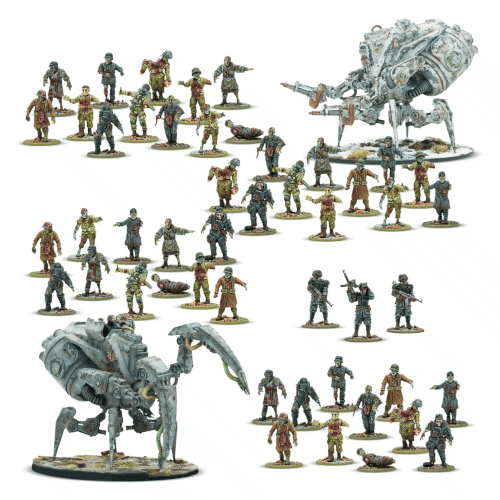
The purchase of the Totenrotte Starter Army, if you play Axis, will likely be indispensable. On the US side, purchasing a Konflikt ’47 United States Starter Army should suffice, supplementing your forces with a box of US GIs. You can also create scenarios with the British Commonwealth, which naturally multiplies the narrative possibilities.
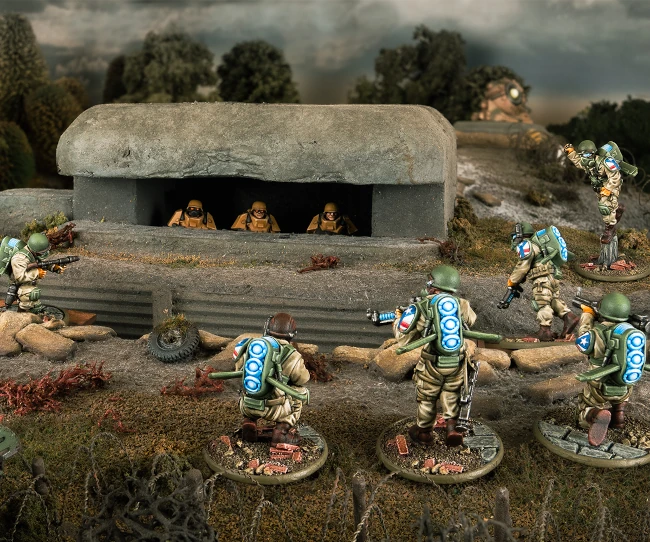
Several types of elements are offered, including defensive zones such as fortress networks and bunkers in open plains, or even fortified cities: Ravensburg, Stuttgart, Nuremberg, and Munich.
The final scenario provided, Fell the Giant, will undoubtedly utilize all the terrain you have built bit by bit to play and experience this campaign with your friends.
Festung Europa – Operation Pluto
This part is aimed at Axis players as well as Soviet players. With the Red Army, boosted by Rift-tech, entering Slovakia in February ’47, the campaign continues in Poland across urban zones and open plains. This offers the chance to deploy companies of soldiers equipped with squads of genetically modified bears or monstrous combat walkers as only Soviet engineers know how to create.
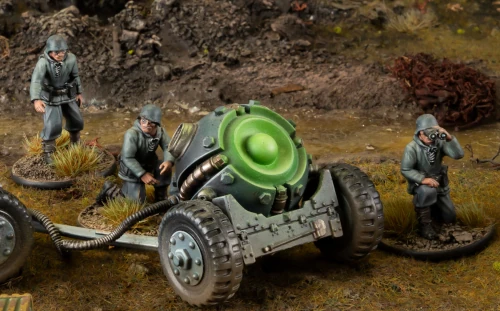
Once again, undead squads will play their part in this campaign, particularly during the fighting in Prague. The final scenario, titled Harvesting the Dead, takes place in Dresden on the banks of the Elbe. It will also require a Totenrotte Starter Army to be fully playable by the Axis player.
Festung Europa – Opération Touchdown
This operation is framed as a deep strike into German territory. In August ’47, troops equipped with anti-gravity jetpacks find themselves deployed into the ruins of Dresden. The city is now overrun by the undead. It is the ideal setting for creating horror scenarios. The departed return to life in an attempt to maintain control of their city.
It is also a campaign of guerrilla warfare and clandestine operations in the Axis rear areas, offering “search and destroy” resource missions for the Americans and pure defense missions for the Axis.
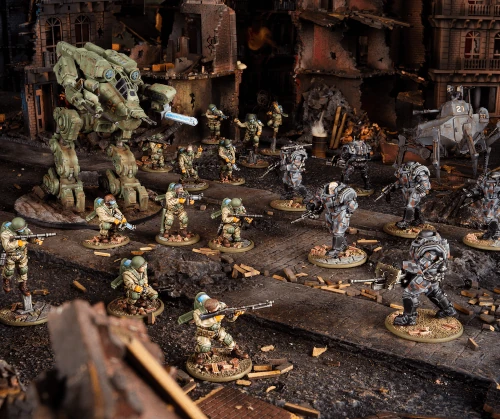
For certain scenarios, you can freely mix your classic Bolt Action German troops with your Firefly units. The Introductory Set is actually perfect for approaching this part of the book, especially if your gaming partner only owns Bolt Action miniatures. It serves as an excellent gateway to introduce the Konflikt’47 universe to a German player who hasn’t yet invested in the range but wishes to test the game. Purchasing a Totenkorps Horde box should then suffice for the initial scenarios featuring the undead.
Where to make your army lists for your Festung Europa scenarios?
The dedicated site here provides you with all the information. All the army lists playable in this supplement were updated at the end of March for the supplement’s release.
Army lists: from historical with Bolt Action to fantastical with Konflikt’47
Intuitively, one might think that only Late War Bolt Action miniatures are compatible. While true, note that several barriers are being broken! In terms of equipment, regular infantry for all nations can now be equipped with SMGs or assault rifles, which is unthinkable within the rigid historical framework of Bolt Action.
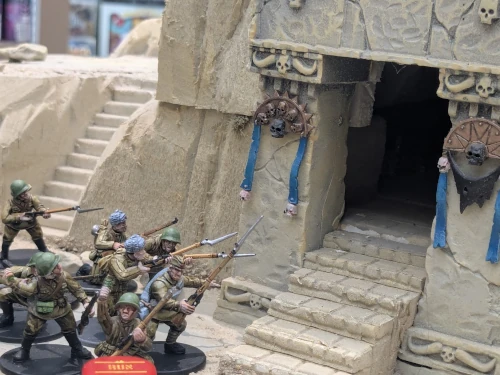
You can therefore recycle your GI or grenadier sections as they are, but it is also an opportunity to indulge in every hobbyist’s favorite pleasure: kitbashing. A bionic arm here, a head with a gas mask there, and your classic troops instantly gain that distinct “Weird War” look.
Warning for Konflikt’47
Integrating Bolt Action units into Konflikt’47 can sometimes lead to unpredictable effects. Should such a situation arise, the Konflikt’47 rulebook suggests that if a unit is not covered by Konflikt’47, the Bolt Action rule must be used. In the event of an unpredictable effect, the authors encourage players to use common sense to resolve any issues.
Does classic infantry still have a place in the Konflikt’47 universe?
In the face of Rift-tech horrors, good old bolt-action rifles might seem trivial. However, they retain their utility through sheer numbers. While heavy armor may resist lead, a saturation of fire can still overcome many threats.
Most Rift-tech-enhanced infantry units remain susceptible to small arms fire. Fortunately, not every troop is a Stahltruppe. There is, therefore, a genuine advantage to mixing in classic infantry units to capture objectives or simply to have troops that, while less resilient, are capable of operating beyond the limitations of Rift-tech.
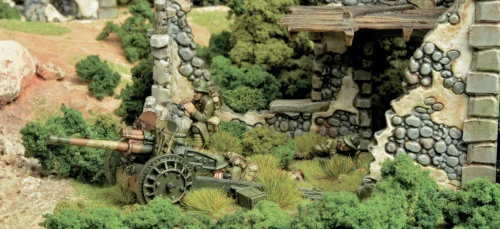
When a unit’s or vehicle’s Rift-tech die is exhausted, it becomes significantly less powerful. In contrast, good old 1940s technology, proven in the fires of World War II, remains reliable and available. This presents a genuine tactical calculation to consider. What could be more frustrating than having to flee from a Sherman because your gravitational pulse cannon is still recharging?
Furthermore, your specialized teams (anti-tank, mortars, snipers) remain indispensable. A trusty old PIAT or bazooka is perfectly capable of immobilizing a combat walker or a “Rift-flavored” armored vehicle.
Competitive players will need to find a delicate balance between Rift-tech units and classic forces.
 Join
Join Support and Backup: the weight of traditions from Bolt Action to Konflikt’47
On the fire support side, machine guns (MMGs and HMGs) remain the kings of the battlefield, especially with the penetration bonus (+1 Pen) for heavy machine guns.
- Mortars: Just as crucial as ever for dislodging targets out of line of sight.
- Artillery: Whether self-propelled or towed, it remains relevant. Combat walkers, with their 9+ armor, particularly fear heavy howitzers.
Historical Tanks from Bolt Action vs. Metal Monsters of Konflikt’47
Late War armored vehicles are not obsolete—far from it. Here are a few non-exhaustive examples to convince you:
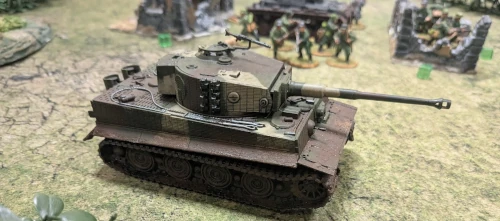
- The Tiger I: Its super-heavy anti-tank gun strikes fear into any walker with 9+ armor.
- The Sherman (76mm): An effective hunting option against German walkers.
- The M4A3E2 “Jumbo”: With its 10+ armor, it soaks up hits to allow your own walkers to advance.
- The M26 Pershing: In its Veteran version with a gyro-stabilizer, it is the king of units. For 390 points, its super-heavy gun and 10+ armor can break any Rift-Tech-enhanced armored vehicle.
Conclusion
Festung Europa is aimed at players of the Axis and the Soviet Bloc as much as those of the British Commonwealth and the US Army. This is not an “army book” filled with troop lists. Above all, this work offers scenarios and campaign timelines to forge your own narratives within this alternate history. It provides an ideal bridge for mixing the Konflikt’47 and Bolt Action miniature ranges. It thus constitutes a perfect opportunity to take the plunge.
The approach is clever: it revisits key moments such as Operation Overlord or the Battle of the Bulge. From 1944 onwards, it injects specific Konflikt’47 units in small touches. It is an invitation to rediscover history with that refreshing “je-ne-sais-quoi” of pulp.
Don’t be afraid to mix genres!
You can start by progressively integrating your Bolt Action miniatures into this alternative setting. With the steady pace of releases from Warlord Games—notably the new plastic kits from late March 2026—the publisher confirms that supporting this range is an absolute priority. Furthermore, a French version seems to be on the horizon for the coming months. Excellent news for those who might still be hesitating to get started.
The game’s context continues to expand. The freedom offered by Festung Europa to reconstruct campaigns is particularly welcome. As a roleplayer, I find that this supplement brings remarkable narrative depth:
- The short stories,
- The hero portraits, which breathe an exciting “role-playing” dimension into the universe,
- The three military campaigns and their scenario suggestions.
Opening up the universe ?
Operation Touchdown is the ideal breeding ground for survival and horror scenarios. Devastated cities serve as the backdrop, where the dead are not quite dead. I don’t know if Warlord Games will ever consider a true Konflikt’47 role-playing game, but Festung Europa proves it already possesses all the depth and potential.
Clues in the book’s sidebars are provided, notably regarding the next supplement—will it cover what is happening in the USA and the Pacific?
Bearfoot Miniature presents Festung Europa right here, and if you haven’t already, be sure to subscribe to the channel:
Update !
Ready your 3D printers for the finale of Operation Valentine! The STL files for the colossal Sturmriese are now available for free. This is the must-have model for the ‘Fell the Giant’ scenario. Download it now and bring some heavy metal to your tabletop!
Written by:


Buy the team a round
No ads, no paywalls, just pure passion. If our guides or deep dives helped you win your last game or discover your next favorite system, consider dropping a small tip on Ko-fi! Every pint helps keep the site independent and running.