 by
by Is your pile of shame constantly growing bigger? Is your hobby room starting to look like a Games Workshop stockroom? Then it’s time to embrace speedpainting—especially if you enjoy playing with painted miniatures!
What is speedpainting?
A speedpainted miniature is a standard gaming model—typically a basic trooper. We’re not talking about a named character, a rare centerpiece model, or your army general or senior officer in a single copy.
You can absolutely apply these principles to those models for their basecoats, allowing you to field fully painted miniatures on the tabletop.
Speedpainting means spending less than 25 minutes on a miniature before being able to play with a fully painted piece.
Master the fundamentals before you start
Before diving into speedpainting, you need to acquire some basic techniques.
- Basecoating (smooth, solid layers of color),
- Proper paint thinning,
- Drybrushing,
- Washes and shading.
What speedpainting won’t allow you to do
Speedpainting isn’t about creating insane display-level effects. Forget about:
- Glass flasks with visible liquid levels,
- Transparency effects,
- Trompe-l’œil details,
- NMM (Non-Metallic Metal),
- Complex cloak blends,
- Eyes on faces,
- Red lips and fine facial details,
- Details smaller than 1 mm,
- Freehand designs.
Stick to simple color schemes. Paint basic troops for the tournament in two weeks. Get your Sunday game ready with friends. Make that new Christmas game look good on the table!
Nothing stops you from revisiting your speedpainted miniatures later for upgrades and refinements.
25 minutes per miniature? Are you serious, Maurice?
The secret of speedpainting in 5 techniques
The secret of speedpainting lies in five key tactics:
- A well-organized, optimized workspace.
- A simple color scheme, with no more than 7 colors.
- Batch painting (minimum 5 miniatures).
- Using no more than 2 brushes (a size 3 all-purpose brush and a size 1 for details).
- Painting sessions of 2 hours maximum.
These techniques dramatically reduce painting time per miniature.
For example: I paint 5 miniatures in 2 hours—that’s just 24 minutes per model. Everything is optimized: color application, drying time, washes, and a fixed 7-color recipe.
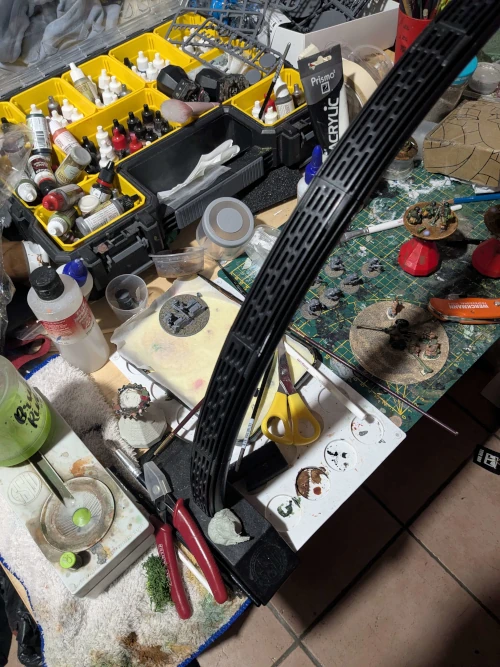
My workspace is designed so everything is within reach.
Preparing your speedpainting session
Like any battle plan, preparation is essential. Before wetting your brushes, take a good look at your workspace.
Ask yourself:
- Are you comfortable?
- Is the lighting good enough?
- Are your water pots large enough?
A well-organized workspace, easy access to paints and brushes, and miniatures mounted on painting handles will significantly boost your efficiency.
Optimizing your color recipe will also greatly improve your speed.
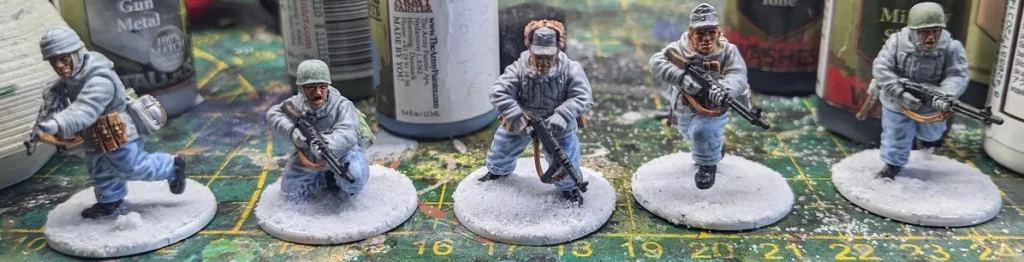
Test miniatures and color recipe
Study your miniature and estimate the number of colors needed. Identify the dominant color and the details. If you count more than 7 colors, you’re no longer speedpainting.
Likewise, if you need to mix custom colors on your palette—like creating a specific pink from red and white—you’re stepping away from the speedpainting mindset.
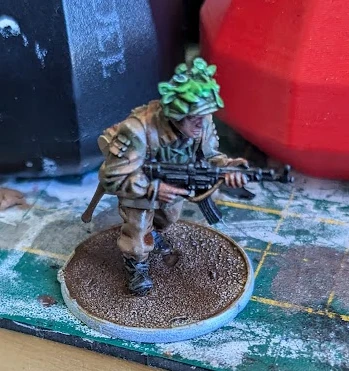
Use ready-to-use paints straight from the pot. Modern miniature paint ranges offer countless pre-mixed tones—take advantage of them.
Write down your recipe
Record your color recipe in a notebook. Months later, when expanding your army, you won’t remember every paint name.
- Boots: Black + thinned
- Jacket: Army Green base + Camo Cloak
- Leather: Leather Brown
- Rifle wood: Dark Wood + Gun Metal (metal parts)
- Face and hands: Tanned Flesh
Fast and efficient painting
The most important factor in improving speed is setting achievable goals.
Accept that your paint job won’t win an international award. Speedpainting is about achieving a good tabletop result at about one meter distance.
Up close, you’ll see flaws—and that’s perfectly fine.
You can always revisit your miniatures later for touch-ups or extra detailing.
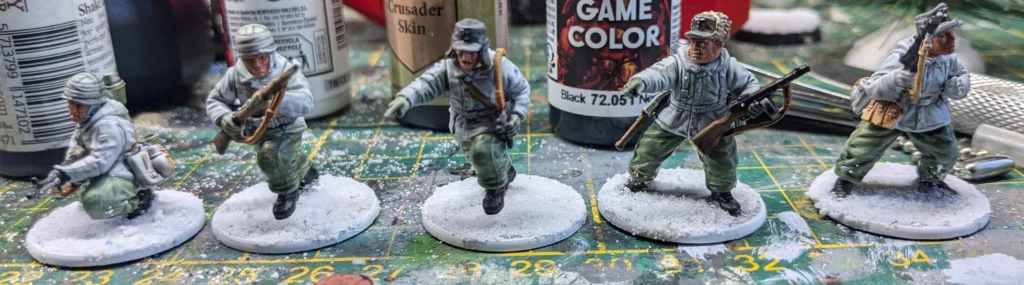
Paint 5 miniatures in batch, 2 hours max
Line up five primed miniatures. Start a podcast—no longer than two hours. Prepare your paints and two brushes: one large all-rounder and one smaller detail brush.
At the end of the podcast, stop and assess. Did you apply your seven colors to all five miniatures? Does the result match your test model? Congratulations—you’re officially a speedpainter!
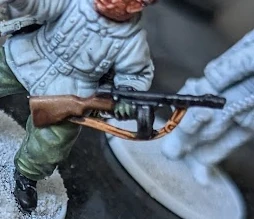
If you only managed three colors, that’s not failure. You’ll be faster next time. Pause, resume tomorrow, and aim to complete all five together. Time yourself.
Add up the minutes and divide by five. If you’re under 45 minutes per miniature, you’re on the right track!
Think it looks bad? Not at all. Corrections are easy. Painting is about adjustments. With experience, you’ll gain precision. Spilled paint on boots disappears under black. Missed leather details hide beneath cloaks or armor.
And at one meter distance—who’s going to call a foul? Your army is painted. End of story!
Thinning tip: achieve more with less
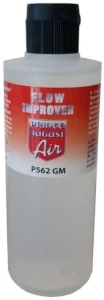
About two years ago, I discovered how paint thinning affects viscosity, drying time, and transparency. What could be better than achieving subtle transparency effects with standard paints?
On a white or black primer, adding a bit of flow improver makes paint ultra-fluid. It applies smoothly, prevents thick buildup, and keeps the surface workable. Unlike water thinning, flow improver avoids the dull finish water can create.
It requires purchasing a bottle of flow improver, but it’s a major advantage and real time saver. It also extends drying time, allowing smoother blends and color filters.
Visual fatigue?
Speedpainting isn’t just about painting fast—it’s about maintaining rhythm. Two hours is my limit. Beyond that, gestures blur and quality drops.
A friend of mine, a physiotherapist and miniature painter, explained it well: it’s not just your eyes. It’s your brain losing focus and your muscles losing precision. Central fatigue and peripheral fatigue. At night, it’s even worse. Sometimes it’s simply time to put the brushes down and return later.
The ultimate hack?
I use this method for all my miniatures. For standout models—generals, named characters, or detailed units like snipers—I later upgrade them. I add details and refine faces. But the base remains speedpainting.
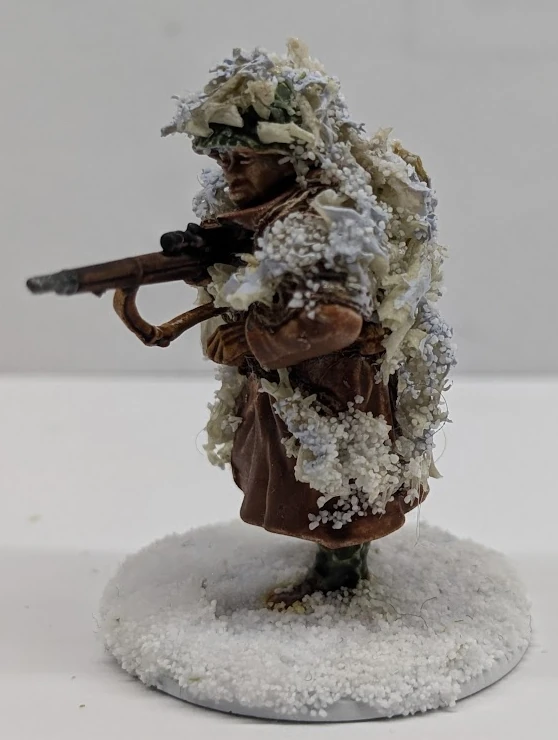
This miniature won second place in a painting competition. The base was 24 minutes of speedpainting. Camouflage effects took hours afterward, along with facial refinements and scope details.
Your pile of shame will shrink thanks to speedpainting
Once you’re painting five miniatures per week, your pile of shame will shrink—and storage will become your next problem!
Happy painting everyone!
If you enjoyed this article, this YouTube video will help you visualize the process.
Painting vehicles fast & well?
This video introduces a 99% sponge-based technique with impressive results for tanks and armored vehicles.
Written by:


Stay tuned
And never miss an article again! Join our Discord to get notified whenever we publish something new. You can even choose which games you want to receive notifications for!