
 by
by In this article, I’ll show you how to organize your first wargame tournament, drawing on my own experience hosting my first Star Wars: Legion event back in 2022.
The basics
Let’s start with the bare essentials required to bring your tournament to life:
- A venue
- Gaming tables
- A date
- Participants
Once you have secured these elements, you can launch your communication campaign. While that is running, you can define other details such as tournament rules, entry fees, etc. While these are also important, they are less urgent and can be communicated to your future participants at a later date.
The venue
There are three main options for your tournament venue:
- Coordinate with a local game store to host the event.
- Use your own space if it’s large enough to host the tournament.
- Rent a hall or local community center.
Option #1 is the simplest if you are a first-time organizer. You won’t have to worry about managing registration payments, as everything can be handled by the store. You will also benefit from the manager’s assistance and the shop’s existing reputation to attract participants. Option #3 is the most stressful, as it involves a risky investment: you will be forced to book the hall before even collecting registration fees.
Venue criteria
Whichever solution you choose, your venue must meet several criteria:
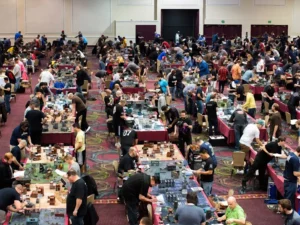
First, the space must accommodate tables of the correct dimensions for your specific wargame. The number of available tables will determine the venue’s capacity and therefore the maximum number of participants your tournament can host. Also, check if the space has side tables where players can place their gaming gear and casualties.
Secondly, since a full day is required to host several games in a row, the venue needs to be accessible on a weekend.
Thirdly, a non-essential point that can work strongly in your favor: the location of your tournament hall. If it is central and easy to reach via public transport, it’s a major advantage. But central to what, you might ask? To your player base! If the majority of players are located in the south of the country, don’t pick a venue in the north…
Finally, don’t forget that the location must also provide access to drinking water and functional (and clean) restrooms. A tournament lasts an entire day, and it would be a lack of courtesy to neglect this point. So no, an abandoned building is not a suitable venue.
Personnal experience
For my tournament, I chose to work with the Ludicorner shop in Gembloux. The store could arrange its space to accommodate either three 3×6′ tables or six 3×3′ tables. By opting for the six tables, I immediately defined my tournament capacity (12 players) as well as the format (Skirmish). Since the Discord player community is almost exclusively located in Wallonia, Gembloux was a geographically ideal location for residents of Charleroi and Namur, while remaining accessible for me as a Brussels resident. As for restrooms and water access, there were no issues there! 🙂
Gaming tables
A wargame match requires a gaming mat and terrain. Unless your venue already provides them, you will need to ask your community to lend you the necessary equipment. The amount of gear you actually need will depend on the number of sign-ups, of course. However, at this stage of planning, you should be able to determine the maximum number of tables, as this was defined by the venue’s capacity.
Personnal experience
As a relatively new business, Ludicorner did not provide gaming surfaces or terrain. We therefore had to ask participants for help. The co-organizer and I provided the materials for three tables, and the participants provided the last two (we had 10 participants, meaning 5 tables to set up).
Date, time, and schedule of events
Preparing a tournament takes time, and you must take this into account when choosing the event date. For a small tournament of about fifteen players, allow at least a month and a half between the moment you decide to organize the tournament and the actual date.
You will also need to set a start and end time. Don’t forget that you will be busy well before the official start to set up tables and welcome participants. The same applies to the end of the day, when you’ll need to pack up the equipment and clean the room.
Finally, you need to define the duration of the rounds and the schedule. Allow fifteen minutes between each round to give participants time to pack their gear and move to another table. If your tournament starts in the morning, include a lunch break to allow players to eat. Wargaming is long and tiring—proper nutrition is essential!
Personnal experience
Since Ludicorner was hosting the tournament, the choice of date was up to them. I was informed on March 19 that the tournament would be held on Saturday, May 7 of the same year, leaving me 1 month and 19 days to prepare. The event started at 11:15 AM, but I had access to the room from 10:30 AM. There were three 1-hour-and-45-minute rounds, a 30-minute lunch break, and buffers of at least 15 minutes between each round.
The participants
Without participants, there is no tournament! Start your communication campaign as early as possible to increase your chances of drawing a crowd. Note that you don’t necessarily need dozens of people to launch an event. Four players are enough to fill a day with three matches per person. If you’re nervous about your tournament being a “flop,” arrange for three gaming friends to show up no matter what. 😉
To promote your event, you should use a dedicated platform, such as Table Top Tournament, Longshank or Best Coast Pairings. You can learn more about those site in the dedicated article here:
Tournament rules
You will need to write down your tournament rules so that participants can review them. These rules should specify the game version applicable during the tournament as well as the format. Also, specify which conditions are acceptable for participation. For example, are proxy miniatures allowed? Does the army need to be painted?
Personnal experience
Back in 2022, we decided to use the 2.0.2 version of the RRG for Star Wars: Legion. This version would remain applicable even if an update were released between the announcement date and the event. Printed cards and up to five proxy miniatures were allowed. A painted army was recommended but not mandatory.
You must also communicate the type of tournament and the number of matches per player. These depend on the duration of your event and the number of participants. For small one-day tournaments, I recommend Swiss Rounds. They allow you to organize as many matches as desired. Indeed, player pairing is based on individual results: winners play against winners, and losers against losers. If your tournament spans two days, it is common to use a Swiss system on the first day and direct elimination (brackets) on the second.
Personnal experience
Since the tournament took place over a single day, I opted for three rounds of 1 hour and 45 minutes using a Swiss system.
Prizes and rewards
While optional, rewarding players for their performance is always welcome. It adds stakes to the tournament and serves as the icing on the cake at the end of the day. The more participants you have, the better the prizes you can offer, as each entry fee contributes to the prize pool.
Personnal experience
The prizes consisted of promotional cards from the official tournament kit.
Pricing
The main costs of organizing a tournament vary. Generally, venue rental, prizes, and your own time are the biggest factors. Do not expect to make a profit on a small tournament; aim only to break even on your investment.
Personnal experience
Purchasing the tournament kit cost €35. This kit contained the necessary cards for a 500-point tournament as well as promotional rewards. Since I paid for this upfront, I communicated the amount to Ludicorner. They then determined the entry fee: €15, which included tournament entry, a store voucher between €5-€15 depending on ranking, and a drink. Ludicorner then reimbursed me the €35. Perfect!
Validating registrations
To ensure that prospective participants actually show up on the day, only confirm their registration once you have received their payment and a valid army list. Army lists must comply with the format rules and should be submitted in advance for verification. To maintain impartiality, these lists should be checked by someone not playing in the tournament.
Personnal experience
I asked a member of the Discord to handle receiving and checking the lists. He even took the liberty of creating printable sheets so that every player had a hard copy of their list. Very handy for checking an opponent’s list during a game. Thanks, Laurent!
The day of the tournament
The day of the tournament will be busy. You will need to set up the room and tables, prepare the scoreboard, and organize the first pairings. Help will be greatly appreciated, so try to surround yourself with a few people to support you.
The organizing staff
The organizing team ensures the tournament runs smoothly. Based on my experience, I have identified three key roles for the staff. As an organizer, you can embody all of them yourself, but I wouldn’t recommend it:
Your spare player
Their role is to fill the gap in case of an odd number of participants. This situation should be avoided at all costs, as it means one participant will receive a “bye” during each round. This is where your joker comes in. Their participation is only confirmed on the day of the event if, for whatever reason, someone is missing.
Personnal experience
As the organizer, I planned to play this role if necessary. I prepared just like any other participant: I submitted my army list on time and brought my miniatures with me on the big day. Since there were 9 registered players, I stepped in as the 10th player.
The referee: the rules Expert
This person possesses an in-depth knowledge of the game’s rules. They help save time (by being consulted directly instead of flipping through the manual) and act as the final word in case of disagreements between players.
Personnal experience
In addition to being a participant, the tournament co-organizer served as our rules reference.
The TO (Tournament Organizer): The impartial lead
This person oversees the smooth running of the tournament. They record scores, enter them into the system, and announce the next pairings to the players. They also handle any emergencies or unexpected issues.
Personnal experience
I would have liked the shop owner to play this role, but I should have briefed him beforehand to make that happen. By default, this role logically fell to me. Fortunately, no unexpected issues required my attention during the games, which would have been tricky since I was already acting as the ringer. After each match, the fifteen-minute buffer I had planned gave me enough time to enter the results. Good call!
Numbering the tables
To identify each table, you must assign them a number. Remember to print out large numbers to place on each gaming table.
Stay tuned
And never miss an article again! Join our Discord to get notified whenever we publish something new. You can even choose which games you want to receive notifications for!
The scoreboard
The scoreboard (or pairing sheet) is used to communicate the time of the next round, the table number, and the opponent each player will face. Print a blank template beforehand and bring a pen and some tape.
Scoring and standings
I highly recommend using a management tool for the rankings. Longshank and Best West Coast have one integrated, but not TableTopTournament. It allows you to choose different tournament types, including the Swiss system. Based on the results entered, the site automatically calculates the standings and generates the next pairings. Compared to a homemade Excel sheet, Challonge has the advantage of being accessible to the players if you share the URL. It’s practical and allows the public to follow the tournament results in real-time!
Personnal experience
This is where I messed up in the tournament organization. As it turns out, Star Wars: Legion does not allow for ties. Since I was mostly used to casual games, this caught me off guard on the day of the tournament. If players cannot be separated based on the mission objective, the winner is the one who destroyed the most enemy points. If it’s still a tie, the “Blue Player” wins. However, with the Swiss system, the margin of victory is vital for calculating a player’s strength (Strength of Schedule). Essentially, winning 5-2 is better than winning 2-1. Yet, higher scores were more easily achievable if a tie occurred. An attentive player would have noticed that it was actually more advantageous to force a tie and focus on destroying as many enemy units as possible.
Conclusion
I wish I’d had a tutorial on hand for my first tournament; it would have saved me from making certain mistakes. Nevertheless, even without one, I was proud of the result. I hope this article serves as a guide for yours or inspires you to organize one yourself. I can only encourage you to try this adventure at least once. It will provide you with a sense of personal accomplishment and a real boost in self-confidence. If that’s not enough, you’ll also earn the gratitude of the players. For one day, you’ll have given them the chance to recharge and escape from their daily worries.
Written by:


Stay tuned
And never miss an article again! Join our Discord to get notified whenever we publish something new. You can even choose which games you want to receive notifications for!