
 by
by In any miniatures game, walls, thickets, rivers, and other obstacles matter when determining lines of sight and who has cover. Malifaux goes further. In Malifaux, terrain is more than simple scenery that can limit movement or visibility. It can be decisive for mobility, survivability, positioning, and sometimes even for scoring Victory Points.
Terrain properties
Each piece of terrain in Malifaux has one or more properties, such as blocking, climbable, impassable, or destructible. I won’t go over the full list here—only the ones that matter for our topic.
Climbable
Any climbable terrain can be climbed. This means a model can stand on it and move across it. Typical examples include walls, piles of crates, flat-roofed houses, and so on.
During a move, you may move vertically along the side of this type of terrain. Note that you are not required to stop at a point where the model can stand; we’ll come back to this when we talk about falling.
In addition, at the end of a Walk action, the model may scale any climbable terrain its base is touching. This is very useful for getting over tall walls quickly, but it can only be done after the move. Plan your movement carefully or you may end up wasting an action.
Impassable
This is somewhat the opposite of the previous property. You can neither climb it nor stand on it. Sloped-roof houses are probably the most common example of this type of terrain.
Blocking
Climbable or impassable terrain will often also be blocking. Here we are talking about blocking lines of sight. If you are behind it, you can no longer be seen.
Another very interesting effect: a model within 2″ of such terrain, with at least one line of sight passing through that terrain, has cover. Cover reduces damage suffered by 1, and it can reduce damage all the way to 0. It is one of the only common effects that can reduce an attack’s damage to 0. Cover therefore works exactly like an automatic shielded token. Armor and the Incorporeal condition, for example, always allow at least 1 damage through.
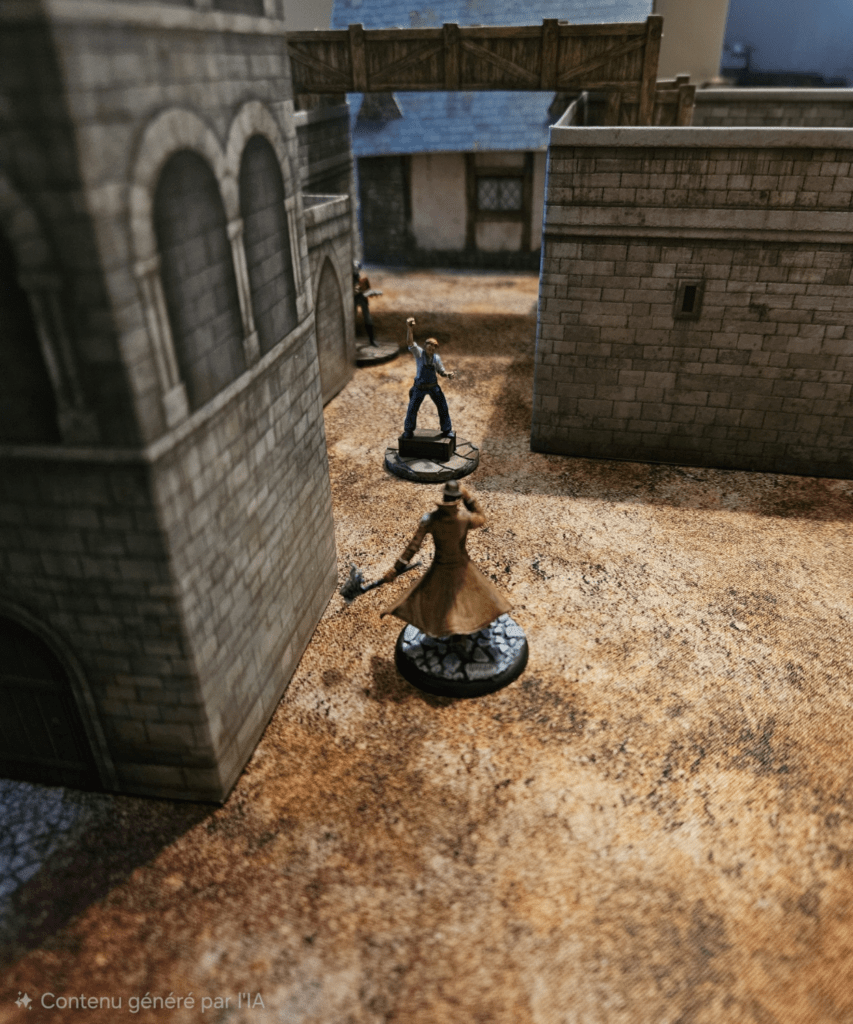
The background of the image has been retouched by AI
Sneaky tip: optimize damage reduction
Apply cover’s damage reduction and the shielded token last if you have other sources of reduction. Most attacks deal 2 or 3 damage before taking any increases into account. If you are shielded and in cover, a 2-damage attack with no increase will deal no damage at all!
Destructible
Any destructible terrain can be removed from the game with a Slam action. This general action has a range of 1″, like the Interact action. It also allows you to remove from the game a marker other than a Scheme.
Palisades and most pieces of terrain described as “obstacles” are destructible. Crates, rocks, coffins, and so on can therefore be destroyed. Walls, on the other hand, are too solid to get rid of that easily.
This means you can, with a single action, destroy an obstacle to clear a line of sight, or to make an enemy perched on it fall. Yes—we’ll talk about falling later.
Height and elevation
Finally, all terrain has a height. It is measured on the same scale as a model’s size. So terrain with height 2 and a model with size 2 measure exactly the same thing.
Elevation is simply the sum of the heights of the stack of climbable terrain the model is standing on. If it is on a height 1 crate that is itself on a height 2 wall, its elevation is 3.
Elevation, line of sight, and cover
Elevation is mainly used to calculate lines of sight and determine whether the target has cover.
Even though all distances are measured horizontally, there is still a blind spot concept. Don’t worry—you won’t have to do trigonometry. In short:
- if terrain that is higher (or at the same elevation) as both models lies between them, they cannot see each other,
- if only one of the two models is the same size as (or smaller than) terrain between them, and that terrain is within 2″ of its base, the line of sight is blocked.
A model is automatically in cover if it is at an elevation at least 2 higher than the model targeting it. Note two things: the terrain does not have to be blocking (but it must be climbable), and this only applies when the target is higher than the attacker.
Elevation is also used to determine whether a higher enemy is within punching distance. Is your punching bag higher up, but the elevation difference is less than or equal to your size? You’re good! However, cover still applies if that difference is 2 or more.
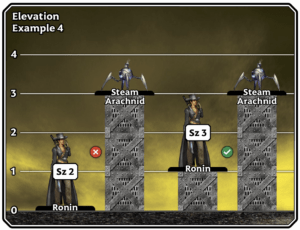
In both cases, the Steam Arachnid benefits from cover if it is targeted.
“It’s over, Anakin, I have the high ground”
So we’ve seen that being higher up provides many advantages:
- you can see over lower obstacles
- if you are at least 2 elevations higher
- you get a free “shield” against attacks (cover)
- you cannot be attacked in melee by an enemy smaller than your elevation difference
In addition, two Schemes from the “Season Zero” of 4th Edition (the season released at the launch of this new edition) require placing markers up high: Scout the rooftops and Take the high ground.
Some profiles have advantages for playing with heights. Some ignore heights entirely, such as flying models (flight). Others gain specific benefits if they are at elevation (increased range, prerequisites for triggers, and so on).
Any model that ignores terrain while moving also ignores that terrain’s vertical distance. They can therefore cross obstacles and climb onto climbable terrain for free. This makes them excellent candidates for claiming the high ground, just like models with Place effects.
Be careful, however: this does not allow them to end their movement in illegal places, such as on impassable terrain. And only the movement rules are modified—these abilities have no effect on other terrain rules (such as cover, lines of sight, and so on).
Moral of the story: if you want to live long, live perched!
Yes, but…
“He tripped on a rope.”
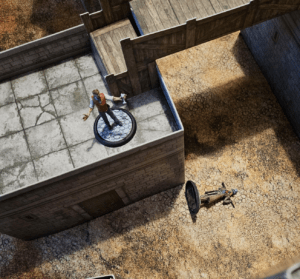
what happened!”
And there we go—we’re finally going to talk about falling.
The rule says that any model with more than 50% of its base over empty space falls, and if a model falls from at least 2″ high, it suffers 1 point of irreducible damage. This is therefore an excellent way to deal one point of damage to a well-protected model.
Just as some Schemes require being up high, one scheme specifically requires making enemy models fall: Make it look like an accident.
How do you cause a fall?
We’ve already talked about destructible terrain that can cause a fall when it is destroyed with a model on it. But almost all movement effects can also be used, including an Obey effect. You simply need to bring the target to at least 2″ of height with less than half of its base on a surface: climb 2″ up a piece of climbable terrain, go over the edge of a roof, and so on.
Be careful, though: models and effects that ignore vertical distance negate falling damage. It is therefore impossible to cause falling damage by Placing the target “in midair,” because a Place effect ignores vertical distance. In addition, it is illegal to Place a model somewhere where more than 50% of its base is over empty space. Flying models are of course always immune to falling.
On the other hand, direct movement effects can cause falls very easily if your target is close to an edge.
Causing a fall with an Obey effect is the easiest option, as long as the target does not ignore vertical distance. With Obey, a simple Walk action can cause a fall. Climbing 2″ up a piece of climbable terrain or going over an edge are the most obvious options. If the model ignores vertical distance during a Walk action, it may still be possible to cause a fall with a Charge. However, you are not allowed to climb or scale during a Charge, so the target must already be at height.
Charge
A Charge includes a straight-line move of up to the model’s Speed, followed (optionally) by an attack. In Malifaux, you do not need to end within attack range to be allowed to Charge. However, this movement is not a Walk action. Therefore, you cannot climb or scale during a Charge unless a special rule comes into play.
A few statistics
Let’s take a look at the numbers to see whether terrain-related schemes are common in 4th Edition.
Three schemes are directly tied to climbable terrain with a minimum height of 2. Three schemes out of the 15 in a season may not sound like much, but it still represents 1 in 5. Since we have three available at the start of the game, there is about a 50% chance that one will be drawn.
4th Edition introduced a change: you can change your scheme each turn within a defined list of three possibilities. Seven other schemes allow you to select Scout the rooftops, Take the high ground, or Make it look like an accident. That’s almost half of the total number of available schemes.
So we have 10 schemes out of 15 that are directly tied to terrain or that can lead to a scheme that is. If you take a second change into account, there is only one that cannot lead to one of these three schemes.
It is therefore certain that at least one of the three schemes will be available during a game! Of course, depending on your crew and your opponent’s, some schemes will be more achievable.

Find Malifaux players
Join your country’s Malifaux Discord community and connect with players nearby.
 Join France
 Conclusion
Compared to the previous edition, climbable terrain is more important. It is an interesting defensive strategic asset and can even help you score Victory Points depending on the schemes chosen.
Given the high probability that you’ll be able to choose a terrain-related scheme during a game, it’s important to take it into account when setting up the terrain. If a table has no climbable surfaces at all, that means 20% of the schemes will be completely impossible.
Written by :

Wep'tak, multi-category editor
I primarily enjoy discovering new games and experimenting with original rule systems. I dabble in everything, from historical wargames to fictional universes, driven by curiosity and the desire to explore. Yet, there are titles I always return to with pleasure: Infinity, One Page Rules, Fireball Forward, Blücher, 5 Leagues from the Borderlands, and 5 Parsecs from Home.
 Buy him a coffee
 Explore our coverage by game



Support an independent wargaming website
Critical Hit is a volunteer-driven project, but it still comes with real costs. If the site helps you in your hobby, please consider supporting us on Ko-Fi. Every contribution, no matter how small, means a lot to us and genuinely helps us keep the project going.
 Support us on Ko-fi