
 by
by If you are a former Guild Ball player, you might have wondered why this game has suddenly sparked conversation again over the last few months. The reason is simple: Steamforged Games has officially restarted the engine. But what happened in the meantime? In this article, I tell the story of a game returning from the dead to fulfill its mission: toppling Blood Bowl from its long-established throne.
When leather challenged steel
The genesis of the challenger
On February 20, 2014, Steamforged Games launched a crowdfunding campaign for its new tabletop game called Guild Ball. Offering clever mechanics and minimizing RNG as much as possible, this medieval football game aimed to position itself as a tactical sports game rather than one rooted in slapstick humor. The campaign reached its goal within 24 hours and raised £93,691 in a single month. The publisher succeeded in its gamble: winning over players looking for a serious alternative to Blood Bowl.
Early success: the birth of a new tabletop phenomenon
It wasn’t until 2015 that the first miniatures—then made of metal—began appearing in specialized shops across Europe. During its first season, Guild Ball invited players to become the coach of one of the 8 available guilds, each offering a distinct playstyle. Only a year later, the publisher refined the gameplay with the release of Season 2, followed shortly after by Season 3.
Guild Ball through the seasons
In Guild Ball, we don’t talk about editions but seasons, much like TV series. Indeed, new rules are accompanied by new protagonists (players or guilds) and new plotlines: some players betray their guild to join another. It’s a true “popcorn drama” that Steamforged Games fueled with story driven tournaments where the results determined the future of the lore!
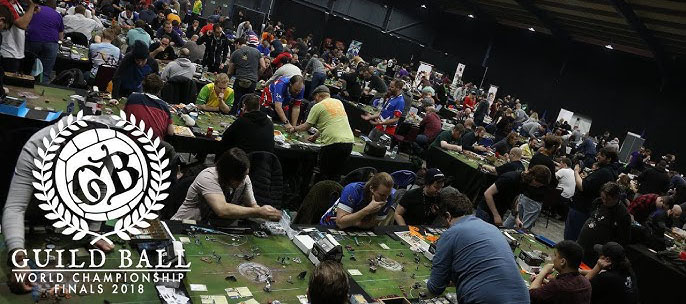
Attracting more and more curious onlookers, the game began building a constantly expanding fan community. And for good reason: Guild Ball forged a reputation as a balanced game with clear rules, offering fast-paced and dynamic matches. Miniature stocks sold out instantly. The community’s enthusiasm was so strong that tournaments inevitably bloomed across Europe and later the United States, culminating in the first World Championship organized at SteamCon 2016!
Did you know ?
It is notably thanks to Guild Ball that the website Longshanks.org was born—one of the most famous tournament organization platforms for miniature games. The site’s name is actually a reference to Guild Ball lore.
Scaling up and polishing the game
The year 2016 also marked a turning point for Steamforged Games. First, a two-player starter set named Kick Off! arrived in stores, signaling the start of Season 3. It was a complete product featuring the Masons’ Guild versus the Brewers’ Guild. The set contained everything needed to play immediately, including a 3×3′ cardboard game board!
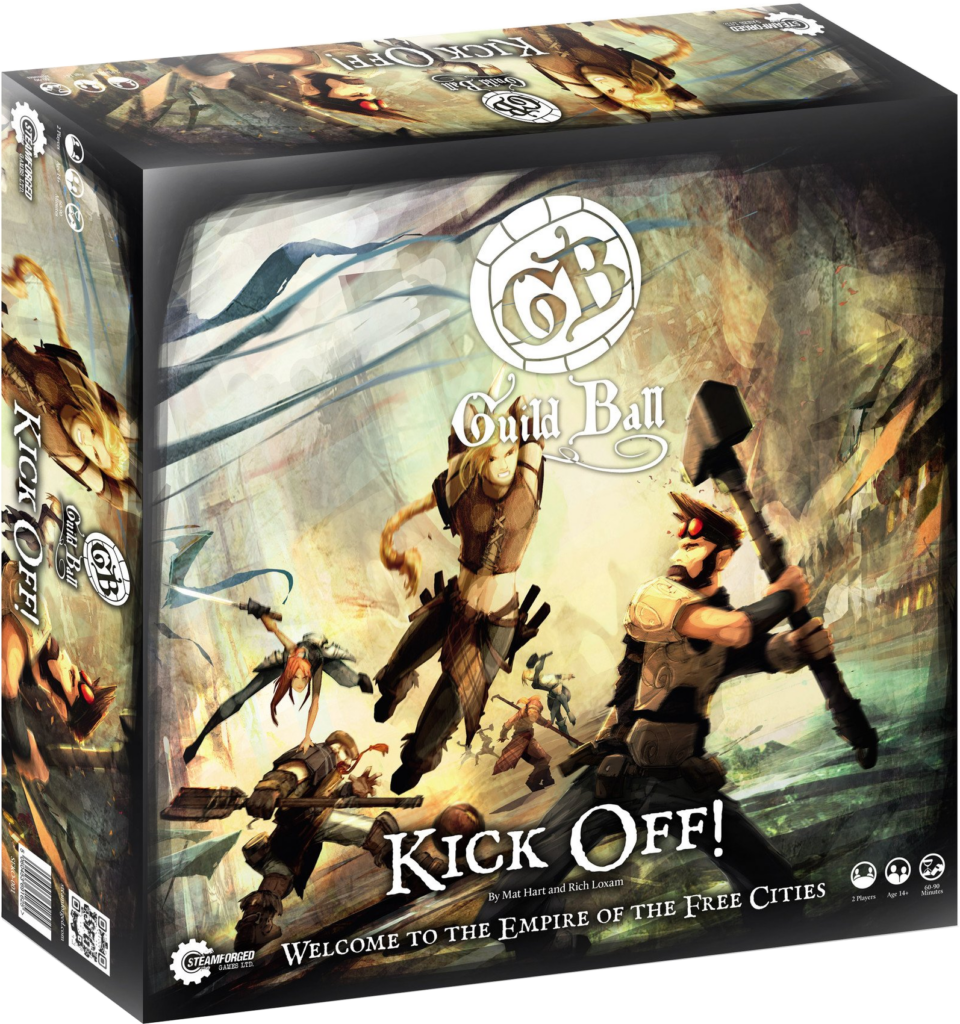
Secondly, Steamforged Games began a production transition: multi-part metal miniatures gave way to pre-assembled plastic figures. The Kick Off! set was the first Guild Ball product to feature these new models. The goal was to make the game as accessible as possible. To accompany this change, the packaging for future guild boxes was also redesigned with a much more appealing look.
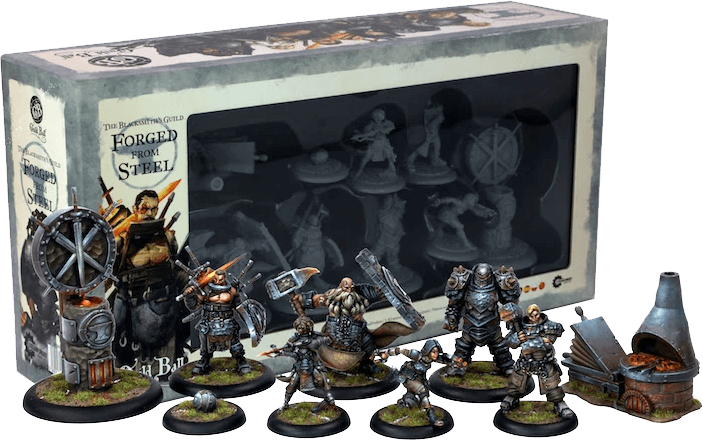
In 2017, Steamforged Games announced the arrival of Minor Guilds, with the ambition that eventually every Major Guild would have its own affiliated Minor Guild. The commercial objective was clear: bring the game to a total of 22 guilds by systematically pairing each Major Guild with a Minor one.
In 2018, Season 4 was released, introducing deep structural changes to make the game even smoother, more intuitive, and better balanced. This season introduced the beloved Game Plan Deck, which replaced the old Plot Cards. It was a season highly appreciated by the community, and rightfully so.
Guild Ball seemed to be on a winning streak. At least, if we ignore the gray skies looming on the horizon…
Shadow over the pitch
Steamforged’s rusty gears
After bringing numerous changes to the game, it was now Steamforged Games’ turn to review its own operations. During 2018, production began to slow down. Steamforged had promised a re-release of the older guilds in plastic, but at that time, less than half were available in that material. The most requested guilds were not being reprinted, which frustrated players. Acquiring certain guilds became a real struggle, preventing new players from entering the stadium.
The silent stadium
Then 2020 reared its head. Along with it came the health crisis we all unfortunately know too well. In its wake, the Reaper caused the cancellation of numerous tournaments. The community was caught between a rock and a hard place: on one hand, the publisher was no longer supplying stock, and on the other, COVID prevention measures prevented friendly meetups. A miniature game, like a tripod, relies on three fundamental pillars to survive: publisher support, the community, and tournaments. Remove even one, and things go south. But two at once? What remains?
The final whistle
In August 2020, Steamforged Games shocked everyone with sad news: the end of production and support for Guild Ball. Among the reasons cited, the publisher pointed the finger at players who weren’t buying new guilds, preferring to stick to a stagnant meta by playing only the old guilds. This clumsy communication shared on their site was deleted some time later (but nothing truly disappears on the internet—you can find the controversial article via the Wayback Machine).
It was a clumsy bit of communication because, while players identify the meta, the publisher alone has the power to disrupt it. It is a complex exercise requiring experience in the field—experience Steamforged likely lacked at the time. The publisher was then more accustomed to board games than “living” games.
Regardless of the reasons given, the result was painful: the game was stopped. Match over. Go home.
The dark years: a community on life support
This news hit the community like a sledgehammer, and it took several months for fans to regain their composure. A few die-hard fans then created the Guild Ball Community Project (GBCP): a player association dedicated to keeping Guild Ball alive. Over the following years, they created the Alchemists’ Minor Guild (The Lamplighters) and unofficial rebalancing updates for existing guilds. Against all odds, the GBCP performed constant CPR on Guild Ball. Some, exhausted, threw in the towel, while others took over. Stay with us Guild Ball, don’t lose consciousness, please…
And then came 2024.
The unexpected extra time
In 2024, observing the GBCP’s impressive commitment and the eternal love of the die-hards for this exceptional game, Steamforged Games announced they were returning to medieval football. But on one condition: limiting costs. The publisher opted for a Print on Demand (POD) model via its webstore for several of the game’s guilds. With this move, the publisher opened the doors for new players and allowed veterans to complete their collections.
In 2025, Steamforged Games stepped on the gas and offered new content: an update to the Game Plan Deck, a new guild (The Lumberjacks), and most importantly, the release of every miniature in the game in STL format via MyMiniFactory! Now, players can print the guilds of their choice for themselves and all their friends!
And suddenly, the heart began to beat again, followed by a deep breath. Slowly Guild Ball opened its eyes…

The Guild Ball machine is slowly but surely getting back up to speed. Content creators, through their blogs or YouTube channels, are once again sharing battle reports, shining a spotlight back on football played with axes.
When you think about it, it’s a beautiful victory for the GBCP and the community. Even if it hasn’t quite reclaimed its former glory, the efforts to keep Guild Ball alive were not in vain. Granted, the cost was high: many players turned their backs on medieval football as the years eroded their passion. But will they one day set foot on the pitch again? Only time will tell…
Find Guild Ball players
Join your country’s Guild Ball Discord community and meet players near you.
 Join France
 Your turn to play

Jack Brussell: This article concludes my series dedicated to Guild Ball, a game I have wanted to cover for several years. And now, it’s done! If you want to keep the momentum going, don’t hesitate to write your own piece about the game and share it on Critical Hit. How to do it?
And if writing isn’t your thing, just grab a whistle and dive into Guild Ball!
Written by :

Jack Brussell, the driving force behind Critical Hit
I discovered miniature games in 2020 through Star Wars: Legion, and soon felt the urge to share insights and strategies about the game with others. That’s how Critical Hit was born in January 2022. What began as a one-man venture into Legion became a true team effort in 2025: As new writers joined the project and I explored more wargames myself, the site expanded to cover many more miniature games, reaching an ever-growing international audience.
 Buy him a coffee
 Explore our coverage by game






Support an independent wargaming website
Critical Hit is a volunteer-driven project, but it still comes with real costs. If the site helps you in your hobby, please consider supporting us on Ko-Fi. Every contribution, no matter how small, means a lot to us and genuinely helps us keep the project going.
 Support us on Ko-fi