
 by
by Are you considering getting started with Guild Ball, the medieval fantasy football miniatures game? But you are still unsure about which guild to choose? To help you decide, I have ranked all the guilds in this article according to their primary win condition: scoring goals or taking out opponents. You will also find a brief description of each guild’s playstyle.
Choosing a Guild
There are currently 20 guilds in Guild Ball:
| Major Guilds | Associated Minor Guilds |
|---|---|
| Alchemists | Lamplighters |
| Butchers | Cooks |
| Engineers | Miners |
| Hunters | Falconers |
| Masons | Lumberjacks |
| Morticians | Ratcatchers |
| Fishermen | Navigators |
| Farmers | Shepherds |
| The Union | The Order of Solthecius |
| Brewers | Coming soon |
| Blacksmiths | Coming soon |
How to choose your guild in Guild Ball?
To identify the guild that suits you best, I recommend asking yourself two questions:
Core flexibility: major or minor Guild?
Among all available guilds, we distinguish between major guilds and minor guilds. A minor guild is always tied to a major guild: for example, the Cooks are associated with the Butchers, and the Falconers with the Hunters. But what exactly is the difference between these two categories?
- Major guilds have a larger player pool (including three captains). This provides greater strategic flexibility, as you have more freedom when building your starting six. Their captains offer very different, sometimes even opposing, playstyles. If you are new to Guild Ball, these choices can be intimidating, and it may be better to start with a minor guild.
- Minor guilds offer a single, clearly defined strategy. They rely on a fixed roster of eight players: the six original members of the minor guild, plus two players borrowed from the associated major guild. Because team-building options are limited, minor guilds are generally more beginner-friendly.
Need to browse all player profiles?
The Guild Ball App website is your best companion when selecting your team. It gives you access to all the game’s cards, making it ideal for getting an overview of every player. Pay attention to the colors of the guild crests: similar colors indicate that guilds are linked together (major–minor).
Securing victory: ball game or brawl?
Remember: you earn victory points either by scoring a goal [4 VP] or by sending an opposing player to the infirmary [2 VP, or 1 VP for mascots]. There are therefore two main ways to win a game of Guild Ball, and each guild has a stronger or weaker affinity with a particular approach: playing the ball, seeking fights, or a mix of both!
This strategic spectrum can be visualized as a line, with the two extremes representing the most polarized playstyles: football on one end and attrition on the other. The center represents a hybrid strategy, able to switch between the two depending on the situation.

In Guild Ball, these three poles are embodied by three iconic guilds:
- the Fishermen, specialists of pure ball play;
- the Masons, the archetype of the versatile guild;
- and the Butchers, the embodiment of an elimination-focused game plan.
All other guilds fall somewhere between these three poles. For greater granularity, the spaces between the poles can even be defined as sub-strategies. Doing so results in a total of five playstyles in Guild Ball:
- Goal scoring;
- Goal scoring with long-range control;
- A balanced hybrid strategy, with an emphasis on control;
- Eliminating opponent players with long-range control;
- Eliminating opponent players.

The illustration above is very useful for quickly making your choice, as, like a restaurant menu, you can see at a glance which part of the axis best suits your preferences.
Personal example
To me, Guild Ball is primarily a football game. I play it to pass and score goals. If my main objective were fighting, I would rather turn to Warhammer Underworlds, an arena game where combat is central to the gameplay.
So I’m looking for a guild focused on goal play. But beware, I also don’t like locking myself into a single playstyle, as I’d get bored quickly. That’s why the guilds that suit me best are those that fall into strategies 2 and 3.
And you? Which approaches interest you the most?
In the rest of the article, I briefly describe each guild, starting with the Fishermen and following the order of the axis. Feel free to jump directly to the one(s) that interest you!
Goal-scoring guilds
The Fishermen

The Fishermen are the most goal-focused guild in the game. They rely on their speed and positioning to score quickly, often securing early goals at the start of a match. Their game plan is then to maintain that lead for the remainder of the game.
Their core roster is made up of players who can cover long distances at speed, win the ball with ease, and convert goals effortlessly—in short, all the key ingredients needed to excel at a ball-control strategy.
To balance this exceptional ball game, the Fishermen suffer from low damage output. They are also fragile, which means they must avoid straight-up fights whenever possible. If they need to take an opposing player out of the game, their best option is usually to push them off the pitch rather than engage in a fair fight.

The Navigators

Following in the footsteps of the Fishermen, their major guild, the Navigators are naturally gifted goal scorers. However, they set themselves apart from their peers thanks to their exceptional reliability. Indeed, the Navigators benefit from the special rule Precise Calculations, which allows them to reroll any number of attack or kick dice. As a result, they are widely considered the most reliable guild in the game.
With highly favorable dice probabilities, the Navigators can more easily break through opposing defenses and mitigate debuff effects that target their TAC. To fully capitalize on their reroll bonus, the guild aims to roll as many dice as possible. This results in a playstyle centered around charging (+4 dice) to tackle the opposing ball carrier, then rapidly sprinting toward goal to score with near certainty. When mastered, this guild can score multiple goals in a single turn.
Like most ball-oriented guilds, the Navigators are not built to remain in prolonged melees. Fragile by nature, they have a polarized profile: extremely strong at scoring goals, but with very few answers to heavy control strategies. As a result, they will dominate certain matchups while suffering greatly against others.
The Order of Solthecius

The Order of Solthecius is a minor guild affiliated with the Union. It is the most aggressive goal-scoring-oriented team, in the sense that it maintains constant offensive pressure and often secures its final victory points by eliminating one or two opposing players. Being extremely fast, the Order imposes an unsustainable tempo on its opponent thanks to its signature special rule: the Ball of Light.
This rule introduces a second ball into play, which cannot be used to score goals. However, it can be used for passing, allowing Order players to make a 4″ dodge each time they do so—particularly useful for escaping melees. In addition, this second ball deals 4 damage to any enemy model that attempts to interact with it (picking it up, tackling it, or passing it). The Ball of Light is therefore a key tactical asset and plays a central role in the Order’s game plan.
To the point where successfully completing passes is vital for the Order, as it fuels their extra movement and makes them nearly unstoppable. This reliance on a frantic tempo is also the guild’s main weakness. Missing passes is their worst nightmare. The guild struggles against opponents who adopt control-heavy strategies and slow the game down. Their average Playbooks make them less threatening in close combat, especially against tough, resilient enemies. That said, one interesting trait sets them apart: the Order fields surprisingly resilient players for the strategy they employ, distinguishing them from the two previously discussed guilds.
The Miners

The Miners are a minor guild affiliated with the Engineers. They primarily focus on proactive ball play and positioning, with the key distinction that they can very easily disengage from melees. This is made possible by their signature ability, Secret Tunnel, which allows their players to reposition by 2″ at the start of their activation.
This crucial ability allows them to escape almost any situation and greatly extends the team’s threat range across the pitch. In addition, Secret Tunnel makes the guild resistant to movement-reducing effects, as the Miners rely more on positional play than raw movement.
Like most ball-focused guilds, the Miners prefer to avoid prolonged combat. If forced into direct confrontation, situations often turn grim. That said, the Miners are noted for their durability, which is relatively uncommon for a team centered on ball play.

Find Guild Ball players
Join your country’s Guild Ball Discord community and meet players near you.
 Join France
 Goal-scoring guilds with long-range control
These guilds are fundamentally focused on scoring goals, but they first rely on long-range board control. This may take the form of area effects or ranged damage to weaken the opposing team, making subsequent goal scoring much easier.
The Engineers

The Engineers are a guild that plays in two distinct phases. Early in the game, they aim to establish long-range board control through various abilities and ranged attacks to weaken opposing players. Then, in the mid-game, they overwhelm the opponent with strong ball-handling capabilities.
To execute their plan, the Engineers must dictate the pace of the game and keep engagements at range until the opponent is sufficiently weakened. For this guild, avoiding melee is not a preference—it is a necessity. Due to their low melee damage output, Engineers can quickly become bogged down if opponents reach them unscathed. They struggle to compete in sustained exchanges of heavy blows. Fortunately, the Engineers have a valuable safety net: their high physical resilience, an unusual trait for a ball-oriented guild.
The Engineers are not recommended for beginners, as they are difficult to play. Mistakes are heavily punished, and once on the back foot, these intellectuals struggle to turn the tide. Their complex abilities must interlock correctly for their game plan to function.

The Alchemists

This guild fully embraces the mad scientist archetype, hurling potions as weapons and delighting in turning the pitch into a toxic wasteland. As such, it is played with a hit-and-run approach, amplified by numerous ranged attacks and effects. It is a team that uses attrition and area control to enable goal scoring, focusing its strategy on two main pillars:
- Conditions: They poison and set their opponents on fire, then exploit these conditions to boost their own statistics or abilities.
- Area-of-effect zones (AOEs): They love littering the pitch with hazardous zones to dictate where opposing players can—and cannot—go.
As is often the case with this archetype, the players themselves are quite fragile. The Alchemists therefore fall squarely into the “glass cannon” category.

The Lamplighters

The Lamplighters want to score goals quickly—and they want to do it in spectacular fashion. Equipped with strong shooting capabilities, excellent mobility, and a remarkable ability to optimize their influence pool, they excel at explosive plays. On the downside, their players are relatively fragile and deal little damage in combat.
Special rule: The Lamplighters wield mastery over fire, represented in-game by their ability to apply or remove the Burning condition from players. Like children playing with a light switch, they toy with an “on/off” cycle throughout the match to trigger various effects. For example, Captain Nightlight’s trait Back to Black allows him once per turn to remove Burning from a friendly model within 6″, immediately granting that model a 4″ dodge. Beacon, meanwhile, increases his melee range to 3″ when “extinguished,” while when Burning, he gains +2 TAC dice and the Burning Strike keyword. Overall, the Lamplighters are a guild with a strong and cohesive theme.
Hybrid strategy guilds (adapting to the situation)
These are versatile guilds capable of alternating between goal scoring and eliminating opposing players. They are generally less efficient at each individual strategy than guilds that specialize exclusively in one. However, this versatility allows them to adapt to their opponent’s game plan and exploit weaknesses as they arise.
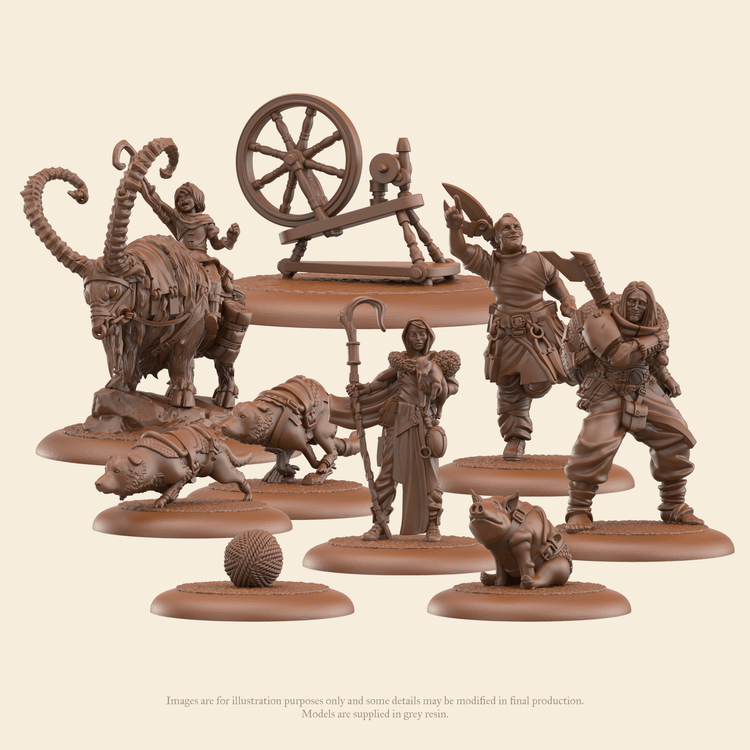
The Shepherds

The Shepherds offer a unique and disruptive playstyle, centered on moving models, both friendly and enemy, through their Herding ability. By deciding where players end up, the Shepherds control the pitch to set up decisive plays or trigger surprise eliminations by pushing opponents off the field. Positioning is their primary tactical weapon, whether carving a path to goal or clearing enemies from the pitch.
Additionally, the Shepherds stand out by representing a flock rather than a traditional team. Animals make up a significant portion of the roster (dogs, a ram, and a pig). Each friendly take-out feels like the loss of a family member: every Shepherd model that is removed provides a benefit to the remaining team. For example, when Ram is taken out, all other characters gain +2 ARM. When Shearer is taken out, they instead gain +1/+1″ Kick for the rest of the turn. The Shepherds walk a razor’s edge, threatening both goals and take-outs in a fast, proactive manner.
And there is more: as a minor guild allied to the Farmers, the Shepherds also inherit the Harvest mechanic. Several of their players can trigger effects by removing Harvest Markers from the pitch. I encourage you to consult the Farmers’ description to learn more about this mechanic.
In conclusion, the Shepherds are a mechanically rich guild. They provide access to board control, push-based eliminations, and goal scoring. Despite being a minor guild, they are not recommended for beginners, as their extensive toolkit requires experience and finesse to fully unlock their potential.
The Morticians

The Morticians are the ultimate control guild: they have a complex, highly strategic playstyle based on manipulating and reacting to the opponent’s actions. They aim to disrupt enemy plans by repositioning allied or enemy players. Tricks and sleight-of-hand moves are common with this guild. They can also steal Momentum from opponents. Points are scored either through Obulus’s ball game or Scalpel’s eliminations.
However, this guild struggles against teams resistant to their control, and their players are vulnerable to targeted attacks. The Morticians require significant experience and practice to unlock their full potential, making them unsuitable for beginners.

The Blacksmiths

The Blacksmiths are a unique guild in their structure. The team is split evenly between Masters and Apprentices. Masters are heavily armed and have Captain-level durability, and any Master can act as Captain in any match. Apprentices are fast and fragile but develop into powerful threats as the game progresses. The Blacksmiths’ strategy relies heavily on training Apprentices, gradually increasing their threat across the board. Predictably, this guild also has the best armor in the game, making them highly resilient against short-strategy opponents.
The Blacksmiths have a versatile strategy, alternating between ball play and eliminations. Like molten metal, they adapt perfectly to their opponent and forge the right tools to overcome any adversary.
This guild is complex to play, relying heavily on player synergies. Separating Apprentices from their Masters can disrupt their plans. Player positioning is critical, as the Blacksmiths struggle against teams capable of repositioning their own units.

The Masons

The Masons are the most balanced guild in the game, following a reactive and versatile playstyle: they can score victory points both in combat and through ball play. Skilled in all phases but excelling in none, they prefer thoughtful play and adapt to the opponent, striking at the optimal moment. Their solid armor and defensive auras discourage engagement from adversaries.
Masons are also known for bending game rules to their advantage, gaining extra activations and movements outside their phase. However, they have no reasonable long-range control or damage tools, making them vulnerable to teams excelling in those areas.

The Ratcatchers

The Ratcatchers are a versatile team, both chaotic and control-oriented, aiming to disrupt the opponent’s ball game while scoring goals themselves. Their strategy is to reduce enemy efficiency by mispositioning players, forcing inconvenient activations, or draining extra resources. They act as plan disruptors, relying on this to shine. Their game typically only comes together mid-match once they’ve slowed the opponent sufficiently.
Special Ability: The Ratcatchers use the Desease mechanic. When a figurine with the Desease condition ends its activation, all players within 2″ also gain the Desease condition. Additionally, deseased players must spend an extra Momentum point to heal.

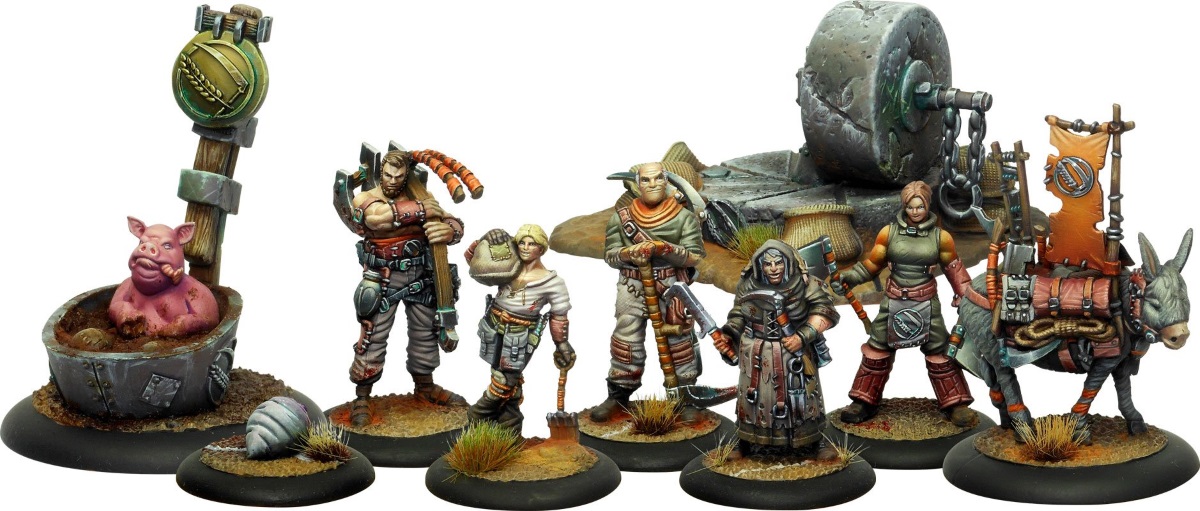
The Farmers

(The following text comes from the official guild booklet). The Farmers adopt a defensive, methodical playstyle, using markers to boost attacks and ensure reliable damage. They focus on careful defensive strategies and long-term investments, planting to later reap the benefits.
The Farmers have limited abilities to disrupt the enemy team, preferring to work together toward a common goal. Individually, their figurines may struggle alone, but united they are stronger than the sum of their parts. They excel from mid to late game, when they can capitalize on their efforts.
The Farmers reward players who enjoy emphasizing teamwork and focusing on long-term strategies rather than short-term objectives.
Guilds focused on eliminations with ranged control
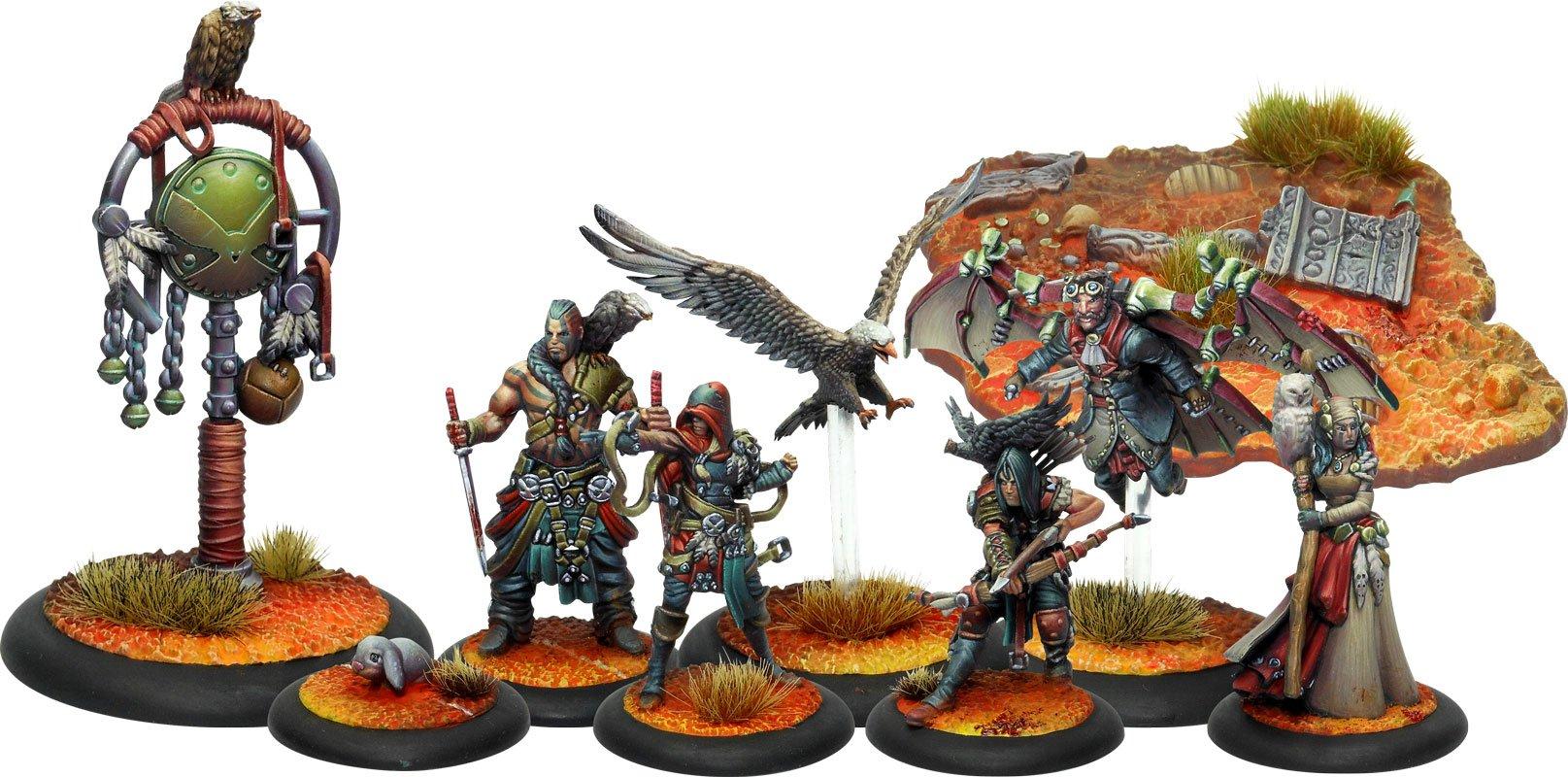
The Hunters

The Hunters focus on eliminating enemy players, weakening their targets with ranged attacks and traps before finishing them off. Indeed, the Hunters’ special ability allows them to set traps on the field. These traps have a dual effect: opponents take 1 damage and receive the Trapped status (1 DEF and –2″/–2″ MOV) when they come within 1″. With this debuff, Hunters can control the opposing team: dictating areas to avoid, and if the enemy ignores them, they suffer severe slowing effects. Combined with their natural speed, Hunters can dominate the field in terms of mobility.
Their typical strategy is cautious and evasive, using a hit-and-run approach. They move along the edges of the pitch to maintain distance from enemy players, staying safe while targeting the weakest opponents for elimination. Fragile by nature, Hunters avoid direct and fair combat.

The Falconers

The Falconers are a minor guild affiliated with the Hunters. Extremely mobile, they aim to keep enemies at range while gradually weakening them through long-range attacks. Once opponents are vulnerable, the Falconers strike to finish them off. Their strategy mirrors that of the Hunters but emphasizes this style of play even more. Being particularly lethal at range, they force enemies to rush toward them to avoid worse outcomes.
The Falconers can deal heavy ranged damage thanks to their special ability Harrier, available on almost every guild member. This allows you to place a persistent Area of Effect (AOE) within 4″ of the player using it. Enemy models within this AOE take +1 damage from character actions and Strategic Guide results that deal damage. Additionally, if Devana is chosen as captain, the Harrier ability costs one less Influence to use.
The Falconers are vulnerable to ball-focused teams. These players must be eliminated before they score, which is challenging given the speed and specialization of such teams.
Combat-focused guilds
These guilds adopt a proactive playstyle and can deal significant damage. However, each of the guilds below has its unique approach to combat.
The Brewers

The Brewers are a brawling guild who enjoy close combat. Their main strength lies in their durability and ability to absorb hits. Known as the toughest guild in the game, their resilience makes them friendly for beginners, allowing mistakes without severe consequences.
Their high durability encourages a board-control playstyle. Slow to start, Brewers aim to wear down opponents by taking hits without flinching and then retaliating with powerful strikes, pushes, and frequent knockdowns. They also have decent ball-handling skills, allowing them to score goals when opportunities arise.
The Brewers’ special ability lies in their numerous Heroic Plays, powerful actions that require one Momentum point to use.
As for weaknesses, they have low mobility and depend on synergies. They must stay grouped or risk getting bogged down.
If you like analogies, the Brewers are a slow but heavily armored war machine. Their advance is relentless, and their consistent damage output allows them to win the war of attrition.

The Union

(Text sourced from the official guild booklet). The Union’s playstyle revolves around role specialization and individual skill. Instead of relying on complex combinations of multiple figures, Union players excel individually, each with strength in a specific domain.
The Union’s strength and adaptability come from pairing skilled players with tasks suited to their abilities. Each figure excels independently without requiring assistance.
The Union rewards coaches who see their team as a set of precision tools, provided these tools are matched to the right situations.

The Cooks

The Cooks are a minor guild affiliated with the Butchers. They employ an aggressive, high-risk offensive style focusing on eliminations. Their strategy often relies on executing crazy combos mixing debuffs and buffs, enhanced with resource optimizations—a winning recipe!
The guild’s special ability is Intimidation, a debuff applied to enemies: when the Cooks attack, enemy models suffer –1 DEF. They also leverage buff effects to optimize stats or resources, such as the legendary Master Cook ability of their captain, whose 6″ aura allows allies to use one of their abilities without paying Influence.
This fast guild uses its speed to deal heavy early damage and can even capitalize on opportunities to score goals later in the match.

The Lumberjacks

The Lumberjacks, affiliated with the Masons, are the newest guild in Guild Ball, released in November 2025. While full experience is limited, initial reports suggest an aggressive and powerful playstyle. Their special mechanic revolves around log stacks. These pieces can be placed on the field after engagement and form the core of the Lumberjacks’ strategy:
- Providing cover, enhanced mobility, and boosted attacks to nearby allied players;
- The guild excels when grouped around these structures, unlocking new effects and abilities;
- The log stacks are movable and can be relocated by Lumberjacks during the game.
Thus, the Lumberjacks focus on methodical elimination of opponents using the collective strength of the team to achieve their goals.

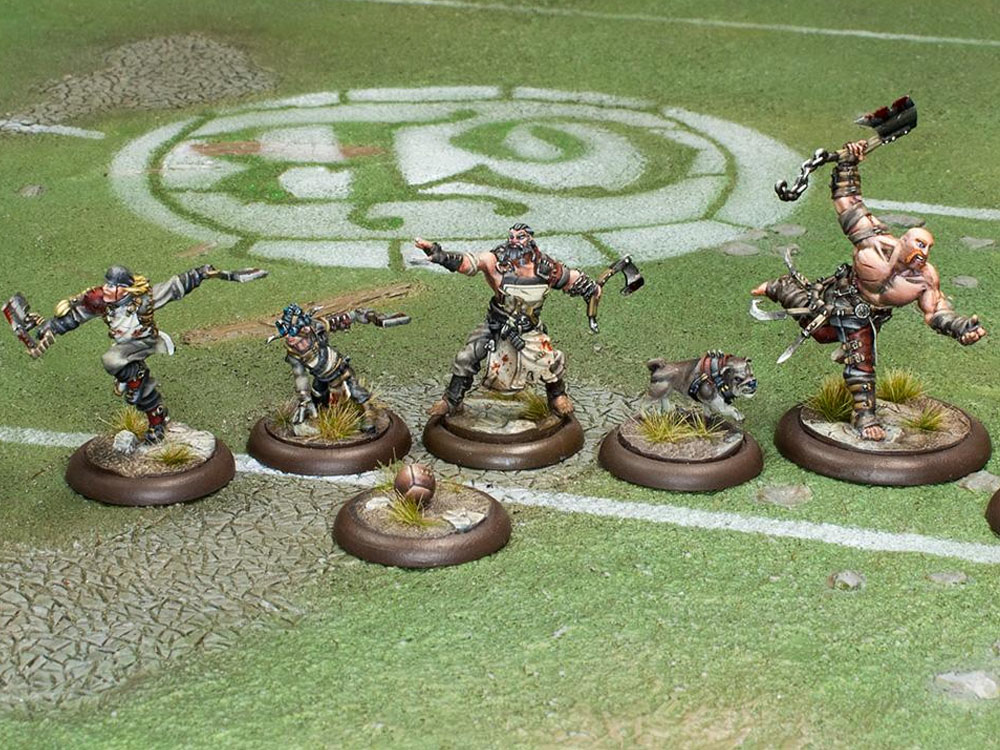
The Butchers

At the opposite end of the spectrum from the Fishermen are the Butchers. They focus entirely on maximizing damage and quick eliminations, generating lots of Momentum through combat. Excelling at raw damage output, they dominate mid-to-late game. With excellent mobility, the Butchers resemble hungry great white sharks charging at their prey.
However, the Butchers cannot absorb hits as well as they deal them. This means Butcher matches are fast-paced: with casualties on both sides, games end quickly!
With their simple, brutal playstyle, the Butchers are accessible for beginners.
Acknowledgements and further readings
I would like to thank Alrik from the french-speaking Guild Ball Discord group for proofreading this article and providing valuable feedback. I would also like to thank Henry Kay and his wonderful blog, Gut and String; the team behind the Guild Ball Community Project website; the Guild Ball wiki; and the Steamforged Games website, all of whom helped me better understand some Guilds I was not accustomed to.
Written by :

Jack Brussell, the driving force behind Critical Hit
I discovered miniature games in 2020 through Star Wars: Legion, and soon felt the urge to share insights and strategies about the game with others. That’s how Critical Hit was born in January 2022. What began as a one-man venture into Legion became a true team effort in 2025: As new writers joined the project and I explored more wargames myself, the site expanded to cover many more miniature games, reaching an ever-growing international audience.
 Buy him a coffee
 Explore our coverage by game






Support us via Maxi Rêves ✨
Help us promote lesser-known miniature games and grow their communities. Order your miniatures from Maxi Rêves using the code MAXITC and be part of our mission!