 by
by Disclaimer
These scenarios are not part of the official Konflikt’47 setting. They are entirely my own invention. They are primarily intended as a way to play a series of short Konflikt’47 games with your fellow players, as part of a small campaign comprising six scenarios.
Scenario: “Dawn of the Rift on the Atlantic Wall”
In the Festung Europa supplement, there are several playable scenarios. While you wait to get your hands on that book, I invite you to discover this mini-campaign.
With this scenario, I propose exploring an alternative history narrative of World War II. It isn’t quite the universe of Konflikt ’47 yet, as we are two years earlier, nor is it strictly Bolt Action, since it is a non-historical uchronia. It serves as the perfect bridge to have fun and experiment with the mechanics offered by both games.
The Pitch
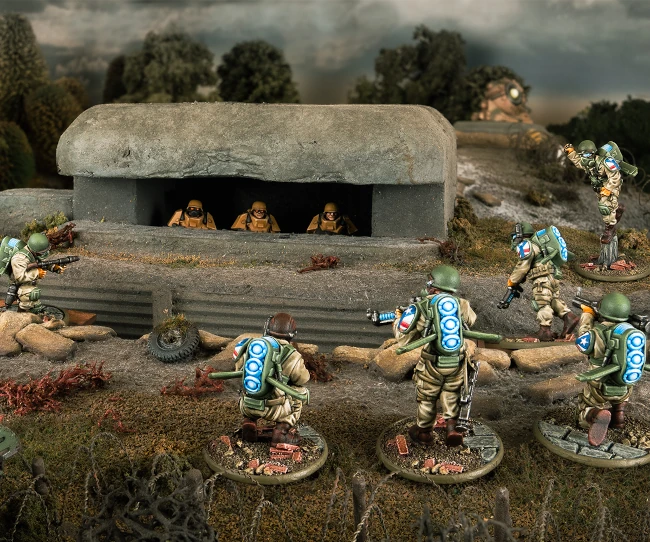
A landing in Belgium, September 1945. The ground troops are identical to those of ’44, but they are supported by Firefly units (jump infantry). Imagine classic tanks landing alongside walkers emerging from the waves of the English Channel… On the German side, the Green Vault has already deployed Vogelspinne light mechs. This is the ideal starting point for an evolving campaign—a bridgehead to reinforce the Allied push that will officially begin in February 1947.
Requirements: This scenario requires the Konflikt ’47 starter set and a collection of US and German soldiers.
The Context
June 1945. Allied bombings have turned Calais and Dunkirk into an inferno. Further north, on the beaches of Middelkerke, Belgium, the front is taking shape. The US plans a vast campaign to establish a permanent additional bridgehead in Europe. The target: the deep-water port of Zeebrugge and, eventually, control of the port of Antwerp. To achieve this, they have decided to land on the beaches south of the Scheldt estuary, taking advantage of the high tides and, most importantly, equipment boosted by Rift Tech.
05:52 AM: Inside Blockhaus MN 128, Heinrich Severloh’s team is on high alert. Suddenly, a monstrous silhouette emerges from the sea foam: the first American walker is approaching.
Forces in Presence
| Side | Hero & Special Units | Points / Notes |
| Axis | Heinrich Severloh (Stahltruppen Officer) + 2 Stahltruppen (StG44Zs) | 166 pts (Damage 7+, Morale 10, Fanatic) |
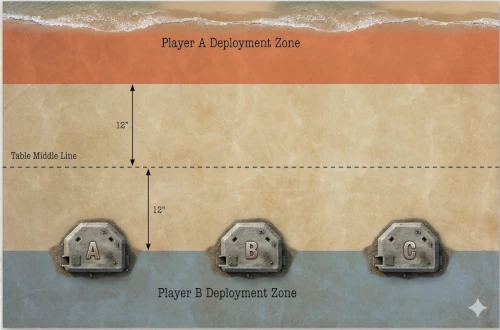
| Axis | 3 Bunkers with Regular Pak 40s | 200 pts per unit |
| USA | John Steele (Jetpack Firefly Officer) + 2 Fireflies (Thompson + Rockets) | 174 pts (Flight, Stubborn, Lucky) |
Complete your lists up to 1500 points at your discretion.
Objectives
- USA: Control the 3 bunkers (6 VPs per controlled bunker, 3 VPs if destroyed).
- Axis: Hold the bunkers (1 VP per turn for each intact bunker under control).
Playing the Transition: A Narrative Approach
A compelling idea is to set your games before 1947. Imagine transition scenarios where Konflikt ’47 units subtly emerge within a classic Bolt Action game. Since the point systems are very similar, this narrative option is seamless.
The interest of this approach is to gradually introduce your gaming partners to Konflikt ’47 by operating a smooth transition—starting with a historical narrative campaign that slowly tilts into the game’s official timeline as participants acquire more specialized units.
 Join
Join Integrating the “Frontline” Format
To run this kind of campaign punctuated by smaller skirmishes, the Frontline format (developed by WMT Benoist) is perfect: low point games (750 pts), a maximum of 9 Order Dice, and specific platoon restrictions.
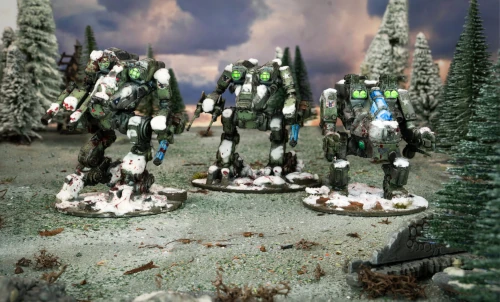
With the addition of Konflikt ’47 units, new options must be included to integrate combat walkers. This allows for shorter games where players learn to handle new units (Grade 1 or 2 heavy armor infantry, walkers) that expand tactical possibilities.
This format is also excellent for introducing new players with a limited number of miniatures. Finally, it’s a great way to test Heroes: accessible to platoon officers, special rules like Lucky, Rift Master, or Guts provide excellent flavor missing from standard Bolt Action.
Frontline 47: Force Structure
To accommodate the specificities of Konflikt ’47, the army format is as follows:
- Assault Platoon (Bolt Action & Konflikt ’47 units allowed)
- Engineer Platoon (Bolt Action & Konflikt ’47 units allowed)
- Armoured Platoon (1 Late-war Bolt Action tank allowed)
- Armoured Walker Platoon (1 Walker OR 1 Rift Tech tank)
- Heavy Weapon Platoon (Bolt Action & Konflikt ’47 units allowed)
Point Limits: In standard Frontline, the limit is 750 points / 9 dice. For Frontline 47, the author (Benoist) suggests 800 points / 9 dice (with a 2-point tolerance).
Campaign: Powered by Frontline 47
Context: European Front / 1945 / Belgium
Goal: Encircle the city of Bruges to liberate it and seize control of the Scheldt.
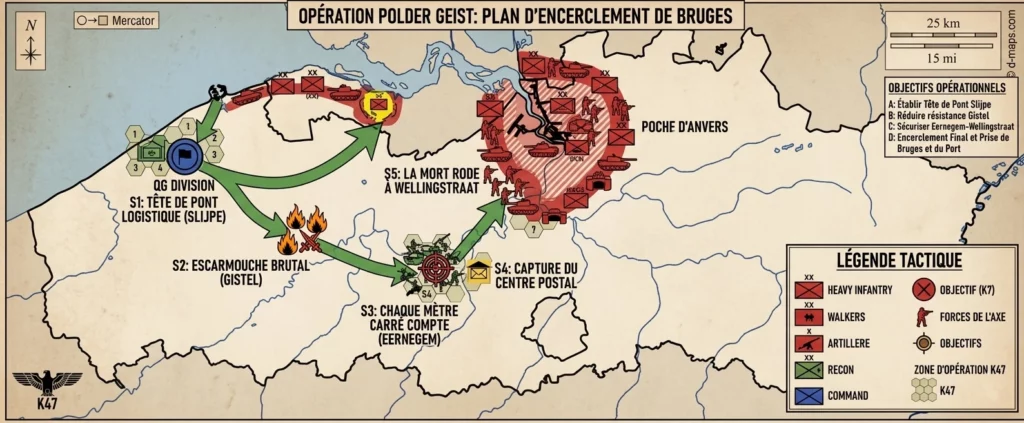
Scenario 1: The Slijpe Logistic Bridgehead
- Format: Forced Advance
- Setting: Village of Slijpe, September 1945.
- Mission: The Axis must defend Slijpe to prevent the Allies from establishing a comfortable bridgehead.
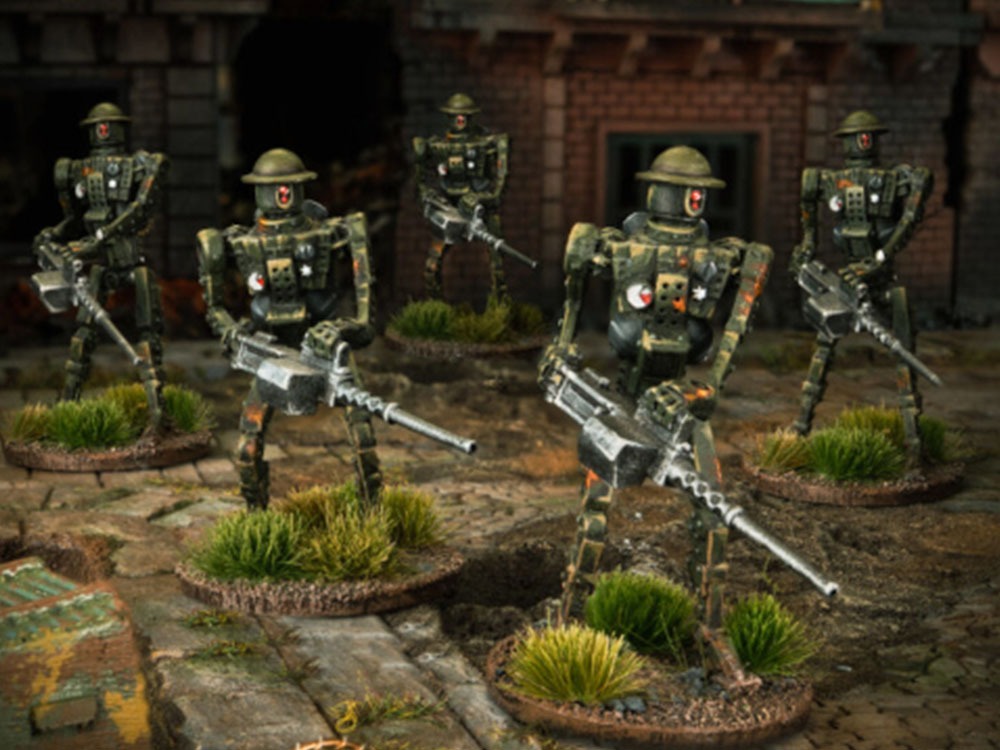
- List Note: Units should be 90% Bolt Action; integrate one Firefly squad, one Stahltruppen unit, and one Hero leading the Assault Platoon.
Consequences for Scenario 2:
- US Victory: Bridgehead secured. The Allies may deploy 2 tanks or 2 walkers (instead of the usual limits). The US leader receives a free Veteran Bodyguard (2 men).
- Axis Victory: Landing is chaotic. US supply lines are cut: No Armoured Walkers allowed. The Axis may place minefields or anti-tank obstacles (3 sections of 6”) around Moerdijk.
Scenario 2: Brutal Skirmish at Moerdijk & Gistel
- Format: Kill the Target
- Setting: Village of Moerdijk, October 1945.
- Mission: Enemy leaders (who can be Konflikt ’47 units) are the primary targets.
Consequences for Scenario 3:
- If US Leader is killed: The local Rift-Tech project is decapitated. No Armoured Platoon. Any US unit using special tech (Tesla, Lasers, etc.) suffers a breakdown on a roll of “1” before their first shot of the game (the shot is lost).
- If Axis Leader is killed: Conventional infantry flees, leaving only fanatics. Limit of 4 Bolt Action squads. However, Stahltruppen or Nachtjäger units become Fearless for the duration of Scenario 3.
Scenario 3: Every Meter of Eernegem Counts!
- Format: Point Blank Range
- Setting: Industrial city of Eernegem, January 1946.
- Mission: Fighting in a devastated industrial zone.
Consequences for Scenario 4:
- Axis Victory: The “Quagmire.” The US forces are exhausted. They must replay Scenario 3 at 850 pts. Their walkers are so poorly maintained that any Damage roll against a US vehicle receives a +1 bonus on the damage table. The Axis receives a free 3-man Stahltruppen unit.
- US Victory: Technological Domination. The US captures the factories. In Scenario 4, they can use the Preliminary Artillery Strike rule; any Axis units hit are automatically Down and arrive only on Turn 2.
Scenario 4: Capture of the Eernegem Postal Center
- Format: King of the Hill
- Setting: Central Eernegem, February 1946.
- Mission: A strategic ruined building holds vital supply intel. Both sides converge to recover it.
Consequences for Scenario 5:
- US Victory: Supply routes secured. In Scenario 5, the US Order Dice limit increases from 9 to 11, allowing for more support units.
- Axis Victory: Technical blueprints recovered. In Scenario 5, the Axis can field a second combat walker in their Armoured Walker Platoon.
Scenario 5: Death Lurks at Wellingstraat
- Format: Accelerated Attrition
- Setting: Suburbs of Wellingstraat, March 1946.
- Mission: A final, bloody confrontation where both forces are at their breaking point.
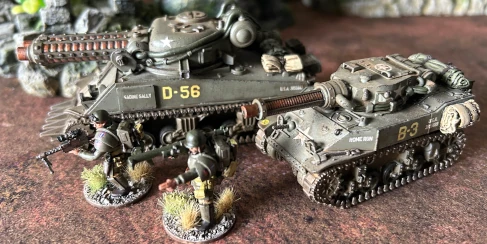
Campaign Conclusion:
- US Victory: Wellingstraat falls. The encirclement of Bruges is nearly complete. The campaign continues into the Summer of 1946 with even more Konflikt ’47 units.
- Axis Victory: The siege of Bruges is broken by a massive counter-offensive from Antwerp, featuring heavy divisions of new combat walkers.
End of Frontline Campaign. Transition to full-scale Konflikt ’47 games.
Written by:


Buy the team a round
No ads, no paywalls, just pure passion. If our guides or deep dives helped you win your last game or discover your next favorite system, consider dropping a small tip on Ko-fi! Every pint helps keep the site independent and running.