 by
by Konflikt ’47 is an alternate history that proposes an extension of the Second World War with the emergence of new technologies.
This article is based on a copy of the game that Warlord Games provided to us free of charge as part of a press relationship. This does not grant any oversight over our editorial content: Critical Hit retains full independence and our opinions remain free and objective.
April 1947 – Normandy near Crépon
Oberstleutnant Meyer had been holding the Atlantic Wall since 1944. Rushed from Saarbrücken during the German counter-offensive, he had been thrown into the furnace of Caen. For five days, he had repelled British assaults amidst a nightmare landscape: a devastated city where thousands of civilians had evaporated in the din of bombardments and barrages. Then, around June 12th, the tide turned. His company had advanced toward the coast, marching over the debris of a crushed Anglo-American bridgehead. From the Baltic Sea, wolf packs had emerged to finish the job, sinking the Allied destroyers that desperately tried to support their ground troops.
The Dresden turning point
In his view, the martyrdom of Dresden had marked the true strategic turning point of the conflict. The removal of the Chancellor and the takeover of the armies by career generals, led by Rommel, had radically changed the situation. The Green Vault, a secret organization, reportedly intervened. This is what the men whisper at night in the barracks. Horrors were said to be emerging from secret laboratories, far more disturbing than the experiments of Nazi doctors in the camps, which were already leaking out at the time.
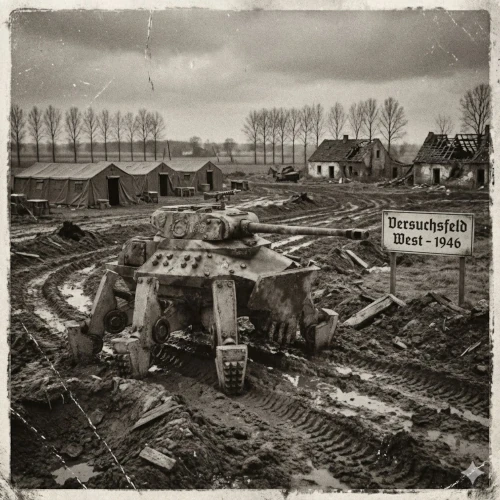
For three years, the Axis had been consolidating its positions, exploiting enslaved labor from southern France to erect impregnable defenses. While the face of war remained familiar, the arsenal had been metamorphosed. The old Panzer IVs were now mere relics compared to the new weapons born from the brains of the Reich’s scientists. For Meyer, a veteran hardened by years of mud and iron, these innovations were still just gadgets. He remembered the propaganda films shown at the Crépon barracks: they featured the Wotan, a colossal “Panzer-mech,” a metal monster bristling with a latest-generation anti-tank gun.
A Norman morning!
That morning, the Norman drizzle clung to uniforms, and the men of the battalion woke with the slowness of gray days. It was the time of the great March tides. Soldiers were already talking about scouring the sand at low tide to improve their rations with a few shrimp or cockles. The acrid smell of chicory floated in the barracks—the immutable scent of military life.
Suddenly, a detonation rattled the windows, barely a hundred meters from the base. The characteristic yelp of anti-aircraft guns followed instantly. An American raid, again, the fourth of the month. Meyer rushed outside, but what he discovered under the low sky of Normandy surpassed everything he had imagined until then…
The Evolution from Version 1 to Version 2 of Konflikt ’47
Konflikt ’47 was born in 2016, in the wake of its “big brother” Bolt Action. The latter was created by two industry legends, Alessio Cavatore and Rick Priestley, known for their work on Warhammer 40,000 and Mordheim at Games Workshop.
For this second edition of Konflikt ’47, a true “dream team” of authors has taken the lead: Andy Chambers, Gav Thorpe, Roger Gerrish, and many others. The presence of Andy Chambers is particularly noteworthy, as we owe him pillars like Warhammer 40,000, Epic, and Battlefleet Gothic. This exceptional pedigree makes Konflikt ’47 a real treat for miniature gaming enthusiasts.
An update focused on action
The game has closely followed the evolution of its predecessor. The transition from V2 to V3 of Bolt Action in September 2024 provided the perfect opportunity to overhaul the system. By sharing the core rules of its brother-in-arms while benefiting from ten years of experience and feedback, this new version of Konflikt ’47 aims to be faster, more modern, and tactically deeper.
Between horror and science fiction: The “Weird World War” vibe
The game’s universe sits in a fascinating middle ground. It is the brutal encounter between military history and fantastic science fiction. Imagine The Longest Day if it had borrowed tanks from Star Wars to face horrors worthy of Howard Phillips Lovecraft’s delusions:
- The Axis deploys legions of undead.
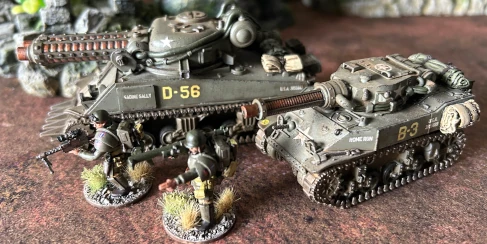
- The Americans rely on the power of their combat walkers.
- The Soviets push the boundaries of genetics on their own soldiers.
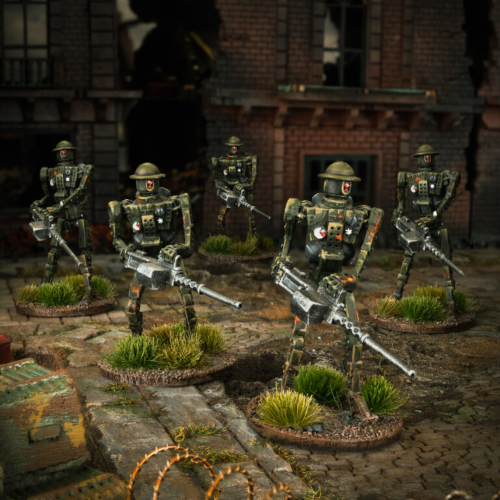
- The British, with their computing lead, bet on AI and robotic soldiers.
- The Empire of Japan plays on stealth with its ghost units.
It is the alliance between “impossible” armor and supernatural horrors that forges the unique identity of Konflikt ’47.
The foundations: The game system of Konflikt ’47
A direct heir to Bolt Action, it features Order Dice: drawing dice randomly from a bag, which triggers the fire initiative mechanism. But there is a little something extra: Rift Dice (dés de Faille in French). These dice are specific to Konflikt ’47. They manage the new armaments available as of 1945: gravity wave weapons, Tesla weapons capable of firing lightning, meteor launchers… These dice add a layer of randomness to the use of these weapons, allowing them to be overloaded or made more effective.
This reflects the lack of mastery over technologies derived from the Rift.
I already presented this system a few months ago in the introduction to Bolt Action.
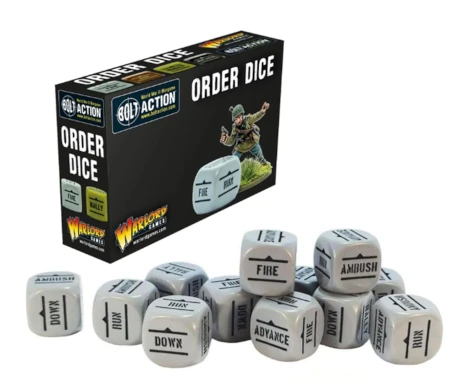
The order dice
Fire
The Fire order allows a squad or vehicle to fire at full power at a target.
Advance
A unit with an Advance order can move its tactical distance—six inches for infantry units—and then fire with a -1 penalty if a target presents itself.
Run
Units with the Run order double their tactical movement but cannot fire in exchange.
Ambush
Units with the Ambush order do not move and wait for the right moment to open fire on a target that enters their zone. The Ambush order die can remain from one turn to the next.
Rally
The Rally order attempts to restore morale to a unit that has taken fire in previous turns. The men try to regain their courage to escape a desperate situation.
Down
This order can be given to a unit that does not yet have an order die for the turn. The unit tries to hit the dirt to benefit from light cover. The Down order can also be forced upon a squad or vehicle under enemy fire if it fails a morale check.
Rift Dice in Konflikt ’47
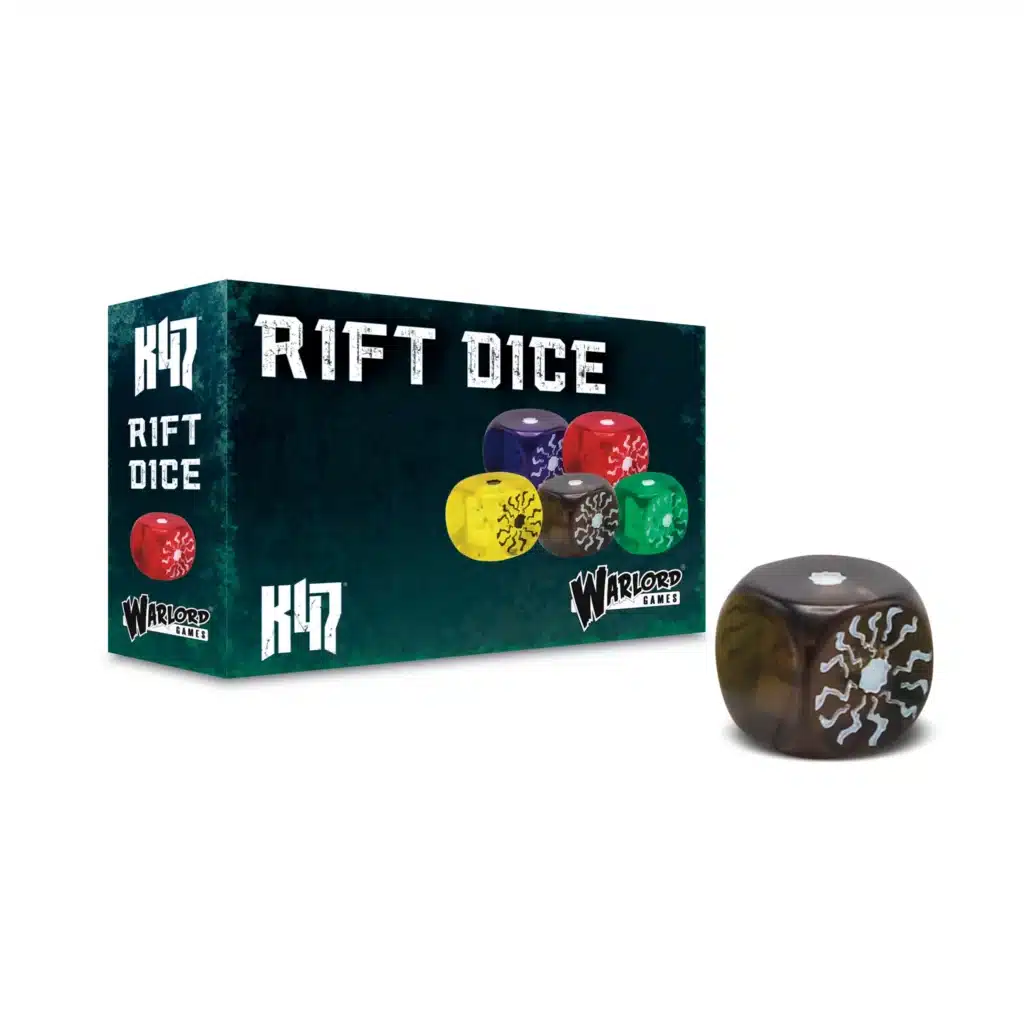
As with order dice, each side has its own color of Rift dice. They are placed next to their unit on the “Active” face at the start of the game. A die goes into the bag if, at the end of the turn, it has been used and is “Exhausted,” or if it remains after being rolled at the end of the turn.
If a Rift die is drawn from the bag, it can be assigned to a unit.
If it is a Rift die:
- The player must roll it and choose one of their Rift units that does not have a Rift die to assign it to.
- If all their Rift units already have a Rift die, the player must choose one of their Rift units that hasn’t yet reached its maximum number of Rift dice to assign the rolled die.
Rift dice have three faces: “Active,” “Overload,” and “Exhausted.” This is the great innovation of Konflikt ’47. Both fun and chaotic, this system adds real tension to the resolution of a battle.
Konflikt ’47: Rift-tech Weapons
Several types of Rift weapons are developed in the game. This is the main difference from Bolt Action. These weapons bring their own specific mechanics. I will present the different types of weapons here.
Achtung !
The weapon presentations and the “lore” are invented by myself and are in no way “official.” I had fun imagining a graphical and very “role-playing” presentation of the weapons. The lore of Konflikt ’47 and the sources available to me offered more descriptions of weapon effects than their origin or actual “action.” That said, I’ll let you discover all these new weapons and the nations that use them to help you choose your future Konflikt ’47 nation.
Corrosive Weapons (Corrosive DX)
Corrosive weapons fire munitions saturated with acidic compounds that literally eat through enemy protection. It’s a very visual technology, almost cinematic: one can easily imagine the acid gnawing at flesh or liquefying the armor of a heavy tank. Radium weapons and meteor launchers fall into this category. The latter, true flagships of British ingenuity, perfectly illustrate the Empire’s penchant for technological gadgets that are as strange as they are devastating.
Crush Weapons
Designed to saturate opponent defenses, Crush weapons hit automatically and pulverize targets. They excel against heavy units with an armor rating of 9 or higher. This technological advancement, primarily exploited by Japan, is found on their combat walkers and within their special infantry sections.
Gravity Pulse Weapons
This technology, which allows for local control of gravity for a brief moment, is the result of Axis scientific research. This weapon propels a concentrated beam of gravitons at a target, and the effect is explosive. For a brief instant, the weight of the target multiplies, and it collapses under the shock. Bodies, tanks—everything falls under the effect of gravity for a short duration, leading to internal destruction.
Hyper Velocity Weapons
These weapons propel warheads of unimpressive mass—a few hundred grams, a body covered in various alloys capable of enduring intense heat. When this warhead enters the magnetic field of the barrel, the repulsion action propels it at extreme speed, several times the speed of sound, making the shell impact ultra-effective. The atmosphere then becomes the warhead’s worst enemy, as friction generates heat. But at “short” range, when the shell hits the target, it delivers truly devastating kinetic force. Very few armors can resist the impact. The Axis developed these types of weapons.
Shockwave Weapons
Soviet scientists developed this type of weapon. It triggers a devastating blast. Everything in the impact zone is subjected to a barotraumatic blast. Flesh is dislocated, lungs explode, and eyes are instantly ruptured. Armored vehicles are so violently shaken that their hulls can deform under the impact, killing the personnel inside through the overpressure generated by the blast. No one escapes these weapons, and cover is ironically useless.
Tesla Weapons (Tesla Arc(X))
Tesla weapons, born from the research of Nikola Tesla, deliver devastating electrical discharges through the air. They strike targets with great efficiency. Stemming from North American scientific research, some sources say Tesla weapons were already on military drawing boards before the emergence of the Rift. It was the electrical power that was lacking to make them work effectively on the battlefield. Rift discoveries reportedly allowed for a “reliable” source of electrical power, enabling their use in 1947. But these claims remain hypothetical.
Creating a Company in Konflikt ’47
We find identical mechanisms to Bolt Action V3. You create a company with an assault platoon, which opens up access to:
- Heavy weapon platoon
- Artillery platoon
- Engineer platoon
- Armoured platoon
- Armoured walker platoon
- Recce infantry platoon
Bolt Action players will not be out of their element with this army creation method. You must add a Hero, who will be attached to your company as a leader. They have special abilities: Guts, Luck, and other innovations. This allows for an even more cinematic immersion into the game system. I will return to this point in more detail in a future article.
The Nations of Konflikt ’47
Five nations are planned for the core game. Each has its own advancements linked to specific Rift technology, giving each nation a different playstyle and a unique range of miniatures. This allows collectors to choose the style that suits them best.
The United States
Industrial power in the United States did not dry up in 1945 or later. Assembly lines across the world’s greatest power continue to churn out tanks, planes, and combat walkers. United behind Roosevelt, the people are determined to destroy the Axis and the horrors spawned by the Rift. Old alliances with Russia have withered, giving way to a communism that is beginning to threaten the planet. Japan remains undefeated; for the United States, the war that began in 1942 was only the opening act.
The Axis
Since the destruction of Dresden by an American atomic bomb, the Axis has been permanently transformed. Overnight, an occult force emerged in the political landscape. It destroyed National Socialism from within, replacing it with something even darker. The Waffen SS were dissolved, their men scattered into other army corps. The Green Vault (the Grünes Gewölbe in German) took control of the state. All nations still under German domination were integrated into the Axis. Every man must go to fight, sometimes even after death. Rift technology allows German scientists to resurrect the bodies of soldiers killed in action. They can create arachnoid armored nightmares and develop weapons of inconceivable brutality.
The Commonwealth
The British Empire did not die in 1947. Retreating is not an option for the English. Churchill’s speech still resonates: “Never surrender!“. Rift technology is used by British scientists to create thinking machines—powerful computers capable of fighting on equal terms with humans. The Empire also mobilizes every man from its colonies; the war effort will come from every British colony without exception. For several months, assembly lines have been operated by robots. Able-bodied men are sent to the front to liberate Europe and destroy the Axis threat.
The Soviet Bloc
The Red Army, forged during the Russian Civil War to protect the revolution against capitalists, has become the most powerful military force in the world. Under Stalin’s absolute leadership, the country has invested in secret scientific cities. Gulag prisoners serve as guinea pigs to create “Soviet supermen.” After the United States refused to share Rift technology secrets, Stalin broke with the Allies, convinced of a capitalist conspiracy. Relying on espionage and the “Hemotype Alpha” serum, the USSR succeeded in creating monstrous units like Ice Ghouls. Although they do not yet possess their own Rift, the Soviets compensate with their immense human reservoir. Stolen technologies and super-powered heavy walkers form the base of their army. Their goal remains global revolution and the total victory of the Motherland.
The Empire of Japan
After a lightning expansion similar to the German Blitzkrieg, Japan found itself facing the overwhelming industrial power of the United States by 1943. While an inevitable war of attrition threatened the Empire, the appearance of Rift technology in 1944 radically changed the situation, transforming a probable defeat into a hope for final victory. Unlike other powers, Japan specialized in stealth and “phasing” technologies. This allowed for the creation of advanced submarines and the fearsome “Ghost battalions.” The imperial army now uses light walkers, power armor, and Rift weapons to maintain its dominance in China.
Asia & the Pacific in 1947
By 1947, the situation is once again reaching a breaking point. In Burma, British forces are regaining ground, using their automatons to wreak havoc among Japanese ranks. American troops continue their advance across the Pacific, specifically in the Philippines. Soviet technological aid is now flowing to the Chinese communists, shifting the balance of power. Ensuring the Empire’s future now rests solely on the total devotion of its people and the success of its latest scientific breakthroughs.
Who will play Konflikt ’47?
Several types of players are likely to play Konflikt ’47.
Logically, Bolt Action players via the compatibility of their army with the universe. They already own several miniatures, vehicles, and tanks to play. But also, undoubtedly, scenery that will serve both games.
The identical game mechanics and army structuring are significant advantages and a logical bridge between the two. Additionally, the major innovation between V1 and V2 comes from the miniatures and vehicles (combat walkers, tanks,…) which are now made of plastic, making their assembly much easier.
This game is also aimed at science fiction enthusiasts. Players of Star Wars: Legion will undoubtedly be interested. It offers a mature, precise game system that provides a real tactical challenge via Order Dice. While the universe is certainly further removed from Star Wars, a change of lore might be a welcome shift.
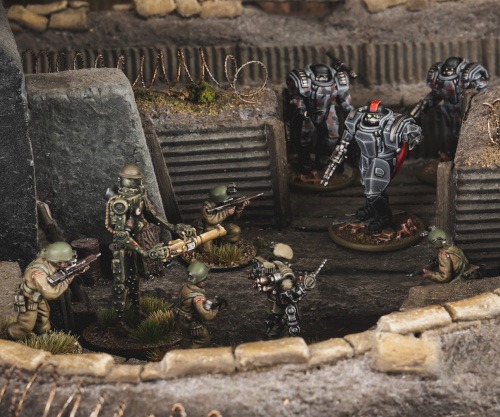
Warhammer 40,000 players might also find what they are looking for, with a system that offers true alternating activations during the same turn. Named characters, acting as leaders of their armies with special powers that impact the performance of their company, are also present. There is a strong chance that this technological “Middle Ages,” with heavy armor, combat walkers, and power-armored infantry, will also appeal to them. In 1947, there is only war!
 Join
Join Starting Konflikt ’47?
Bolt Action players will be able to use their troops (if they are available for Late War) as well as their Army books. The two games are truly evolutions of each other.
New players can look toward
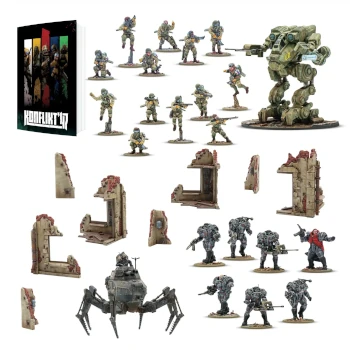
- The Konflikt’47 Introductory Set. It offers two small forces (US & Axis) and everything needed to play: Rift dice, Order dice, and scenery elements.
- The Konflikt ’47 Starter Set which offers more comprehensive content and the full rulebook.
History has derailed, and it’s for the better!
Konflikt ’47 Version 2 successfully meets the challenge of transforming an excellent historical game into a formidable fantastic playground. By building on the solid and proven foundations of Bolt Action V3, this new edition gains speed and tactical depth. The introduction of Rift dice brings that touch of madness and uncertainty necessary to represent a technology that the nations themselves struggle to master.
World War II veterans can spice up their games with combat walkers and werewolves. Science fiction players will find an alternating activation system that is more strategic than the classic “turn-based” style. In any case, Konflikt ’47 has something to offer you.
The switch to plastic for iconic units also marks a major turning point, making the game more accessible and enjoyable to assemble. In 1947, the front did not stop; it mutated to become a hell of occult science and screaming steel.
So, will you choose American industrial power, Axis technological horror, British automation, Soviet genetics, or Japanese stealth? The Rift is open, the Order dice are in the bag… All that’s left is to choose your side.
Some useful online resources
Warlord Games offers players a dedicated Konflikt’47 website here:
Whether you are a beginner or a V1 loyalist, this site brings together the essentials for your Bolt Action games:
- Optimized army lists (old and new miniatures).
- Quick reference sheets.
- Historical Archives (Background).
- Miniature spotlights.
- PDF Introductory booklet with summarized rules and scenarios.
A 15-minute cinematic battle report awaits you here. Perfect for appreciating the game rules as well as the new tactical possibilities of Konflikt’47.
Additionally, quick reference sheets for playing, focusing mainly on the extra elements introduced to Bolt Action, are available. These documents are originally available in English on the dedicated Konflikt’47 website.
Festung Europa
The article on the first supplement for Konflikt’47 was published recently. It provides an in-depth look at the game’s setting in Western Europe across both fronts of the Axis: the Soviet bloc to the east and the US and British Allies to the west, who are attempting to liberate Europe.
On the agenda: the undead, ruined cities and three military campaigns.
Written by:


Buy the team a round
No ads, no paywalls, just pure passion. If our guides or deep dives helped you win your last game or discover your next favorite system, consider dropping a small tip on Ko-fi! Every pint helps keep the site independent and running.